How to Start SSP Fertilizer Manufacturing Business
- 2026-07-20
The fertilizer market is racing past $230 billion. Single Super Phosphate grabs a quiet chunk of that — not because it’s fancy, but because it’s cheap to make and farmers actually buy it.
I’ve talked to enough plant owners to notice a pattern. The ones who succeed aren’t the ones with the biggest checkbooks. They’re the ones who understood three things early: rock sourcing makes or breaks your margin, regulatory delays cost more than equipment mistakes, and working capital is the silent killer.
If you’re figuring out how to start SSP fertilizer manufacturing business, you don’t need another 50-page report. You need to know which decisions actually move the needle. Here’s what matters.
Soil conditions across most of Asia and Africa are sulfur-starved. SSP delivers 11–12% sulfur alongside 16–20% P₂O₅. DAP and MAP can’t make that sulfur claim. That’s not a marketing line — it’s why SSP keeps selling even when commodity prices swing.
And unlike complex fertilizers, SSP’s production process is straightforward. Rock phosphate meets sulfuric acid. Reaction happens. You cure it. You sell it. That simplicity is why so many entrepreneurs land on how to start SSP fertilizer manufacturing business instead of chasing DAP plants that need 3× the capital. If you’re comparing fertilizer types, our DAP vs SSP fertilizer comparison guide breaks down the cost and application differences.
What You’re Actually Making
Quick answer: To start an SSP fertilizer manufacturing business, you need $1.1M–$2.6M in capital for a 50 TPD plant. The process takes 12–18 months from ground-breaking to first sale. Your three biggest decisions: phosphate rock sourcing (determines your margin), plant location (determines your freight costs), and working capital management (determines whether you survive the first year).
SSP is Single Super Phosphate. You take phosphate rock, react it with sulfuric acid, and cure the result. That’s it. The output is 16–20% P₂O₅, 11–12% sulfur, and 18–21% calcium.
Why do farmers buy it? Two reasons. First, it’s the cheapest source of P₂O₅ per unit. Second, the sulfur content matters more than most people realize — oilseeds, pulses, and legumes need sulfur for protein building. DAP doesn’t give them that.
The calcium in SSP also improves soil structure. Clay soils drain better. Roots go deeper. It’s not the sexiest benefit to put on a brochure, but farmers who’ve used it keep coming back. If you’re evaluating how to start SSP fertilizer manufacturing business, the product’s agronomic advantages are your sales pitch — lean on the sulfur and calcium story.
Does the Market Actually Need Another SSP Plant?
Short answer: probably yes, but you need to check three numbers first.
One: local P₂O₅ consumption. Your country’s fertilizer association or agriculture ministry publishes this. If demand is growing at 3–5% annually and existing plants are running near capacity, there’s room.
Two: subsidy policy. In India, Nigeria, Indonesia, and much of East Africa, phosphate fertilizers get government subsidies. That creates a floor under demand. It also means you need to register with the subsidy program early — a bureaucratic step that some first-timers underestimate when planning how to start SSP fertilizer manufacturing business.
Three: freight economics. SSP is bulky and low-margin. Ship it more than 500 km and freight eats your profit. Look at the radius around your planned site: how many hectares of cropland sit within it? That’s your addressable market.
Don’t obsess over competitor count. I’ve seen plants thrive sitting 200 km from three other SSP producers because their rock supply was cheaper and their bagging operation ran tighter. The question isn’t “is there competition” — it’s “can I make a ton of SSP for less than the next guy.” Entrepreneurs who research how to start SSP fertilizer manufacturing business with a cost-per-ton mindset, rather than a market-share mindset, tend to build operations that survive price wars.
The Steps That Actually Matter
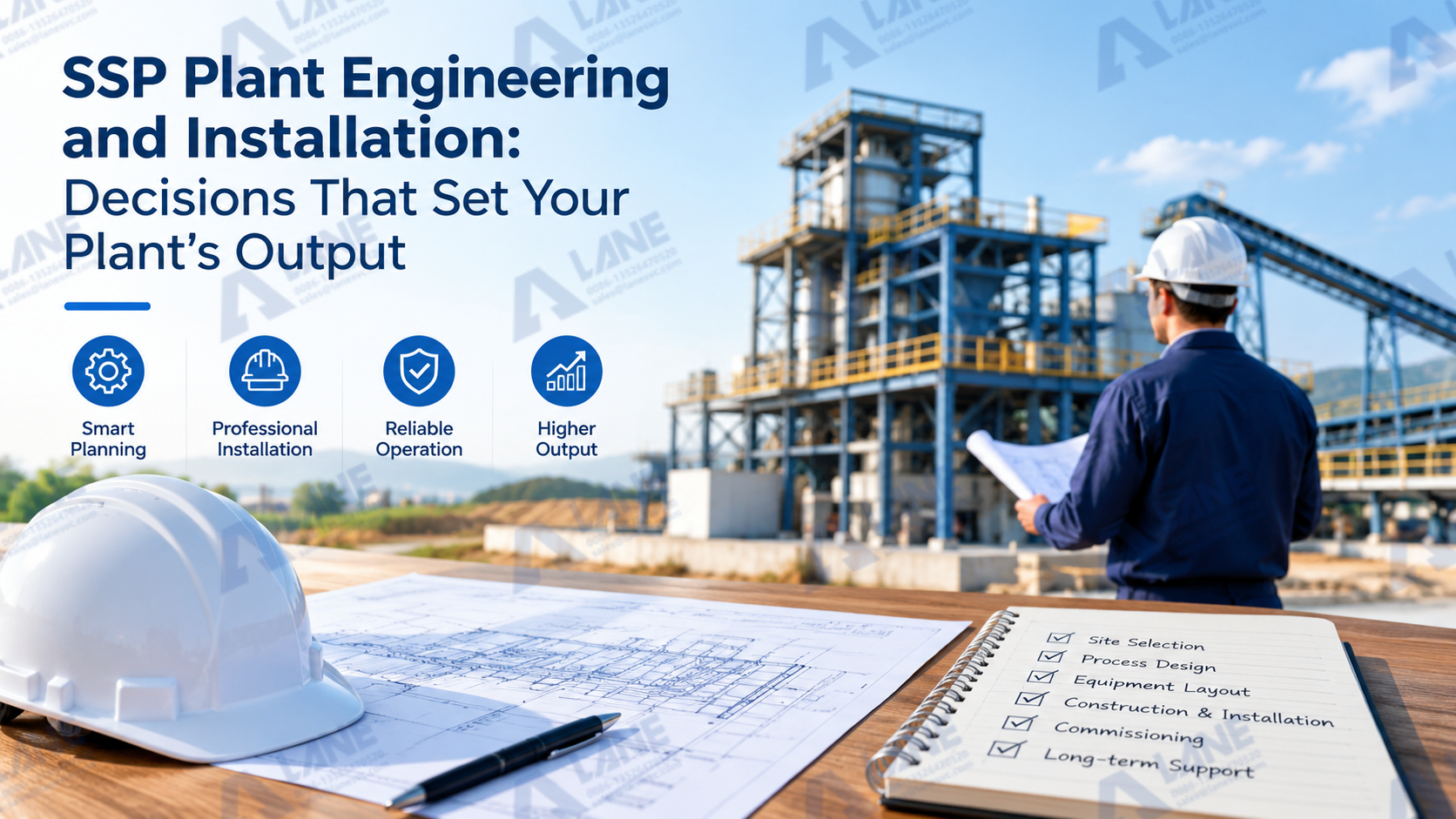
When you’re figuring out how to start SSP fertilizer manufacturing business, eight things will make or break you. Skip one and you’ll feel it later.
Step 1: The Feasibility Study You Can’t Skip
I know — feasibility studies sound like consultant busywork. But here’s what happens without one: you guess demand, guess costs, and run out of money 14 months in.
Your feasibility study for how to start SSP fertilizer manufacturing business answers three questions: Is demand real? What’s the real number? When does money come back?
Go to your target farming districts. Talk to fertilizer dealers — not one, not two, at least twenty. Ask what they sell, what moves fastest, what farmers complain about. That’s your demand signal. Everything else is spreadsheets.
Your business plan should cover: demand data from those dealer conversations, itemized capital costs from real supplier quotes (not website estimates), a 12-month working capital schedule, and a risk section that names specific things that could fail — not generic boilerplate about “market conditions.”
Step 2: Permits Will Delay You. Plan for It.
Fertilizer manufacturing is regulated everywhere. When you’re learning how to start SSP fertilizer manufacturing business, here’s what the permit stack actually looks like:
Company registration comes first. Then a fertilizer manufacturing license from the agriculture ministry. Environmental clearance takes the longest — your EIA needs to address fluoride gas emissions (SiF₄ and HF from the acidulation reaction). Budget 4–8 months just for environmental approvals. Add a factory license from the local industrial authority. Tax registrations. And quality certification if you want to sell to government programs.
Hire a local industrial licensing lawyer. Not a general corporate lawyer — someone who’s done factory permits before. The cost ($5,000–$15,000 in most markets) is nothing compared to 6 months of idle plant overhead because one form got stuck.
Step 3: Where You Build Determines What You Earn
Location is the biggest fixed-cost decision in your SSP fertilizer manufacturing business, and you can’t undo it later.
Put the plant near phosphate rock or a port that receives it. Rock is heavy. Trucking it 300 km vs. 50 km can swing your per-ton cost by 15%. This is the kind of detail that separates a profitable SSP fertilizer manufacturing business from one that bleeds cash on logistics. Then look at your buyers — if farmers are 400 km away, outbound freight eats the margin you saved on inbound rock.
Utilities matter more than you think. A plant making 50 TPD needs consistent power. One voltage dip during acidulation and you’re scraping hardened slurry out of the reactor for two shifts. Ask the local grid operator about outage frequency, not just the listed tariff.
When visiting sites for your SSP fertilizer manufacturing business, check water availability. You need process water year-round — a seasonal stream that dries up in April doesn’t count.
Step 4: Equipment — Where the Money Goes
When evaluating how to start SSP fertilizer manufacturing business, equipment eats 40–50% of your budget. Here’s the line-up for a 50 TPD plant:
- Rock crusher/grinder: Getting rock under 100 mesh is non-negotiable. Coarser grind = slower reaction = lower P₂O₅ in your product.
- Acid storage tanks: Corrosion-resistant, with secondary containment. Sulfuric acid leaks are expensive and dangerous.
- Reaction mixer (den): This is where rock meets acid. Temperature control here determines your free acid content and final product quality.
- Curing conveyor/shed: The reaction takes 24–72 hours to finish. You need covered space — rain on uncured SSP creates a disposal problem.
- Granulator (optional but recommended): Powdered SSP works fine. Granulated SSP sells better and handles easier. If your market uses mechanical spreaders, go granulated.
- Dryer, cooler, screener: Moisture below 5%, uniform 2–4 mm granules for the granulated route.
- Scrubber: Catches fluoride gases. Don’t cheap out here — regulators will check.
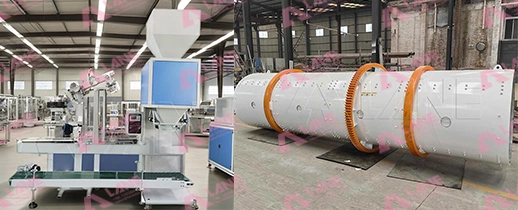
A big chunk of your spend when you start an SSP fertilizer manufacturing business goes to machinery. Get quotes from at least three suppliers. Visit their reference plants. A supplier who won’t give you three customer references is hiding something.
Step 5: Raw Materials — Your Margin Lives and Dies Here
Two materials. Two supply chains. Both need backup plans.
Phosphate rock is 70–75% of raw material cost. If you only remember one thing about how to start SSP fertilizer manufacturing business, remember this: grade matters. 28% P₂O₅ rock vs. 34% rock changes everything — lower-grade rock needs more acid per ton of output and leaves more gypsum waste. Morocco (OCP), Jordan, China, and the US dominate global supply. If you’re importing, lock in long-term contracts with pricing tied to a published index. Spot-market rock buying during a commodity spike has sunk more than one SSP fertilizer manufacturing business.
Sulfuric acid is the wildcard. It’s a smelting and refining byproduct, so its price tracks industrial activity, not agriculture. Dual-source from two suppliers minimum. On-site storage needs corrosion-resistant tanks and spill containment — acid is cheap until it leaks.
Anyone who’s done the math on how to start SSP fertilizer manufacturing business will tell you: rock and acid together represent 60–70% of per-ton costs. You can’t save enough on labor or electricity to compensate for a bad raw material deal.
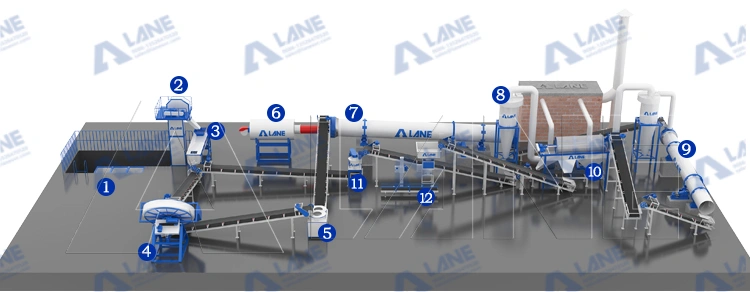
Step 6: The Manufacturing Process (What Happens Inside the Plant)
If you want to know how to start SSP fertilizer manufacturing business, you need to understand the production flow cold. Here it is:
- Crush and grind phosphate rock to under 100 mesh. Coarser grind = slower reaction = worse product.
- Mix with sulfuric acid (60–70% concentration) in the reactor. Exothermic reaction hits 100–110°C. You get a slurry of monocalcium phosphate and gypsum.
- Cure the slurry for 24–72 hours. This is where the reaction finishes. Skip the cure and your free acid is too high — farmers notice when the bag burns their hands.
- Granulate (if you’re making granules). Steam and water in a drum granulator. Target 2–4 mm.
- Dry and cool. Rotary dryer at 200–300°C inlet, then cool to ambient. Moisture must stay under 5%.
- Screen and recycle. Oversize back to crusher, undersize back to granulator.
- Bag and store. 50 kg woven PP bags are the standard. Bulk loading for large farms and plantations.
Three quality levers: rock grind size, acid-to-rock ratio, and cure time. Nail these and your P₂O₅ will be consistent batch to batch.
Step 7: Quality Control — The Thing That Keeps Customers Coming Back
Farmers have a long memory for bad fertilizer. One season of inconsistent product and they switch brands — permanently. Anyone researching how to start SSP fertilizer manufacturing business needs to understand: your first season’s quality determines whether you get a second season.
If you’re serious about how to start SSP fertilizer manufacturing business, put a QC lab on-site from day one. You need to test: total P₂O₅, water-soluble P₂O₅, free acid, moisture, and granule size distribution. Our fertilizer quality control lab setup checklist covers equipment specs and testing protocols.
Test every batch before it ships. Not every fifth batch. Every single one. The lab costs maybe $30,000 to set up. That’s cheap compared to the cost of rebuilding trust with 200 farming villages.
Step 8: Getting It Sold
Making SSP is half the work. Getting bags into farmers’ hands before planting season is the other half.
Build a dealer network. Agri-input retailers in farming districts are your channel — give them decent margins, point-of-sale materials, and product training. A dealer who can explain why sulfur matters will sell more of your product than a discount.
Bid on government tender programs. Many countries procure SSP through centralized fertilizer subsidy schemes. The margins are thinner but the volume is predictable.
Set up regional warehouses before the season. Planting windows don’t wait for trucks. If your product sits in a central warehouse while farmers 300 km away are already seeding, you’ve lost that season. When planning how to start SSP fertilizer manufacturing business, warehouse positioning deserves as much thought as plant location. Learn more in our fertilizer distribution and logistics guide.
What It Costs (Real Numbers for a 50 TPD Plant)
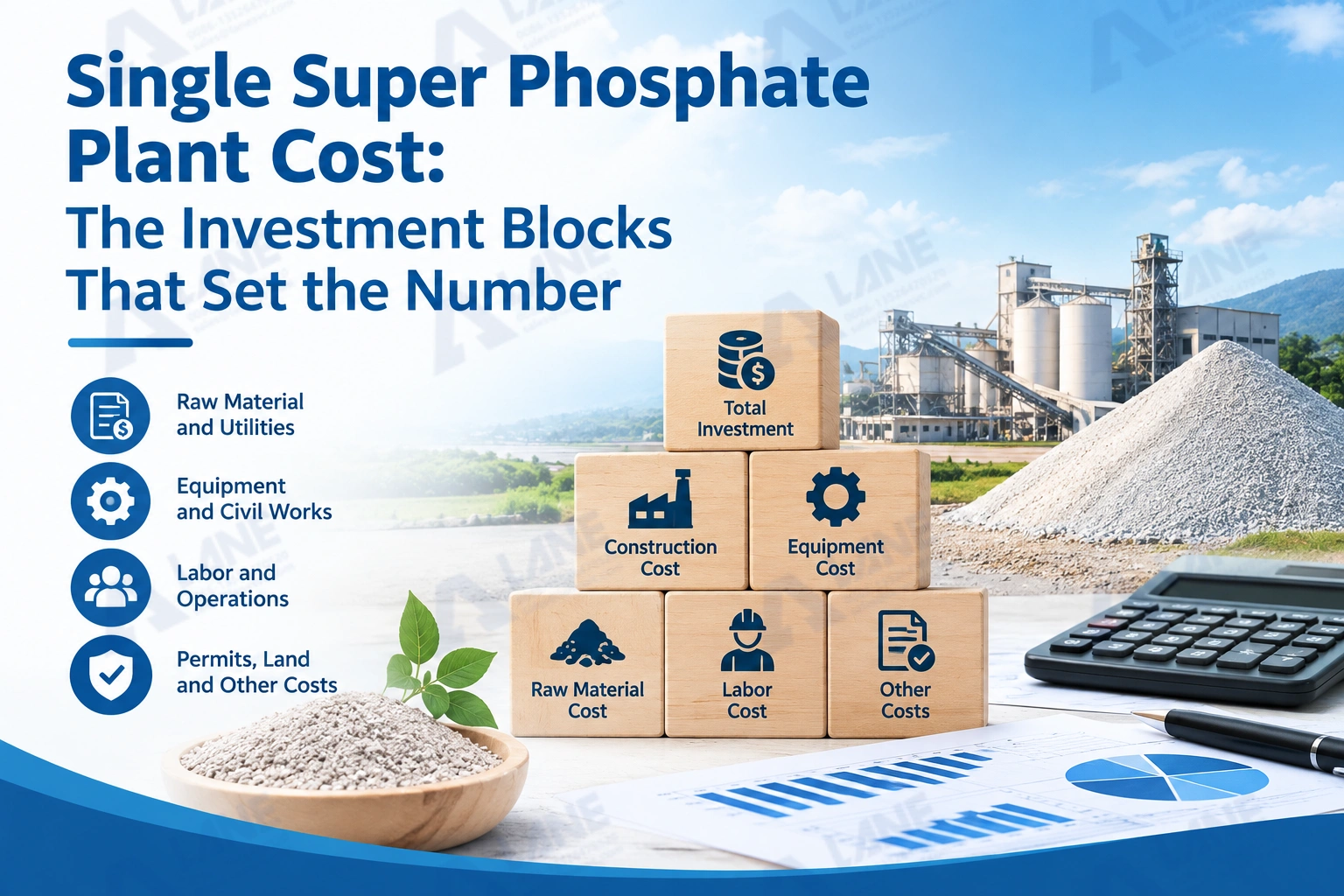
If you’re planning how to start SSP fertilizer manufacturing business, the capital stack for a 50 TPD operation looks roughly like this:
| Cost Category | Range (USD) | % of Total |
|---|---|---|
| Land and site prep | $100,000 – $250,000 | 8–12% |
| Civil works and building | $200,000 – $400,000 | 15–20% |
| Machinery and equipment | $500,000 – $1,200,000 | 40–50% |
| Installation and commissioning | $80,000 – $150,000 | 5–8% |
| Working capital (3 months) | $200,000 – $500,000 | 15–20% |
| Permits and pre-operating costs | $30,000 – $80,000 | 3–5% |
| Total | $1,110,000 – $2,580,000 | 100% |
These numbers shift a lot by country. Equipment from Chinese suppliers vs. European ones. Local construction costs. Import duties on machinery. The range exists for a reason — get specific quotes before anchoring on any number.
Working capital is what trips up first-timers. You’re buying rock and acid, paying labor and power, running the plant — and you haven’t sold a single bag yet. Then planting season hits and you need inventory already positioned at regional warehouses. Budget 3–6 months of operating cash. If you’re serious about how to start SSP fertilizer manufacturing business, the cash flow timing matters more than the P&L.
Smaller plants (10–25 TPD) need less absolute capital but higher per-ton production costs. The math on how to start SSP fertilizer manufacturing business at small scale: at 10 TPD, your fixed overhead gets spread across fewer tons. You can make it work if you’re in a remote region where inbound freight on competing fertilizers is painfully high. Otherwise, aim for at least 50 TPD to hit competitive unit economics.
Six Ways People Get This Wrong
Learning how to start SSP fertilizer manufacturing business means studying the mistakes that kill most new plants:
1. No feasibility study. You’d be surprised how many people jump into how to start SSP fertilizer manufacturing business by dropping $2 million on equipment before verifying that farmers within 300 km actually want SSP. A few thousand dollars of market research upfront beats a plant running at 40% utilization.
2. Cheap scrubber, expensive shutdown. Environmental inspectors don’t care that you “didn’t know” about fluoride gas limits. They shut you down. Install proper emission control before you start, not after your first violation notice.
3. One sulfuric acid supplier. When that supplier’s refinery goes into turnaround maintenance for six weeks, your plant stops. Have a backup — even if the backup price is 10% higher. Idle plant costs more.
4. Running out of cash during ramp-up. You’re making product, building dealer relationships, and waiting for planting season demand — all while burning working capital. If you haven’t secured enough cash to cover 6 months of operations with zero revenue, you’re gambling.
5. Inconsistent quality. Farmers test one bag. If the P₂O₅ is low or the product is clumpy, they buy from your competitor next season. They won’t tell you why — they’ll just stop calling.
6. No farmer-level support. The plants that win long-term employ an agronomist who visits farming communities, runs soil tests, and teaches dealers about sulfur benefits. That’s not overhead — it’s customer retention. When researching how to start SSP fertilizer manufacturing business, budget for someone who can talk to farmers in their language.
Common Questions
What’s the smallest SSP plant I can start with?
A 10–25 TPD plant. Below that, per-ton costs kill you — unless you’re in a remote region where imported fertilizer freight makes your higher-cost local product still the cheapest option. Most people who ask how to start SSP fertilizer manufacturing business should target 50 TPD minimum if the market can absorb it.
For a deeper look at plant sizing, see our fertilizer production equipment guide.
How long from breaking ground to first sale?
12–18 months. Permits take 3–6 months. Equipment manufacturing and shipping eats 4–8 months. Construction runs 6–10 months. Commissioning adds 2–3 months. Anyone promising 6 months is selling you something.
What margins should I expect from SSP manufacturing?
15–30% gross, depending on rock cost, plant efficiency, and local pricing. Integrated producers who make their own sulfuric acid push higher. Pure SSP plants without acid production sit closer to 15–20%. Your margin on how to start SSP fertilizer manufacturing business lives in your raw material contracts.
Read our SSP production cost breakdown for detailed per-ton economics.
Can I export SSP fertilizer?
Technically yes. Practically, SSP’s low value-to-weight ratio makes long-distance shipping uneconomical unless you’re on a port and the destination market has no domestic production. Most SSP plants sell within a 500 km radius.
The Short Version
How to start SSP fertilizer manufacturing business comes down to this: find cheap rock, build near farmers, get your permits early, don’t skimp on the scrubber, and never run out of working capital. If you learn how to start SSP fertilizer manufacturing business the hard way, it’ll cost you twice as much. Learn from the people who’ve already done it.
The plants that survive decade after decade aren’t always the biggest or best-funded. They’re the ones where the owner knows the acid-to-rock ratio by heart, visits dealers personally during peak season, and never ships a bad batch because they test every single one.
The fertilizer market isn’t going away. Farmers need phosphate. If you’ve been researching how to start SSP fertilizer manufacturing business, you already know: SSP is the cheapest way to give it to them — with sulfur and calcium as free bonuses. If you do the groundwork, secure your supply chain, and keep quality consistent, an SSP fertilizer manufacturing business generates steady returns in an industry that exists as long as people eat.
Need equipment quotes? Talk to manufacturers who’ve built SSP plants before — not general fabrication shops. And visit reference plants. Always visit reference plants.