Single super phosphate plant cost: the investment blocks that set the number
- 2026-10-12
Search for single super phosphate plant cost and most results hand you retail bag prices, or a supplier’s figure with no scope. Neither helps when you are underwriting a project. This guide splits that investment into blocks you can price separately, shows how the single super phosphate manufacturing process fixes each one, and explains how the superphosphate price per tonne you can achieve decides whether the plant repays.
What an SSP plant produces, and who buys it
Single superphosphate is phosphate rock, ground and reacted with sulfuric acid:
2 Ca5(PO4)3F + 7 H2SO4 + 3 H2O → 3 Ca(H2PO4)2 + 7 CaSO4 + 2 HF
Each unit of P2O5 you make brings roughly two units of calcium sulfate and releases hydrogen fluoride gas that must be captured. That drives most of the equipment scope and nearly all of the environmental scope.
The grade you choose sets the equipment
Commercial SSP runs 16% to 20% P2O5, with 16% and 18% the grades most often specified. About half the mass is calcium sulfate, so the product also supplies sulfur (roughly 11% to 12%) and calcium (roughly 18% to 22%). Grade limits are regulated: India’s Fertiliser (Control) Order, 1985 sets specifications, and most markets apply their own P2O5, free acid, and moisture limits, which become design requirements for acid rate, curing, and drying.
Where the demand sits
SSP carries P2O5 at low concentration, so freight works against it. It wins where rock, acid, or granulation capacity sits nearby: pasture in Australia and New Zealand, sugarcane in Brazil, oil palm in Southeast Asia, and volume across South Asia and Sub-Saharan Africa. Distance also sets your netback, because the superphosphate price per tonne is set by the market while freight is not. Check IFA and FAO trade data before fixing capacity.
The single super phosphate manufacturing process, step by step
The single super phosphate manufacturing process has six stages. The first three are chemical and cannot be compressed without losing conversion. The last three are physical and scale with the product form you sell.
1. Crushing, grinding, and metering
Rock arrives too coarse for any acidulation mixer, so it passes through crushing and grinding, usually to about 80% passing 100 mesh. Coarse grind leaves unreacted rock cores inside the granule, and the fertilizer then fails its own analysis. Grinding power and mill wear climb as the target gets finer.
2. Acid metering and mixing
Sulfuric acid, typically 93% to 98%, is metered into ground rock in a continuous mixer. The acid-to-rock ratio follows from ore chemistry, above all its CaO to P2O5 ratio, carbonate, and silica content, so it is a laboratory number for your rock. Mixer internals are stainless or lined carbon steel.
3. Curing
Curing is the slowest stage of the single super phosphate manufacturing process. Material leaving the mixer is still reacting, so it needs residence time for conversion to finish and free acid to fall to a safe level. Pile curing needs little equipment and ties up product for two to six weeks. Continuous den curing costs more in equipment and cuts residence time to days.
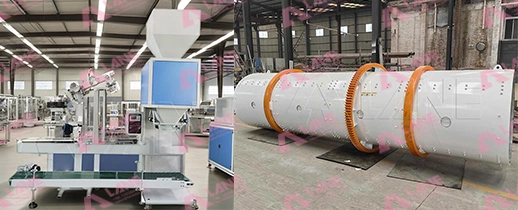
4. Granulation
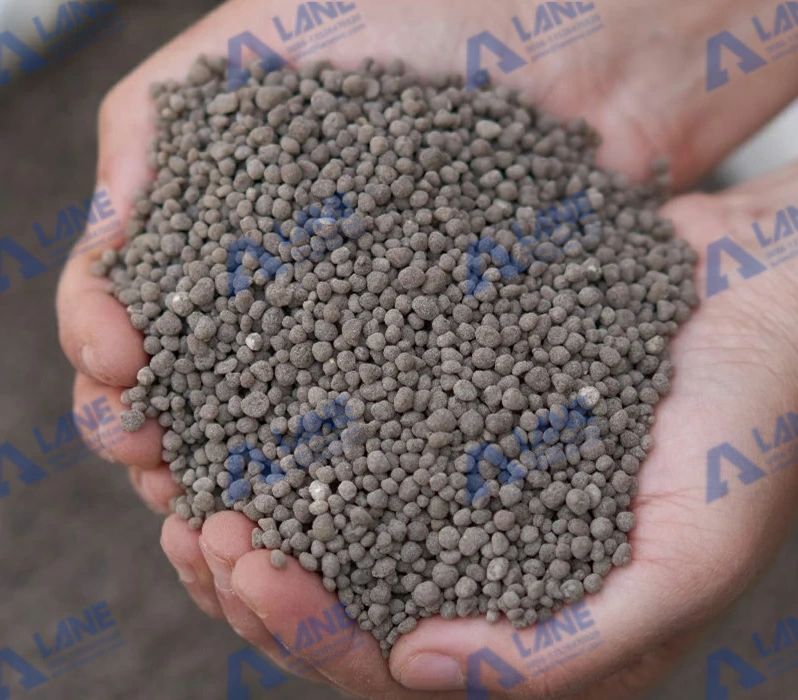
Powder SSP is a valid product, and skipping granulation removes the most energy-hungry equipment from the flowsheet. Granulated SSP costs more to build and pays that back in handling and application. Formation happens at controlled moisture in a rotary drum, with a recycle loop of undersize and crushed oversize. Moisture and drum speed decide whether you get strong granules or a dust problem.
5. Drying, cooling, and screening
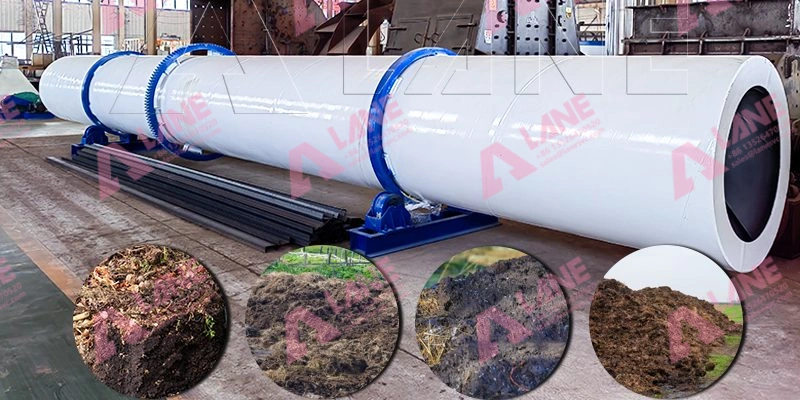
Wet granules go to a rotary dryer, then a cooler, then screens. Drying prevents caking in storage and corrosion inside the bag, and screening sets the saleable size band while returning the rest to the granulator.
6. Fluorine scrubbing, dust control, and loadout
Hydrogen fluoride from the reaction must be captured in a gas scrubber, and the resulting solution needs an approved disposal route. Cyclones or bag filters handle dust. This stage is the most underestimated in early estimates, because where permits set emission limits, scrubbing performance becomes a condition of operating.
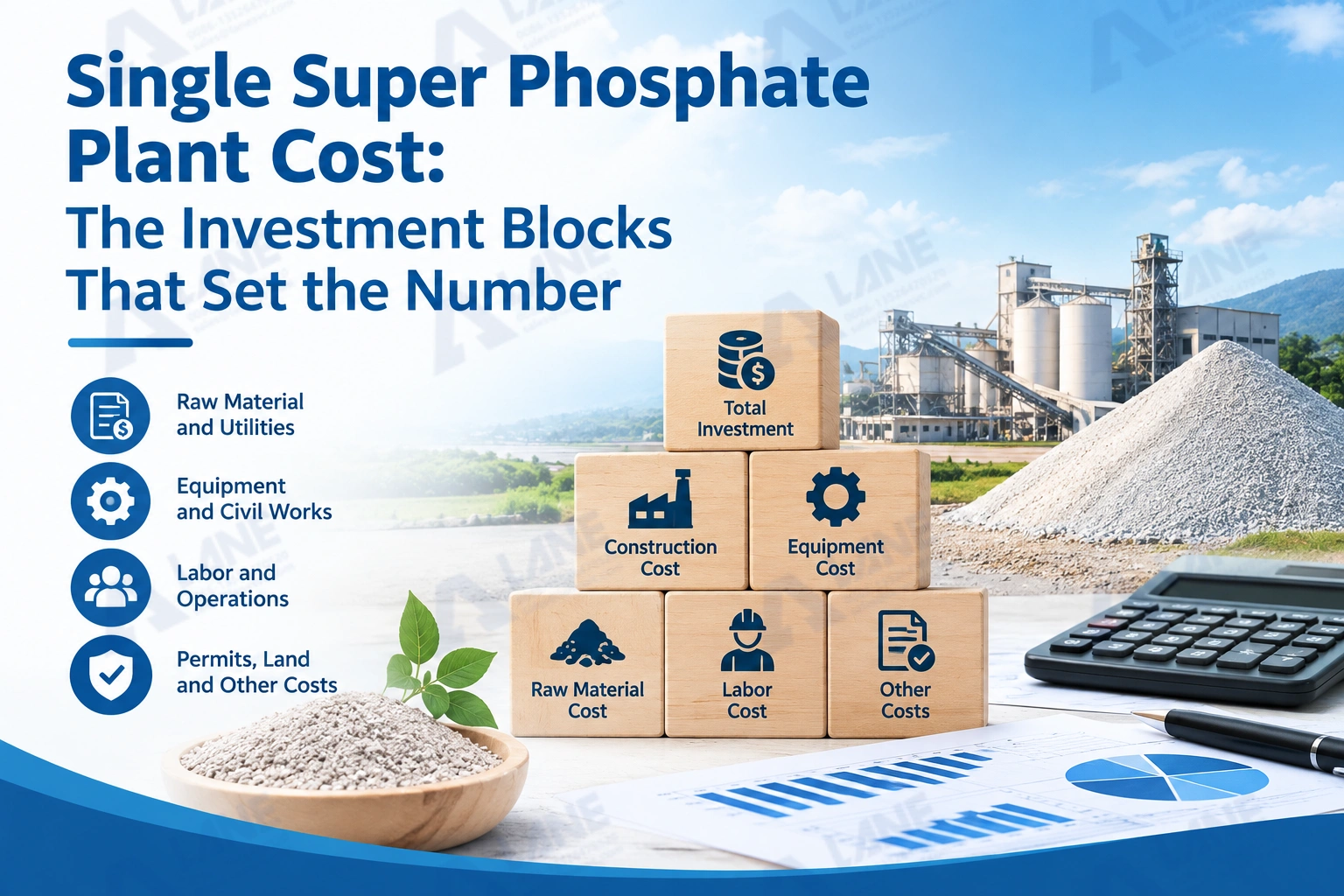
Single super phosphate plant cost: the four blocks that set the number
Price the blocks separately: one lump sum hides which block a supplier is thinly resourcing.
| Cost block | What sits inside it | What decides its size |
|---|---|---|
| Mechanical equipment | Grinding, acid metering and mixing, curing chamber or den, granulator, dryer, cooler, screens, conveyors, dust collection, scrubber, bagging | Product form, capacity, automation, materials of construction |
| Acid and raw material infrastructure | Acid storage, unloading, pumps and piping, bunding, rock stockpile and feed, weighbridge, laboratory | Delivery mode, distance to acid supply |
| Civil, structural, and utilities | Foundations, acid-resistant flooring, buildings, electrical distribution, heat source, water, compressed air, effluent handling, permits | Site conditions, local codes, park or standalone site |
| Working capital and commissioning | Product locked in curing, first fills of rock and acid, spare parts, erection, commissioning, training | Curing route, spares policy, delivery model |
The acid side usually decides the project
Buyers watch the machinery because it is visible. Acid infrastructure is what surprises them: storage, unloading, containment, and safety systems carry heavy design and permitting requirements, and a distant acid supply turns logistics into a permanent operating cost. Acid also dominates operating cost, which is why single super phosphate plant cost responds more to acid supply than to machinery choices.
What a quotation must contain before you compare prices
- Rated capacity in tonnes per hour and per year, with the basis stated
- Every item included and excluded (civil works, incoming power, utilities, freight, duties, erection)
- Performance guarantees with defined test conditions
- Consumables, spare parts, and first-fill quantities
- Commissioning scope, duration, and operator training
- Warranty terms, and what voids them
When two quotes for the same capacity differ widely, the gap is usually an exclusion rather than a discount.
What moves single super phosphate plant cost the most
Six variables explain most of the variation between projects of the same nominal size, and none change the superphosphate price per tonne you sell at.
Product form. Granulation adds a granulator, dryer, cooler, screens, recycle conveyors, and a bigger dust system. It is the largest step change and raises power use permanently.
Capacity. Cost per annual tonne falls as capacity rises, because equipment does not scale linearly. Below a certain throughput the plant cannot carry its overheads; above it, capital, civil, and working capital climb faster than investors expect.
Rock quality and hardness. Harder rock consumes more grinding power and wears mills faster. Silica and iron raise acid demand, and carbonate changes the reaction. Low-grade ore is workable, but it must be designed for.
Site conditions. A greenfield site needs civil works, power connection, water, access, and often a substation. A brownfield site in an industrial park removes much of that.
Automation. Manual plants cost less to buy and more to run; closed-loop acid dosing and interlocks cut rework and protect specification.
Environmental scope. Scrubbing, dust control, effluent treatment, and monitoring are permit conditions in most jurisdictions. Their cost depends on local limits and the fluorine content of your rock.
Equipment selection and supplier evaluation
Benchmark the rock before the equipment
Send representative samples for full analysis: P2O5, CaO, silica, iron, carbonate, and fluorine. Ask the supplier to convert that into an acid consumption estimate and a curing time. A supplier who will not put acid consumption in writing has not done the engineering behind the single super phosphate manufacturing process.
Ask for a mass balance, not a photo gallery
A credible proposal contains a process flow diagram, a mass and energy balance, a utility table for power, fuel, water, and air, and materials of construction per item. Ordinary carbon steel in the wet section is a saving that will be repaid as corrosion.
Guarantees worth writing into the contract
Throughput at the specified rock analysis. P2O5 content and water-soluble fraction. Granule size distribution. Final moisture. Dust emission and scrubbing performance. Power per tonne. Acceptance test criteria, and the remedy if the test fails.
Ask for the supplier’s ISO 9001 and ISO 14001 certificates, and for CE marking if the plant will be exported into the EU.
Reference plants, and who owns the guarantee
Visit a plant running rock similar to yours, and ask operators, not the sales team, about downtime and wear part life. Then settle the contract shape: split packages lower the purchase price and raise interface risk, while turnkey EPC puts process responsibility in one place.
Maintenance and operating plan after handover
Corrosion is a design constraint, so acid contact zones need stainless steel or lined carbon steel for tanks, piping, and mixer internals. Budget wear parts from day one: mill liners and grinding media, mixer blades, granulator scraper blades, dryer lifters, screen decks, belts, bagging seals, and filter media. Ask suppliers for expected life in operating hours at your rock hardness, then build the spares budget from those figures. The ten items whose failure stops the line should be on site before commissioning is signed off.
Project case: 20 t/h granular SSP line in Southeast Asia
LANE delivered a turnkey granular SSP plant in Southeast Asia for a client near a regional phosphate deposit. Ore grade fluctuated, so adaptability to variable feedstock went into the design brief. The train runs through hammer crushing, a double-shaft stainless acidulation mixer, a rotary curing chamber, a rotary drum granulator, a rotary dryer, screening and recycling, and dust collection. The specification was written against the ore rather than a catalogue, which is why the plant accepts fluctuating rock quality without losing conversion efficiency. Full write-up: phosphate rock fertilizer process guide for a 20 t/h SSP line.
FAQ
How much does it cost to build a single super phosphate plant?
No single market price exists, because single super phosphate plant cost varies with all four blocks. Ask for a scope-defined quotation in those blocks, then compare annual tonne cost against the superphosphate price per tonne you expect.
What capacity should a new SSP plant start at?
Start from the market you can serve within economical haul distance. Freight limits the selling radius, so overbuilding means selling further away once the superphosphate price per tonne is fixed locally.
What is the difference between SSP and TSP?
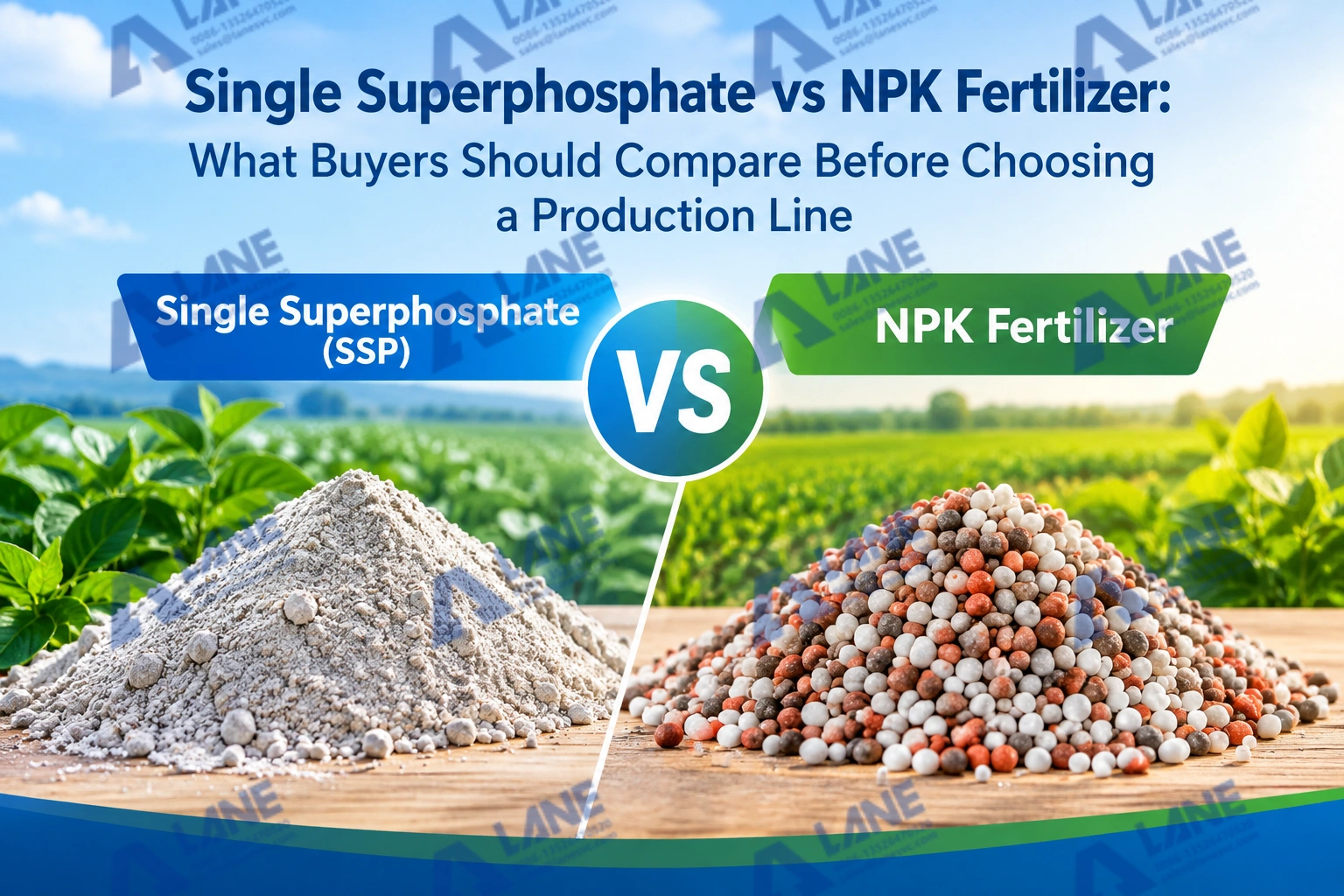
SSP is made with sulfuric acid and contains monocalcium phosphate plus calcium sulfate. TSP is made with phosphoric acid, carries 44% to 46% P2O5, and ships cheaper per unit of nutrient.
How much rock and acid does SSP production consume?
Acid demand follows from the CaO to P2O5 ratio, carbonate content, and target conversion; rock consumption follows from ore grade. A laboratory acidulation test is the only reliable way to fix these numbers before the single super phosphate manufacturing process is specified.
Do I need my own sulfuric acid plant?
Rarely. Captive acid production only makes sense at very large scale, or where acid cannot be sourced reliably. Most producers buy acid and invest in safe storage and containment instead.
How long does it take to build and commission an SSP plant?
It depends on permitting, site condition, and whether civil works, acid storage, and utilities sit in the same contract as the process equipment. Allow separate time for commissioning with the actual ore.
How does the superphosphate price per tonne affect payback?
Payback is a margin calculation, not a cost calculation. Take the superphosphate price per tonne you can achieve net of freight, then subtract cash operating cost, which acid and rock dominate.