Turnkey SSP Fertilizer Production Line Cost & ROI Analysis
- 2026-06-17
Every fertilizer investor I’ve met, from first-time project developers in Nigeria to seasoned phosphate producers in Pakistan, asks the same question within the first ten minutes: “What’s it actually going to cost me, and when do I see returns?” Honest answer? It depends. But it depends in ways that are completely predictable if you know where to look.
This article breaks down the real cost structure of a turnkey SSP fertilizer production line, the ROI math behind it, and the decisions that separate profitable plants from expensive regrets.
What “Turnkey” Actually Means in SSP Production
The word “turnkey” gets thrown around loosely in industrial equipment sales. In this context, it should mean one thing: you hand over the project scope, and a qualified supplier handles engineering, equipment fabrication, installation, commissioning, and operator training — delivering a plant ready to produce on day one.
What it should not mean is a collection of mismatched machines with a commissioning certificate slapped on top. I’ve seen that more than once, and the downstream costs are brutal.
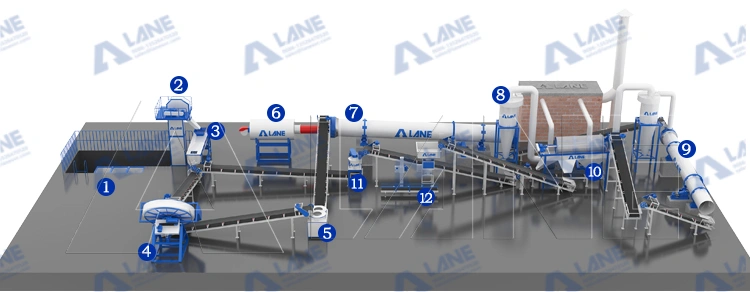
A legitimate turnkey SSP fertilizer production line covers the complete production workflow: phosphate rock grinding, acidulation with sulfuric acid, curing, granulation, drying, cooling, screening, and bagging. Each stage must be sized and integrated with the others. Skimping on any link breaks the chain.
Core Equipment in the Production Process
Understanding what you’re actually buying helps you evaluate quotes and negotiate intelligently. Here are the core machines inside a properly configured turnkey SSP fertilizer production line:
- Raymond mill: Grinds phosphate rock to the required fineness — typically 80–120 mesh — for efficient acidulation.
- Acidulation reactor: The chemical heart of the process. Phosphate rock and sulfuric acid react here to form single superphosphate.
- Belt conveyor system: Moves material between every stage. Often underestimated in cost estimations.
- Rotary drum granulator: Forms the cured material into uniform, marketable granules. Consistency directly affects product pricing.
- Rotary drum dryer: Removes moisture post-granulation to meet storage and transport requirements.
- Rotary drum cooler: Brings product temperature down before screening to prevent caking.
- Vibrating screen: Classifies granules by size. Off-spec fractions return to the granulation loop.
- Coating machine: Applies anti-caking agents or micronutrient coatings — increasingly expected in export markets.
- Bag filter and dust collection system: Captures phosphoric dust and acid mist. Non-negotiable for regulatory compliance.
- Automatic Packaging Line: Packages finished product into 25 kg or 50 kg bags at commercial throughput speeds.
Each machine needs to come from a supplier who understands how they interact as a system, not just as individual units.
What Does a Turnkey SSP Fertilizer Production Line Cost?
Let me be direct: cost ranges vary widely, and anyone quoting a precise number without knowing your site, capacity, raw material profile, and local utilities is guessing.
That said, here’s a framework based on what projects actually look like in the field.
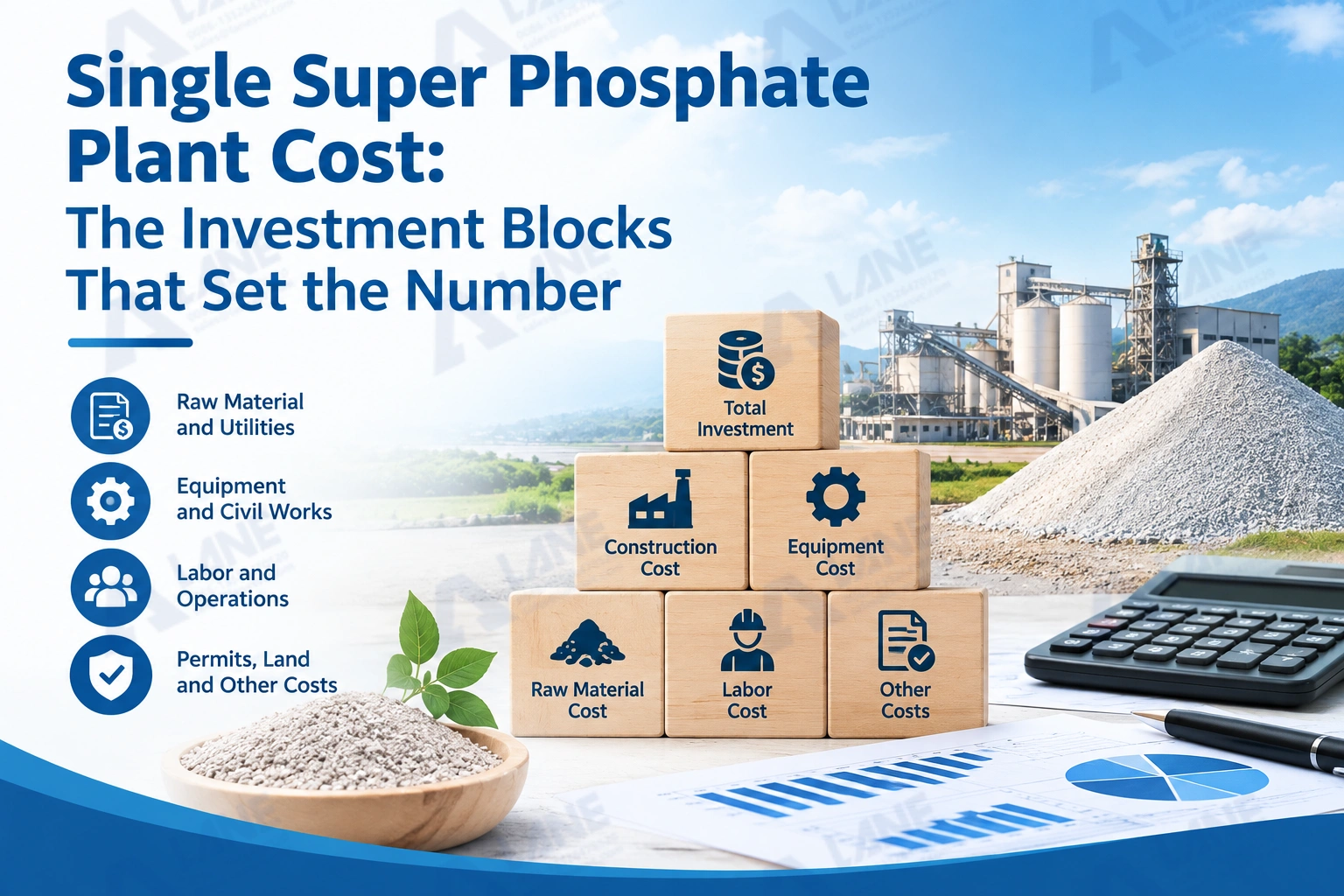
For a small-scale SSP fertilizer plant at 5,000–10,000 tons per year, total investment typically falls between USD 800,000 and USD 1.5 million. Mid-scale operations — 30,000 to 50,000 tons annually — usually run between USD 2.5 million and USD 5 million. Larger industrial-scale SSP fertilizer plant configurations above 100,000 tons per year can reach USD 8 million to USD 20 million, depending on automation level and site complexity.
Civil construction, local infrastructure, and customs duties can add 15–30% on top of equipment costs in African and South Asian markets. Budget for that from day one.
ROI Analysis: What the Numbers Actually Look Like
From what I’ve seen in the field, a well-designed mid-scale SSP fertilizer plant with solid feedstock access typically reaches payback in 3 to 5 years.
Production margins come down to the spread between phosphate rock and sulfuric acid input costs versus SSP market price, plus production uptime and distribution logistics. If SSP sells at USD 180 to 260 per ton and your input costs stay below USD 90 to 130, you can pull USD 40 to 60 per ton in gross margin.
At 30,000 tons per year and a USD 45 net margin per ton, that’s USD 1.35 million in annual operating profit. Against a USD 4 million total investment, you’re looking at roughly a 3.0-year payback. That’s before any working capital optimization, and before the premium you might get for granular product over powder.
Equipment suppliers like LANE will often run the ROI numbers with you before you finalize machine specs. That kind of pre-sale transparency is a useful filter. If a supplier won’t run the numbers with you upfront, that tells you something.

Key Factors That Shift Your ROI
To be honest, returns on any SSP fertilizer plant are predictable — but only if you control the variables that matter.
Phosphate rock quality is the biggest hidden cost driver. Low-grade rock at 18% P₂O₅ requires more acid and yields less product per input ton. Verify your feedstock specs before finalizing reactor sizing.
Proximity to sulfuric acid supply is equally critical. Transport costs can swing your input cost by USD 20–40 per ton depending on distance. Projects located near industrial acid producers have a real structural advantage.
Automation level affects both CAPEX and long-term operating costs. In markets where skilled labor is expensive, higher process automation in your turnkey SSP fertilizer production line pays back within two to three years through wage savings alone.
Conclusion and Next Steps
A turnkey SSP fertilizer production line is one of the more predictable industrial investments in the agricultural input sector — provided the engineering is solid, feedstock economics are validated, and your equipment supplier has genuine commissioning experience in your target region.
The cost is real. The ROI is real. The risk is manageable with the right data.
If you’re at the feasibility stage and want to understand how your capacity, location, and feedstock profile affect investment and returns, reach out to our engineering team today. We build project models grounded in actual plant performance data, not spreadsheet estimates.
FAQ
Q1: What is a turnkey SSP fertilizer production line?
A turnkey SSP fertilizer production line is a complete, integrated production system delivered by a single supplier — covering all equipment, installation, commissioning, and operator training to produce single superphosphate from phosphate rock and sulfuric acid.
Q2: How much does a turnkey SSP fertilizer production line cost?
Investment varies by capacity and site. Small-scale SSP fertilizer plant projects (5,000–10,000 t/year) typically range from USD 800,000 to USD 1.5 million. Mid-scale operations (30,000–50,000 t/year) fall between USD 2.5 million and USD 5 million. Always include civil works and logistics in total budget.
Q3: What is the typical ROI timeline for an SSP fertilizer plant?
Most well-managed mid-scale operations achieve payback within 3 to 5 years, depending on local market prices, feedstock costs, and production uptime. Premium granular product and higher automation tend to shorten payback.
Q4: What equipment is included in a turnkey SSP fertilizer production line?
Core equipment includes a Raymond mill or ball mill, acidulation reactor, belt conveyor system, rotary drum granulator, rotary drum dryer, rotary drum cooler, vibrating screen, coating machine, bag filter, and automatic bagging line.
Q5: What factors most affect the profitability of an SSP fertilizer plant?
The three biggest factors are phosphate rock quality and cost, proximity to sulfuric acid supply, and local SSP market price. Secondary factors include production uptime, automation level, and distribution infrastructure.
Q6: Is granular SSP more profitable than powder SSP?
Generally, yes. Granular SSP commands a price premium of USD 15–35 per ton in most markets, due to easier handling, reduced dust, and better compatibility with mechanized spreading equipment. A line configured with granulation capability typically improves overall project economics meaningfully.
For more details, please feel free to contact us.
Henan Lane Heavy Industry Machinery Technology Co., Ltd.
Email: sales@lanesvc.com
Contact number: +86 13526470520
Whatsapp: +86 13526470520