Steep Angle Belt Conveyor for Fertilizer Plant: Buyer Guide
- 2026-11-18
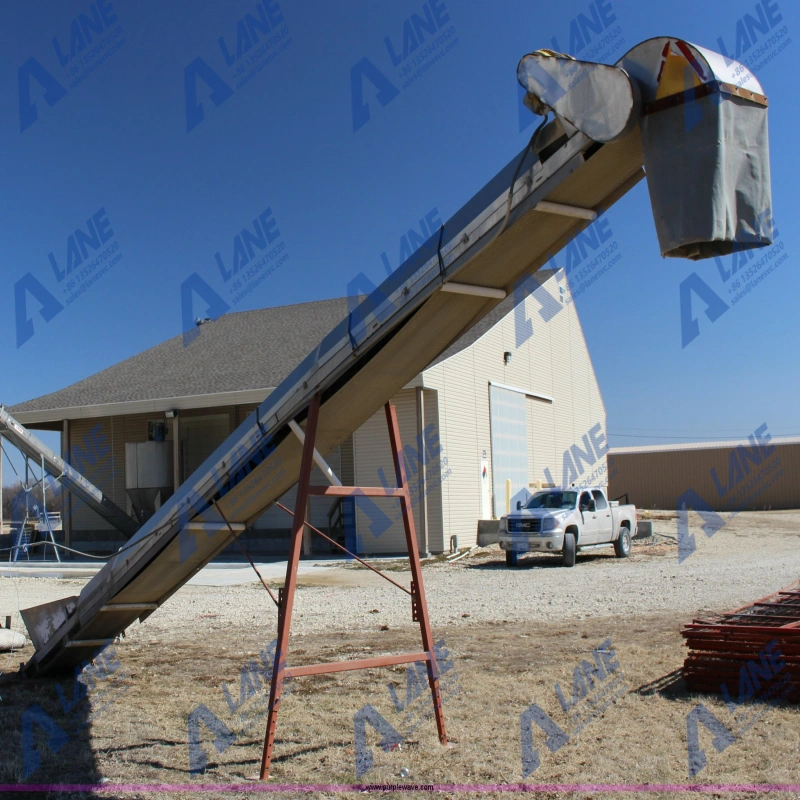
A steep angle belt conveyor for fertilizer plant applications is designed to move fertilizer materials between different elevations when a conventional horizontal conveyor would require too much floor space. In a fertilizer factory, this matters because crushers, granulators, screens, dryers, coolers, and packing systems rarely sit at the same elevation.
The conveyor uses a belt, drive unit, drums, rollers, and a tensioning system to transfer material from one point to another. For large-angle conveying, the key engineering issue is not simply whether the belt can climb. It is whether the material remains stable on the belt during elevation changes without excessive rollback, spillage, or loss of conveying efficiency. LANE’s large-angle belt conveyor description specifically identifies the belt, drive device, drums, rollers, and tensioning device as the main components.
For fertilizer plant owners and purchasing managers, the practical question is therefore different from “How much does a conveyor cost?” The better question is: Can the conveyor fit the plant layout, material characteristics, elevation difference, and required throughput without creating a maintenance problem later?
Why Should a Fertilizer Plant Use a Steep Angle Conveyor?
The strongest reason is usually layout efficiency, not simply conveying speed.
A conventional belt conveyor needs a relatively long horizontal distance to achieve a significant elevation change. When the fertilizer production line has limited floor area, that can create longer transfer routes, additional support structures, and more complicated material-return arrangements.
A large-angle belt conveyor can shorten the transfer route by handling a greater elevation change within a smaller footprint.
LANE’s product page describes the equipment as being intended for situations requiring large-angle lifting or lowering and notes that the conveying system increases friction between the belt and material to achieve the elevation change.
In an actual fertilizer plant, the advantages are more specific:
- Less floor space is required for elevation transfer.
- Material can be moved between different process levels.
- Transfer points can be arranged more compactly.
- The conveyor can connect separate processing sections.
- The overall material-handling route can be simplified.
But there is an important purchasing point here: a shorter conveyor route does not automatically mean a cheaper project. If the conveyor requires stronger structural support, special belt treatment, or additional guarding and access platforms, those items must be included in the project quotation.
Where Does a Steep Angle Belt Conveyor Fit in a Fertilizer Production Line?
The best position depends on the plant layout.
A steep angle belt conveyor may be used to transfer material between preparation, granulation, screening, drying, cooling, and packing sections. The exact arrangement depends on the process route and the elevation difference between machines.
For example, a fertilizer plant may need to move material from a lower-level crushing or screening section toward an elevated processing or storage section. Instead of extending a conventional conveyor over a long horizontal distance, an inclined conveying section can reduce the required footprint.
This is particularly relevant when the conveyor is part of a larger fertilizer production line rather than a standalone machine.
For buyers planning a complete project, the SSP fertilizer production line provides the broader process context for SSP equipment and material handling.
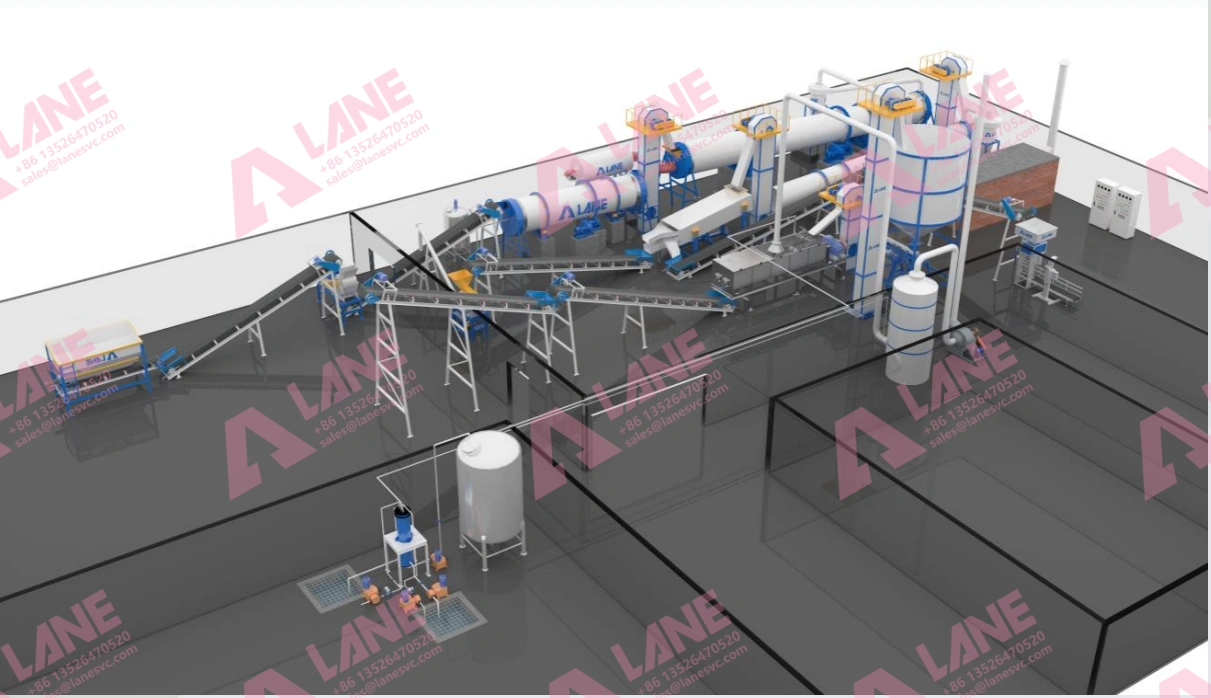
The conveyor should be designed as part of that process rather than purchased independently and forced into the layout afterward.
That distinction can save considerable modification costs during installation.
What Are the Main Components of a Steep Angle Belt Conveyor?
The basic mechanical structure is relatively straightforward, but each component affects reliability.
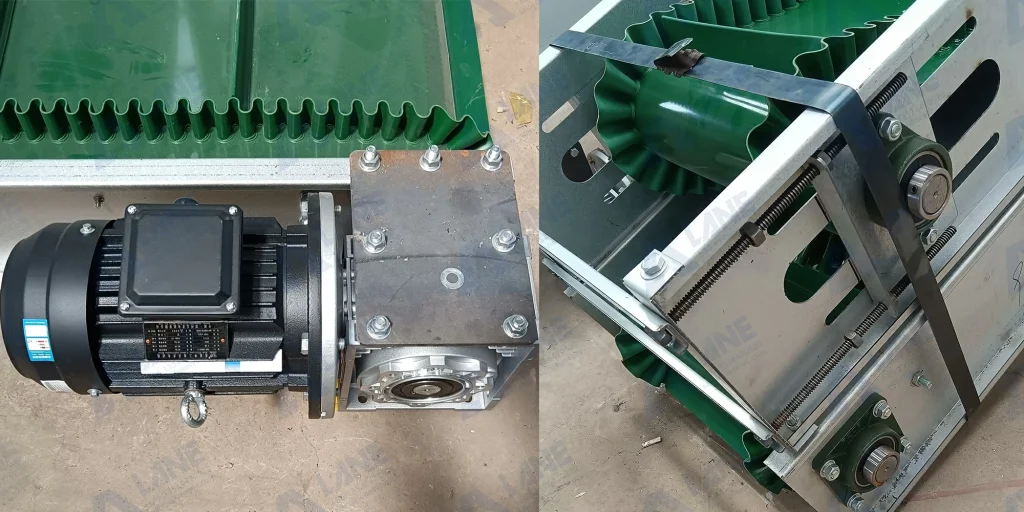
According to LANE’s equipment description, the main structure includes the conveyor belt, drive device, drums, rollers, and tensioning device.
Conveyor Belt
The belt carries the fertilizer material and must withstand continuous movement, loading impact, and contact with the conveyed product.
For fertilizer applications, buyers should pay attention to abrasion resistance and the operating environment rather than selecting a belt based only on price.
Drive Device
The drive assembly normally includes a motor and reducer. Its job is to provide the torque needed to move both the belt and the material load.
The motor should be selected from the actual conveying duty rather than from a standard catalogue model.
Drive and Return Drums
The drums guide the belt and transfer drive force to the conveying system.
Alignment is important. Poor alignment can cause belt tracking problems and accelerate wear on both the belt and supporting components.
Rollers
Rollers support the belt and reduce running resistance. Their arrangement needs to match the conveyor structure and loading conditions.
Tensioning Device
The tensioning system maintains appropriate belt tension during operation. Too little tension can contribute to slipping or tracking problems, while excessive tension increases mechanical loading.
For this reason, tensioning should be treated as part of the conveyor design rather than an accessory added after the main machine has been selected.
What Parameters Should Buyers Check Before Ordering?
The most important information should be defined before requesting a quotation.
A supplier should understand at least:
- Material type
- Required conveying capacity
- Horizontal conveying distance
- Vertical lifting height
- Installation angle
- Material bulk characteristics
- Feeding and discharge conditions
- Available plant space
- Local power supply
- Required belt width and conveyor configuration
Do not accept a quotation that gives only a conveyor length and motor power without explaining the design basis.
For a fertilizer plant, the conveyor’s actual duty point is more useful than a generic catalogue specification.
Key Selection Parameters
| Parameter | What the Buyer Should Provide | Why It Matters |
|---|---|---|
| Material | SSP, fertilizer granules, powder, or other bulk material | Determines conveying and belt requirements |
| Capacity | Required finished-material flow rate | Determines conveyor loading |
| Lift height | Vertical elevation difference | Affects conveyor geometry |
| Horizontal distance | Distance between loading and discharge points | Determines overall layout |
| Conveyor angle | Required installation angle | Influences material stability |
| Belt width | Selected according to material flow and capacity | Affects loading and conveying performance |
| Drive system | Motor and reducer arrangement | Determines available conveying power |
| Tensioning | Required belt tensioning arrangement | Supports stable belt operation |
| Discharge point | Exact receiving equipment location | Prevents transfer-point mismatch |
What Is the Most Common Conveyor Selection Mistake?
The most common mistake is selecting the conveyor according to length alone.
A 20-meter conveyor handling one material at a particular loading rate is not equivalent to a 20-meter conveyor handling another material at a different elevation and throughput.
The actual design must consider the complete conveying duty.
Another underestimated issue is the discharge point. A conveyor may technically have sufficient capacity but still create problems if the discharge trajectory does not match the receiving machine.
In fertilizer plants, transfer points should be considered together with the machines before and after the conveyor.
This is one reason experienced suppliers ask for a plant layout or equipment arrangement before finalizing the conveyor.
What Should Be Included in a Fertilizer Plant Conveyor Quotation?
A serious quotation should contain more than the conveyor’s headline price.
Ask the supplier to identify:
- Conveyor dimensions
- Belt specification
- Motor and reducer specification
- Drive and return drum arrangement
- Roller configuration
- Tensioning system
- Supporting structure
- Feed and discharge arrangements
- Electrical control requirements
- Spare parts
- Installation scope
- Testing and commissioning scope
The buyer should also ask whether structural supports, platforms, guards, chutes, and electrical components are included or excluded.
This is where apparently inexpensive quotations can become expensive projects. A low equipment price does not necessarily represent a low installed cost.
Planning a Fertilizer Plant? Check the Conveyor as Part of the Whole System
If the conveyor is being purchased for an SSP project, it should be evaluated together with the other material-handling equipment.
LANE’s SSP equipment site provides information on SSP production equipment and related process systems. SSP fertilizer production line
For broader fertilizer equipment requirements, Fertilizer Industry Leader covers fertilizer production lines, granulators, mixers, crushers, drying and cooling equipment, and other fertilizer machinery. fertilizerindustryleader.com
For chemical fertilizer equipment and related conveying solutions, buyers can also review LANE Machinery, where the company lists fertilizer production equipment and a large inclination belt conveyor among its equipment range. lanemachinery.com
The practical recommendation is simple: if the conveyor is part of a complete plant, give the supplier the upstream and downstream equipment information before asking for the final conveyor specification.
That gives the engineering team something real to design around.
What Should Buyers Check for Maintenance and Long-Term Operation?
Maintenance requirements are usually manageable, but only when the conveyor is correctly designed and installed.
The main inspection points include:
- Belt tracking
- Belt tension
- Roller condition
- Drum alignment
- Drive-system condition
- Fasteners and structural connections
- Material buildup around transfer points
A conveyor that continuously runs off-center should not be treated as a normal operating condition. It usually indicates an alignment, loading, tension, or component issue that should be corrected before belt damage becomes significant.
The belt itself is also a consumable component. Buyers should ask about replacement-belt availability and recommended spare parts before commissioning the plant.
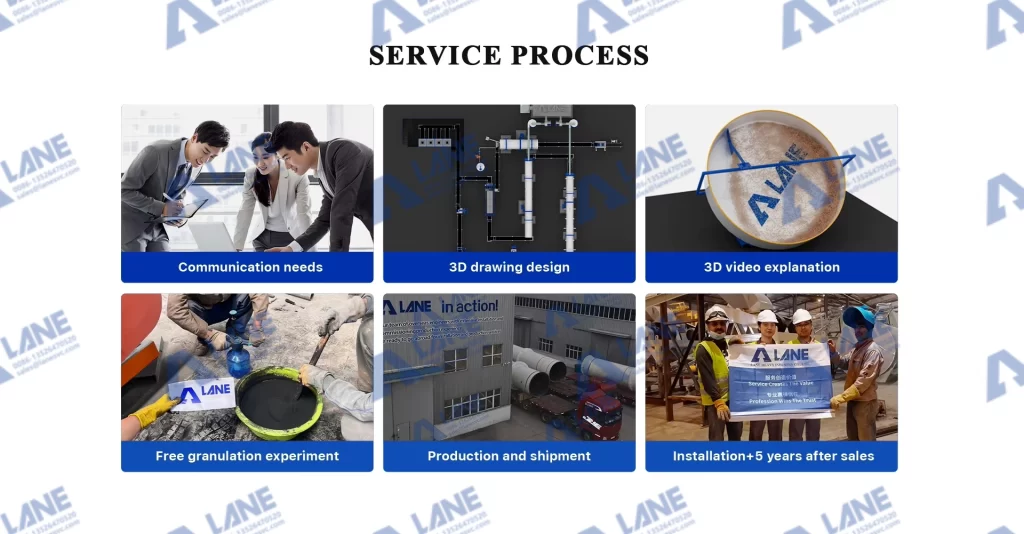
LANE states that it provides remote technical guidance and can provide on-site installation guidance when required. lanemachinery.com
That is worth clarifying in the contract because “after-sales service” can mean very different things between suppliers.
How Should You Compare Conveyor Suppliers?
Do not compare suppliers using the equipment price alone.
A better comparison includes:
| Buyer Concern | Supplier A | Supplier B | What to Verify |
|---|---|---|---|
| Conveyor design | Based on actual plant duty | ||
| Belt specification | Material and wear requirements | ||
| Motor and reducer | Power and operating conditions | ||
| Structural support | Included or excluded | ||
| Transfer chutes | Included or excluded | ||
| Installation guidance | Remote or on-site | ||
| Spare parts | Availability and recommended stock | ||
| Warranty | Written warranty terms | ||
| Testing | Factory and site acceptance | ||
| Total installed cost | Compare complete scope |
FAQ: What Do Fertilizer Plant Buyers Usually Ask?
1. Can a steep angle belt conveyor handle fertilizer materials?
Yes, it can handle fertilizer materials when the conveyor is designed around the material and conveying duty. The supplier should evaluate the material form, capacity, elevation, belt configuration, and loading conditions before confirming the final design.
2. Does a steep angle conveyor save plant space?
Yes, its main layout advantage is reducing the horizontal space required for elevation transfer. The actual space saving depends on the required lift height, conveyor angle, and plant layout.
3. What information should I send when requesting a quotation?
You should provide the material, required capacity, lifting height, horizontal distance, feeding point, discharge point, and available installation space. A plant layout or equipment arrangement drawing is even more useful because it allows the supplier to design the conveyor around real connection points.
4. Does LANE provide installation support?
Yes, LANE states that it provides remote technical guidance and can provide on-site installation guidance when required. Buyers should confirm the exact installation scope, travel arrangements, commissioning responsibilities, and training requirements in the quotation. lanemachinery.com
5. Should I buy the conveyor separately or with the fertilizer production line?
For a new plant, integrating the conveyor into the overall production-line design is usually the better approach. It reduces the risk of mismatched elevations, transfer points, capacities, and structural requirements between individual machines.
What Should You Confirm Before Signing the Conveyor Contract?
For a steep angle belt conveyor for fertilizer plant projects, three points deserve particular attention before the purchase order is signed.
First, confirm the design basis. The supplier should clearly state the material, capacity, conveying distance, lifting height, belt configuration, and drive system used for the design.
Second, confirm the complete supply scope. Make sure the quotation clearly identifies whether the support structure, chutes, guards, electrical components, spare parts, installation guidance, and commissioning are included.
Third, confirm acceptance criteria. Do not rely only on “machine runs normally.” Define what will be checked during testing, including conveying performance, belt tracking, material transfer, and operating stability.
These details are more important than choosing the lowest initial quotation.
If your conveyor is part of an SSP project, you can also review the SSP fertilizer production line before discussing the conveyor layout with the engineering team.
For broader fertilizer machinery requirements, you can visit Fertilizer Industry Leader or LANE Machinery to review related fertilizer production equipment and project services. fertilizerindustryleader.com
Final Decision: What Matters Most When Buying a Steep Angle Belt Conveyor?
The right conveyor is not simply the one with the largest motor or the lowest quotation.
For a fertilizer plant, the buyer should focus on actual conveying duty, layout compatibility, complete supply scope, and long-term maintenance access.
If those four points are clearly defined before ordering, it becomes much easier to compare suppliers on engineering value instead of comparing incomplete quotations.
For more details, please feel free to contact us.
Henan Lane Heavy Industry Machinery Technology Co., Ltd.
Email: sales@lanesvc.com
Contact number: +86 13526470520
Whatsapp: +86 13526470520