Phosphorus and Sulfur Fertilizer for Agriculture: Production Line Setup, Equipment & ROI Guide
- 2026-05-18
There’s a reason experienced agronomists keep coming back to the same conversation: nutrient balance. And right at the center of that conversation, you’ll almost always find phosphorus and sulfur fertilizer for agriculture. These two elements don’t just support crop growth — they drive it. Phosphorus fuels root development and energy transfer. Sulfur activates enzymes and boosts protein synthesis. Together, they form a nutritional partnership that most modern soils simply can’t provide on their own.
For fertilizer producers and agricultural investors, this creates a real opportunity. Demand for phosphorus and sulfur fertilizer for agriculture is climbing steadily across Africa, Southeast Asia, and the Middle East — regions where soil depletion is accelerating faster than local supply chains can respond. Setting up the right production line isn’t just a manufacturing decision. It’s a market positioning move.
Why This Compound Fertilizer Outperforms Single-Nutrient Products
Let me tell you something I’ve seen repeated across dozens of production facilities: manufacturers who produce phosphorus and sulfur fertilizer for agriculture as a compound product consistently outperform those selling each nutrient separately — both in agronomic results and in market pricing.
Chemical reactions can also be explained satisfactorily. sulfur acidifies the macrozone around fertilizer grains and improves the availability of phosphorus in alkaline soils. this is especially valuable in regions such as sub-Saharan Africa and South Asia where high soil pH is a persistent factor limiting yields. when farmers understand this interaction, they are not just buying products, they are buying soil solutions.
From what I have observed on the ground, the composite formulation approach also simplifies the application process for small-scale farmers. One product, used once, containing two essential nutrients. That is a genuine value proposition. And honestly, that’s exactly why demand for phosphorus sulfur fertilizer has been expanding in markets where input efficiency matters most.
Core Equipment for a Phosphorus Sulfur Fertilizer Production Line
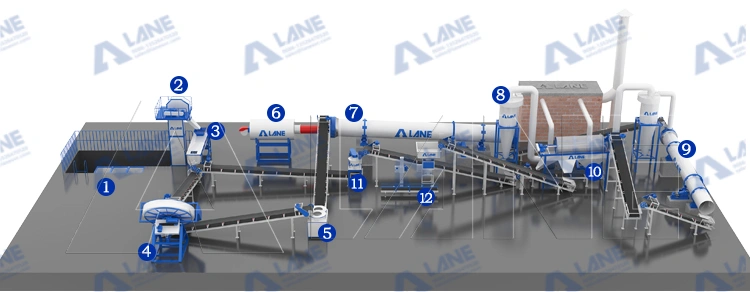
Setting up a practical production line requires careful sequencing of the equipment. Each unit is responsible for converting raw materials into granules that can be shipped to the market. The items typically included in a standard compound feed line are as follows:
- Raw Material Batching System — Automated dosing and proportioning of phosphate rock, elemental sulfur, ammonium sulfate, or other sulfur-bearing inputs. Precision here directly affects final nutrient uniformity.
- Crusher — Reduces raw phosphate rock and sulfur to the particle size required for consistent mixing and reaction.
- Double-Shaft Mixer — Achieves homogeneous blending of phosphorus and sulfur sources before granulation. Mixing time and shaft speed are critical variables.
- Rotary Drum Granulator — The workhorse of most compound fertilizer production lines. Converts blended powder into spherical granules using steam or liquid binders. Widely preferred for its adaptability to various formulations.
- Rotary Drum Dryer-Cooler — Controls moisture (2–4%) and cools granules for stable storage and processing.
- Rotary Screening Machine — Separates on-spec granules from oversized and undersized material. Oversized granules return to the crusher; undersized material recycles into the granulator feed.
- Coating Machine— Applies anti-caking agents or slow-release coatings. Increasingly important for export markets with strict shelf-life requirements.
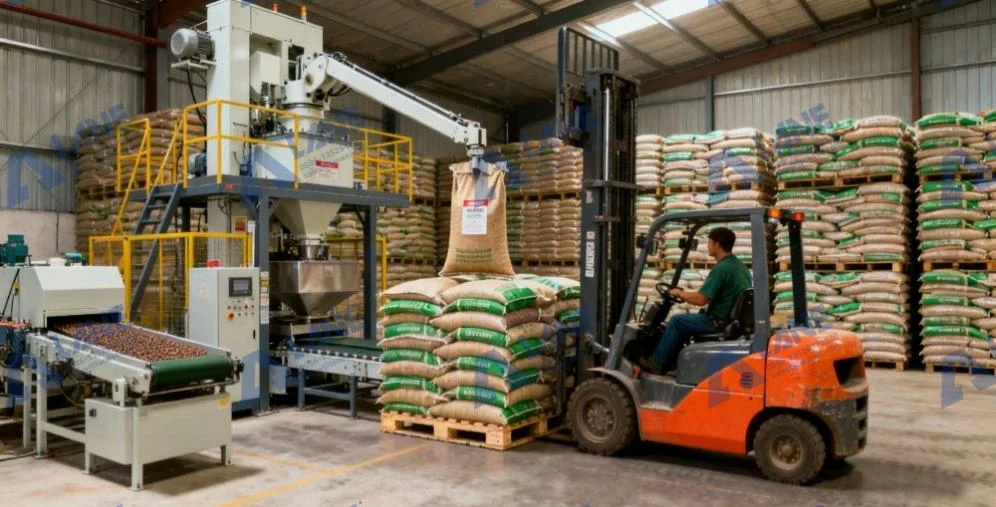
- Automatic Packaging Machine— Completes the phosphorus sulfur fertilizer line with accurate weight-filling and bag sealing for 25 kg, 50 kg, or bulk formats.
Manufacturers working with LANE, a specialist manufacturer of fertilizer equipment, equip these units with variable frequency drive controls that allow granule moisture and retention time to be adjusted in real time. Fine technical details have a major impact on granule hardness and product integrity.
Production Capacity and Investment Overview
Capacity planning is where most new investors underestimate complexity. A 10 t/h line for phosphorus and sulfur fertilizer for agriculture doesn’t cost twice as much as a 5 t/h line — it costs roughly 60–75% more, because certain fixed infrastructure costs don’t scale linearly.
For a mid-scale operation targeting 5–10 metric tons per hour of phosphorus sulfur fertilizer output, total equipment investment typically falls in the USD 280,000–520,000 range. That figure covers the full production line but excludes civil construction, utilities, and raw material inventory.
The structure of raw material costs varies significantly depending on the source of sulfur. elemental sulfur recovered from petroleum refining is considerably cheaper than sulfate-based inputs, but additional oxidation processes and mixing with ammonium sulfate are required to ensure agricultural effects. This decision alone could potentially alter input costs per ton by between 15 and 25%.
ROI Considerations: Is Phosphorus and Sulfur Fertilizer for Agriculture Worth the Investment?
Actually, the ROI case here is more straightforward than many investors expect — once your account for regional demand dynamics.
Gross margins on phosphorus sulfur fertilizer typically run 18–32% for well-positioned manufacturers. The higher end of that range is achievable in markets where local production is scarce and import logistics are expensive. Nigeria, Ethiopia, and several Southeast Asian markets currently fit that profile.
The recovery period of mid-range line is generally 2.5 years to 4 years, under the reasonable premise of 300+ production days per year, stable raw material supply, stable regional pricing. Lines that add slow-release coating capabilities tend to shorten the collection period as coating fertilizers have a price premium of 20-35 percent in the commercial agricultural market.
Summary and Next Steps
Phosphorus and sulfur fertilizer for agriculture represents one of the more defensible investment opportunities in the fertilizer manufacturing space right now. The agronomic need is real. The supply gap in key growth markets is documented. And the production technology — rotary drum granulation, precision batching, coating systems — is proven, scalable, and available.
when evaluating production line setup, start with local soil data and target crop types. This determines the optimal P:S ratio, which in turn influences equipment configuration and cost structure. If the order is set correctly, everything else will follow in a more natural manner than many investors might expect.
Frequently Asked Questions
Q1: What is the typical N-P-S ratio in this type of compound fertilizer?
It varies by target crop and soil type, but common formulations for phosphorus and sulfur fertilizer for agriculture include 0-20-0+18S, 12-24-12+8S, and similar compound ratios. Soil testing should always precede formulation decisions.
Q2: Can elemental sulfur be directly granulated with phosphate in the same phosphorus sulfur fertilizer production line?
Yes, but with important caveats. Elemental sulfur requires fine grinding to ensure agronomic availability. Many producers blend it with ammonium sulfate or use a bentonite-sulfur approach. Your granulator temperature and retention time settings will need adjustment depending on the sulfur form you’re processing.
Q3: How long does it take to set up a phosphorus and sulfur fertilizer for agriculture production line from order to commissioning?
For a standard mid-scale line, expect 90–150 days from equipment order to on-site commissioning. Civil construction and utility installation run in parallel and are typically the critical path items, not equipment delivery itself.
Q4: What is the minimum viable capacity for a phosphorus sulfur fertilizer line to be commercially competitive?
In most markets, 3–5 metric tons per hour is the practical minimum for commercial viability. Below that threshold, fixed overhead costs per ton become difficult to offset through market pricing, unless you’re serving a highly specialized niche.
Q5: How does sulfur addition affect phosphorus availability in soil?
Sulfur oxidation produces sulfuric acid, which lowers localized pH and dissolves phosphate complexes that would otherwise remain inaccessible to plant roots. This mechanism is central to why phosphorus and sulfur fertilizer for agriculture consistently outperforms single-nutrient phosphate products in alkaline and calcareous soils.

For more details, please feel free to contact us.
Henan Lane Heavy Industry Machinery Technology Co., Ltd.
Email: sales@lanesvc.com
Contact number: +86 13526470520
Whatsapp: +86 13526470520