Industrial SSP Fertilizer Production System Cost & ROI
- 2026-05-27
There’s a question I hear constantly from phosphate fertilizer producers in emerging markets — “How much does it actually cost to get a line running, and when do I see real returns?” Fair question. Setting up an industrial SSP fertilizer production system is a substantial capital commitment, and the margin for planning errors is thin. What I can tell you is this: the numbers matter but understanding why they look the way they do matters even more.
What Drives the Cost of an Industrial SSP Fertilizer Production System
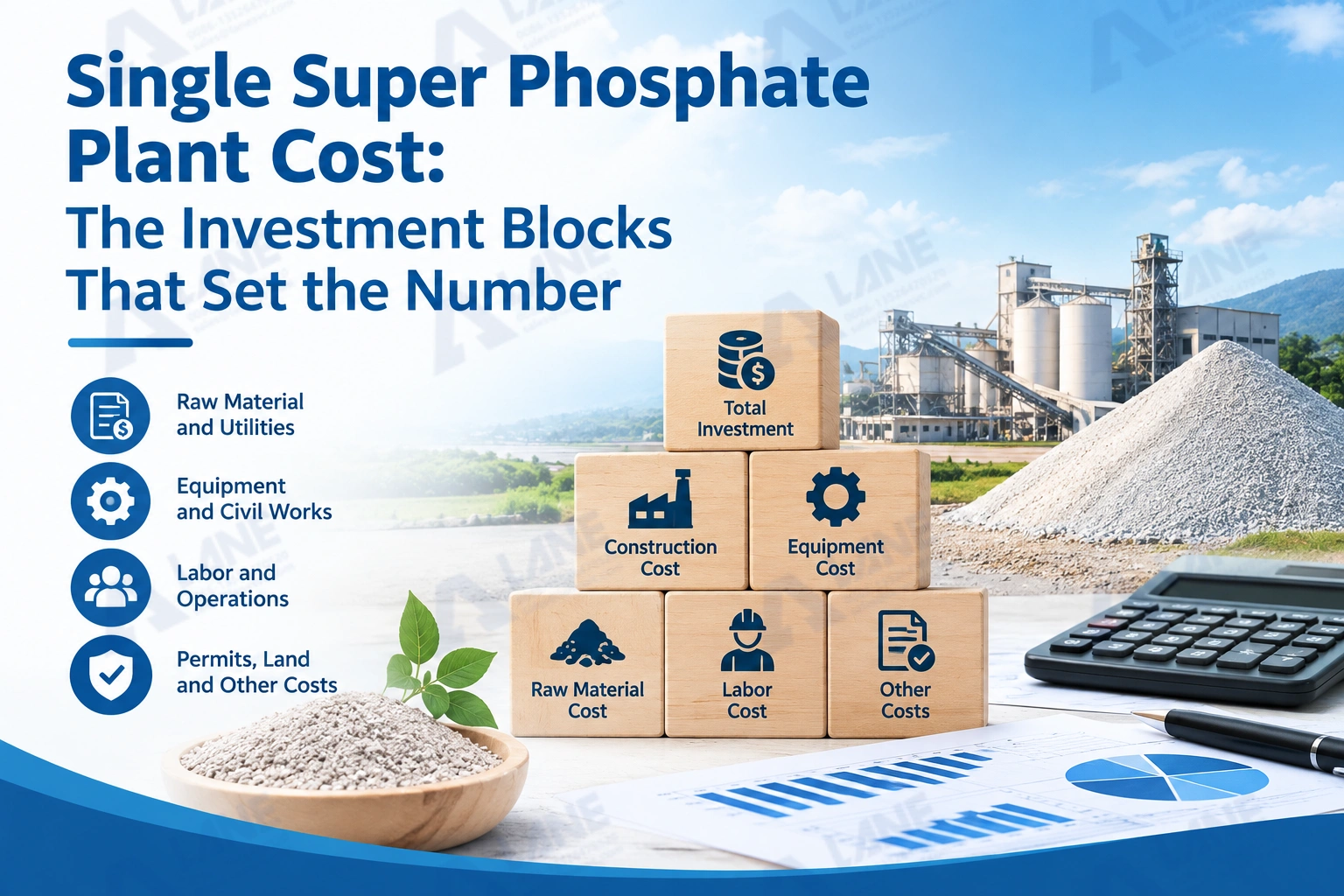
To get straight to the point: The price range for this equipment was not set arbitrarily. A small, semi-mechanized production line costs approximately $80,000, while a fully automated, continuous production line requires over $1.2 million. The cost is determined by multiple factors, and any oversight in any aspect can lead to significant deviations in budget estimates.
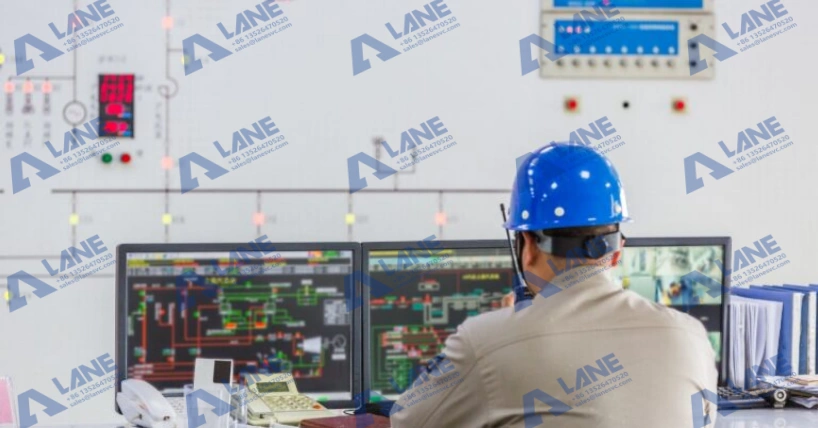
Production capacity is the single biggest driver. A 5 t/h industrial SSP fertilizer production system and a 30 t/h system are fundamentally different animals, not just in scale but in structural reinforcement, blower sizing, acid dosing, and curing shed requirements. Raw material characteristics come next. High moisture phosphate rock with variable P₂O₅ content requires more pre-processing capacity upfront. And automation level — the gap between a PLC-managed, fully instrumented plant and a manually operated one can represent 30 to 40 percent of total equipment cost.
Geographical factors also contribute to additional cost differences. Shipping costs, import duties, and local installation labor rates vary significantly between Nigeria, Bangladesh, and Vietnam, resulting in noticeable disparities in the final cost of the equipment.
Core Equipment in a Complete Industrial SSP Fertilizer Production System
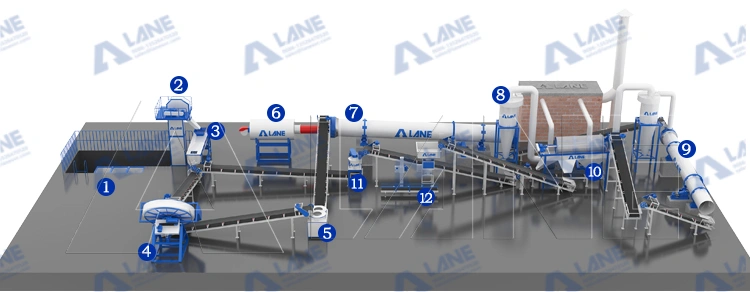
An industrial SSP fertilizer production system isn’t a single machine — it’s a coordinated sequence of units, each critical to product quality and operational stability. Here’s what a standard continuous production line includes:
- Phosphate rock grinding mill— Reduces run-of-mine rock to the 80–100 mesh fineness needed for efficient sulphonic acid reaction. Typically, a Raymond mill or ball mill depending on rock hardness.
- Sulfuric acid storage and dosing system— Precise acid metering is non-negotiable. Under-dosing means incomplete reaction; overdosing creates handling hazards and product quality failures.
- Belt conveyor and curing system— Freshly acidulated SSP needs 3 to 6 weeks of curing to complete the reaction and stabilize free acid content.
- Rotary drum granulator— Once curing is complete, granulation converts powdered SSP into market-ready, dust-free granules. The rotary drum granulator is the workhorse of this stage.
- Rotary drum dryer— Reduces post-granulation moisture to the 2–4% range required for storage stability and bag integrity.
- Rotary drum cooler— Brings product temperature down before screening and bagging, preventing caking in storage.
- Vibrating screen— Separates on-spec granules from oversized and undersized fractions, with oversize returned to the crusher and fines recirculated.
- SSP granulation equipment— Final conditioning and packaging. Quality SSP granulation equipment at this stage dramatically reduces post-sale complaints and return rates.
Henan Lane has extensive experience in the field of large-scale fertilizer production equipment and can provide a complete set of production line equipment that meets specific specifications. By choosing this one-stop solution, you no longer need to procure individual machines from multiple manufacturers, which can significantly simplify the process of connecting and integrating the equipment.
ROI Timeline: What the Numbers Actually Look Like
To be honest, while many projects use essentially the same equipment, the returns on investment vary greatly. The key factors are the sourcing of raw materials, market positioning, and whether the agricultural input distribution network was established beforehand or built gradually after the factory began production.
That said, here are realistic benchmarks that buyers of an industrial SSP fertilizer production system consistently report:
Payback period for a mid-scale industrial SSP fertilizer production system (10–15 t/h) typically runs 2.5 to 4 years in markets with domestic phosphate rock access. In regions where rock must be imported, that extends to 4–6 years.
Gross margin on SSP sits between 18 and 35 percent depending on input costs and local market pricing. Nigeria, Ethiopia, and parts of Southeast Asia represent particularly strong margins right now, given the persistent gap between local SSP supply and smallholder demand.
Operational cost structure on a well-run line: raw materials (phosphate rock + sulphonic acid) 60–65%, labor 8–12%, energy 10–15%, maintenance 5–8%, overheads 5–10%. Tight control of the acid-to-rock ratio is your primary lever for cost management at the production level.
Hidden Costs Most Budget Models Miss
From what I’ve seen in the field, two items consistently blow first-year budgets: curing shed construction and effluent treatment infrastructure. The curing shed is substantial — you need covered area for 4–6 weeks of SSP output. And environmental compliance, particularly acid mist scrubbing and fluoride emission control, adds real capital cost that desktop feasibility studies routinely underestimate. Budget for both.
Personnel training is easily overlooked. The production of diammonium phosphate requires the use of concentrated sulfuric acid. Even if the hardware protection is excellent, inadequate employee training will result in a lack of safety and quality assurance.
The Takeaway
An industrial SSP fertilizer production system is a long-term infrastructure investment, not a commodity purchase. The producers who generate strong ROI aren’t necessarily the ones who bought the cheapest line — they’re the ones who sized their system accurately, invested in proper curing and environmental infrastructure, and entered markets with genuine demand before starting construction.
If you are evaluating the production line and need to determine the production capacity, ensure that three things are in place first: the supply channel for phosphate ore, the local selling price of superphosphate, and the supply system for sulfuric acid. These three points are the foundation of all efforts.
Frequently Asked Questions
Q1: What is the minimum viable capacity for a commercially profitable industrial SSP fertilizer production system?
In most developing market contexts, 5 t/h is considered the lower threshold for commercial viability, though 8–10 t/h is more commonly recommended for standalone operations. Below 5 t/h, fixed overheads — particularly curing infrastructure and acid handling systems — tend to erode margins significantly.
Q2: How does SSP granulation equipment affect product quality and marketability?
Significantly. Granular SSP commands a premium over powder and faces far fewer handling challenges. Quality SSP granulation equipment produces uniform granules with good crush strength and low dust generation — factors that directly influence argopelter acceptance. When evaluating SSP granulation equipment, always request crush strength test data before purchasing.
Q3: What sulphonic acid concentration is recommended for SSP production?
The standard practice involves using 68% to 70% sulfuric acid. The higher the concentration, the more thorough the reaction will be, but the associated operational risks will also increase. Mixing equipment and piping must be replaced with higher-grade acid-resistant materials.
Q4: How long does it take to commission a new industrial SSP fertilizer production system?
From equipment arrival to first commercial production, most mid-scale installations require 3 to 5 months, covering civil works, mechanical installation, electrical integration, safety system commissioning, and trial runs.
Q5: Can an existing NPK or organic fertilizer plant be retrofitted to add SSP production?
This can only be partially achieved. If the existing granulation and drying equipment specifications are suitable, additional front-end acidification and maturation units can be installed. However, the sulfur treatment equipment and maturation sheds are not compatible with conventional compound fertilizer production lines, requiring significant additional investments.
Q6: What financing options are available for industrial SSP fertilizer production system projects?
Three financing methods are commonly employed in the industry: equipment manufacturer credit, agricultural development bank loans, and government agricultural industrialization subsidies, which are widely used in sub-Saharan Africa and South Asia. It has become increasingly easier to secure financing backed by export credit agencies for projects with a total value exceeding $500,000.
For more details, please feel free to contact us.
Henan Lane Heavy Industry Machinery Technology Co., Ltd.
Email: sales@lanesvc.com
Contact number: +86 13526470520
Whatsapp: +86 13526470520