How to Manufacture Single Super Phosphate Fertilizer Step by Step — Equipment, Process & Cost Breakdown
- 2026-04-30
Every year, producers across Asia, Africa, and Latin America ask the same question: how do you actually build a reliable SSP line that hits quality targets and stays profitable? The answer starts with understanding how to manufacture single super phosphate fertilizer from the ground up — not just the chemistry, but the equipment sequence, the process controls, and the real cost drivers that feasibility reports tend to gloss over.
I’ve worked alongside fertilizer equipment projects long enough to know that most production failures aren’t chemistry failures. They’re engineering and sequencing failures. Let’s fix that.
What Is Single Super Phosphate?
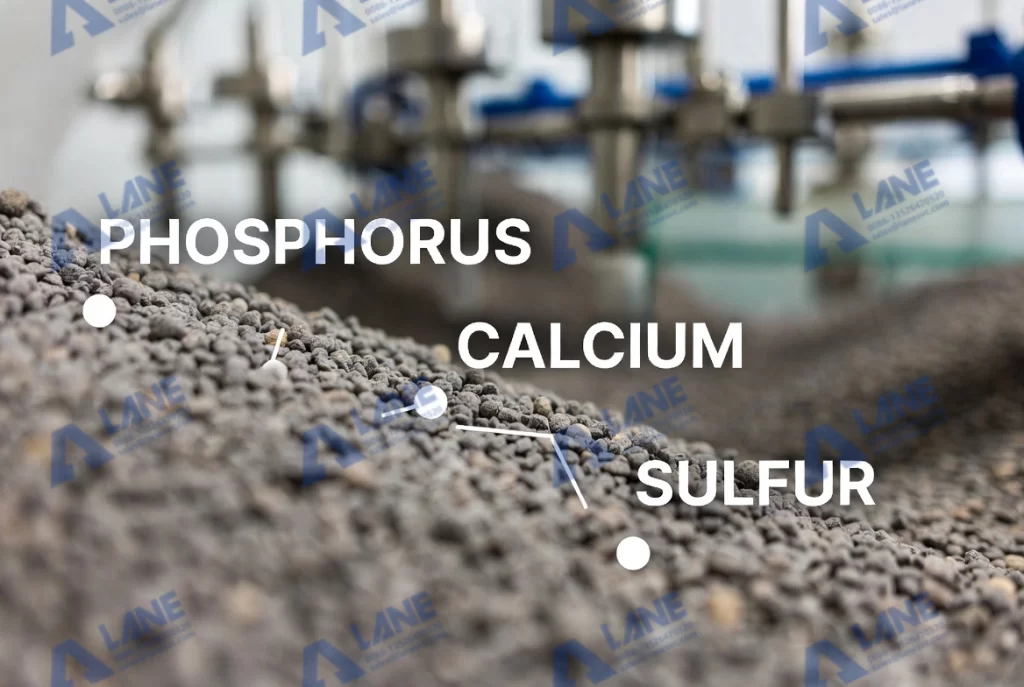
Single super phosphate is produced by reacting ground phosphate rock with sulfuric acid, yielding a product containing 16–20% available P₂O₅ and 10–12% elemental sulfur. That dual-nutrient profile is genuinely valuable in sulfur-deficient agricultural regions. It’s one reason demand for SSP has remained durable across decades of competition from higher-analysis alternatives.
Understanding how to manufacture single super phosphate fertilizer means understanding that the chemistry itself is straightforward — it’s the process discipline that determines whether your output is consistent and marketable.
Step-by-Step Production Process
Step 1 — Phosphate Rock Grinding
Before any reaction occurs, raw phosphate rock must be ground to 80–90% passing a 100-mesh screen. Under-ground material reacts unevenly and pulls your P₂O₅ numbers down.
The standard equipment options here are the Phosphate Rock Ball Mill and the Raymond Mill. Selection depends on feed hardness and target throughput. Both are proven in commercial SSP operations worldwide.
Step 2 — Acidulation
This is the core step in how to manufacture single super phosphate fertilizer. Ground rock is fed into an Acidulation Reactor — sometimes called a Den Reactor — where it contacts sulfuric acid at controlled concentration and flow rate. The reaction is exothermic and releases fluoride gas, which must be captured by a properly designed scrubbing system. No shortcuts here.
Acid concentration, feed ratio, and retention time all directly affect final product quality. Get these parameters wrong and you’re correcting problems at every stage downstream.
Step 3 — Curing
Reacted material moves to a dedicated SSP Curing Building for 18–24 hours. This allows the acidulation reaction to reach full completion and moisture to stabilize. From what I’ve seen in actual plant operations, the producers who cut curing time to chase throughput end up with product that clumps, fails lab testing, and generates buyer complaints. Not a trade-off worth making.
Step 4 — Crushing and Screening
Cured SSP exits as a hardened cake. It’s mechanically broken down and classified through a Vibrating Screen. Oversize material recycles to re-crushing; fines either feed back into the granulation circuit or go to powdered product.
Step 5 — Granulation
Most commercial buyers now specify granular SSP. A Double Shaft Mixer conditions the material before it enters a Rotary Drum Granulator or Disc Granulator, where moisture and recycle fines drive agglomeration. Granule size uniformity here determines product shelf performance and, frankly, how easily your customers handle it in the field.
Step 6 — Drying and Cooling
Wet granules move through a Rotary Drum Dryer — reducing moisture to under 5% — then immediately into a Rotary Drum Cooler that brings product temperature to within 5°C of ambient. Skipping the cooling step causes caking inside bags. I’ve seen this damage commercial relationships. Don’t skip it.
Step 7 — Screening and Packaging
A final Vibrating Screen removes off-spec particles before on-grade product travels via Belt Conveyor System to the Automatic Packaging Machine. Your single super phosphate plant has now completed the full production cycle.
Core Equipment for a Single Super Phosphate Plant
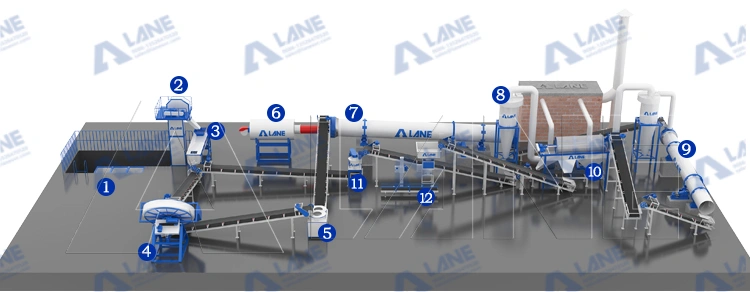
Any well-engineered single super phosphate plant requires these key equipment units:
- Phosphate Rock Ball Mill— raw material grinding
- Acidulation Reactor— core reaction chamber
- SSP Curing Building— post-reaction stabilization
- Double Shaft Mixer— pre-granulation conditioning
- Rotary Drum Granulator — granule formation
- Rotary Drum Dryer and Cooler—Reduces moisture to specification and lowers temperature before packaging.
- Vibrating Screen— multi-stage particle classification
- Belt Conveyor System— inter-unit material transport
- Automatic Packaging Machine — finished product packaging
Bag Filter and gas scrubbing systems are consistently underbudgeted in early feasibility work. Build them in from the start — regulators in most markets won’t give you a choice.
Cost Breakdown
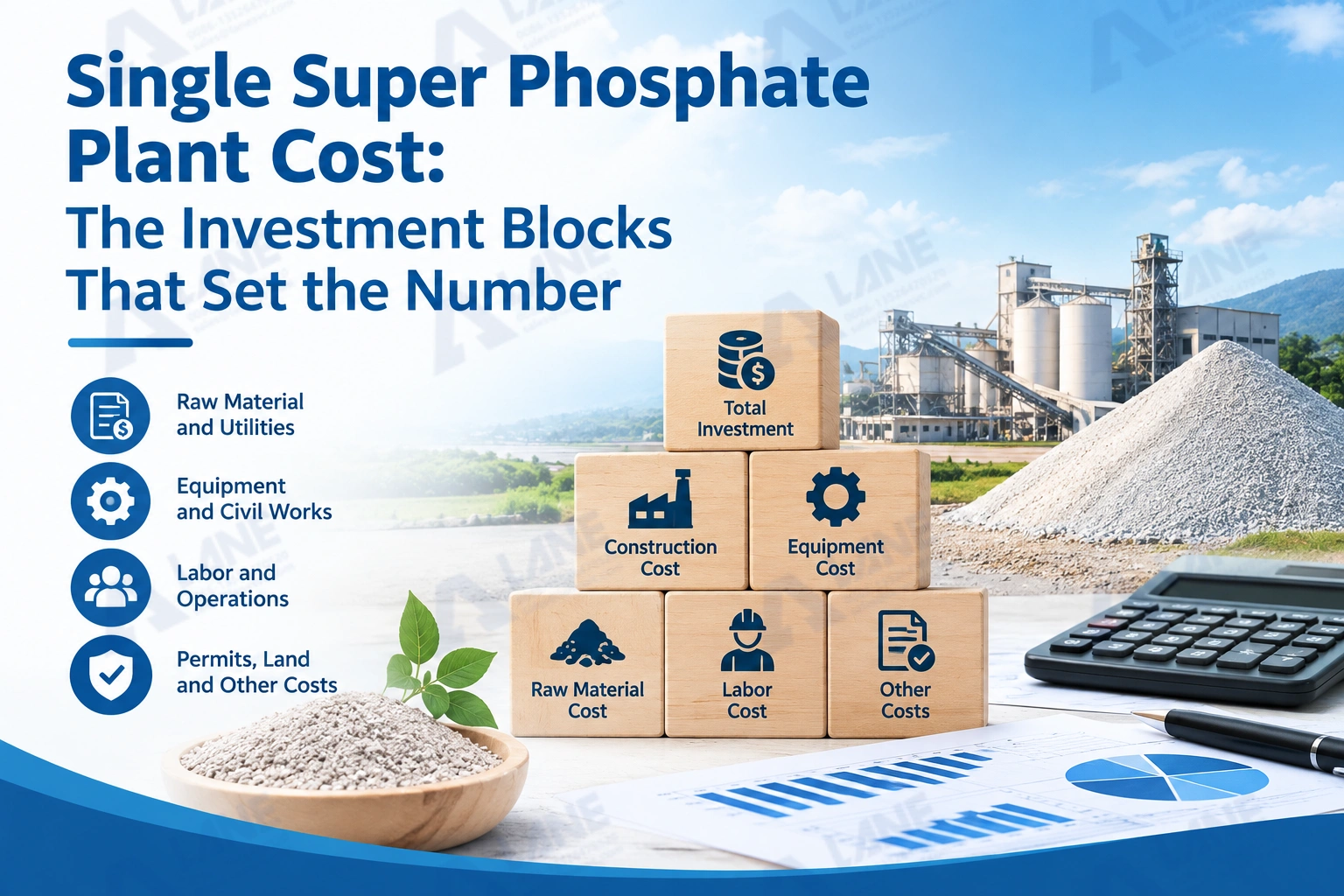
For a small-to-mid-scale single super phosphate plant running 5–15 TPH, total capital expenditure typically ranges from $400,000 to over $1,000,000 USD. The acidulation system and curing building are the dominant Capex items. On the operating side, sulfuric acid alone accounts for 60–70% of direct raw material cost. Dryer energy consumption and grinding equipment maintenance are the next most significant recurring line items.
Suppliers like LANE, which specializes in large-scale fertilizer production equipment, offer modular single super phosphate plant configurations designed for phased capacity expansion — a practical structure for producers who want to enter the market without committing to full-scale Capex upfront.
Final Thoughts
Knowing how to manufacture single super phosphate fertilizer is genuinely accessible knowledge. What separates consistent, profitable operations from struggling ones is process discipline: correct equipment specification, full curing time, and emissions compliance built into the design from day one. Get those three things right and SSP production is a viable, durable business at almost any market scale.
If you’re planning a new single super phosphate plant or expanding existing capacity, engage your engineering and equipment partners before capital is committed — not after the layout is fixed.
Frequently Asked Questions
Q1: What does the process of how to manufacture single super phosphate fertilizer actually require in terms of raw inputs?
The two primary inputs are phosphate rock — ideally 28–32% P₂O₅ grade — and sulfuric acid at 93–98% concentration. Rock quality is the main determinant of final product P₂O₅ content.
Q2: How long does a complete single super phosphate fertilizer production cycle take?
From acidulation through to bagged product, total processing time runs 24–30 hours. The curing stage accounts for the bulk of that window.
Q3: What is the minimum viable capacity for a single super phosphate plant?
Commercial viability generally starts at 3–5 TPH. Below that level, the fixed costs of acid handling, curing infrastructure, and emissions control equipment make unit economics difficult to justify.
Q4: What environmental compliance requirements apply when you manufacture single super phosphate fertilizer?
Fluoride gas from the acidulation reactor and fine particulate dust from grinding and granulation are the two primary regulatory concerns. A Bag Filter combined with reactor vent gas scrubbing is the standard compliance configuration.
Q5: How do I calculate ROI for a new single super phosphate plant investment?
A reliable ROI model incorporates local phosphate rock and acid pricing, realistic product selling price, planned capacity utilization, and full financing costs. Well-run mid-scale operations in markets with stable raw material supply typically achieve payback within three to five years.
For more details, please feel free to contact us.
Henan Lane Heavy Industry Machinery Technology Co., Ltd.
Email: sales@lanesvc.com
Contact number: +86 13526470520
Whatsapp: +86 13526470520