SSP for Pulses: Uses, Selection & Production Buyer Guide
- 2026-11-06
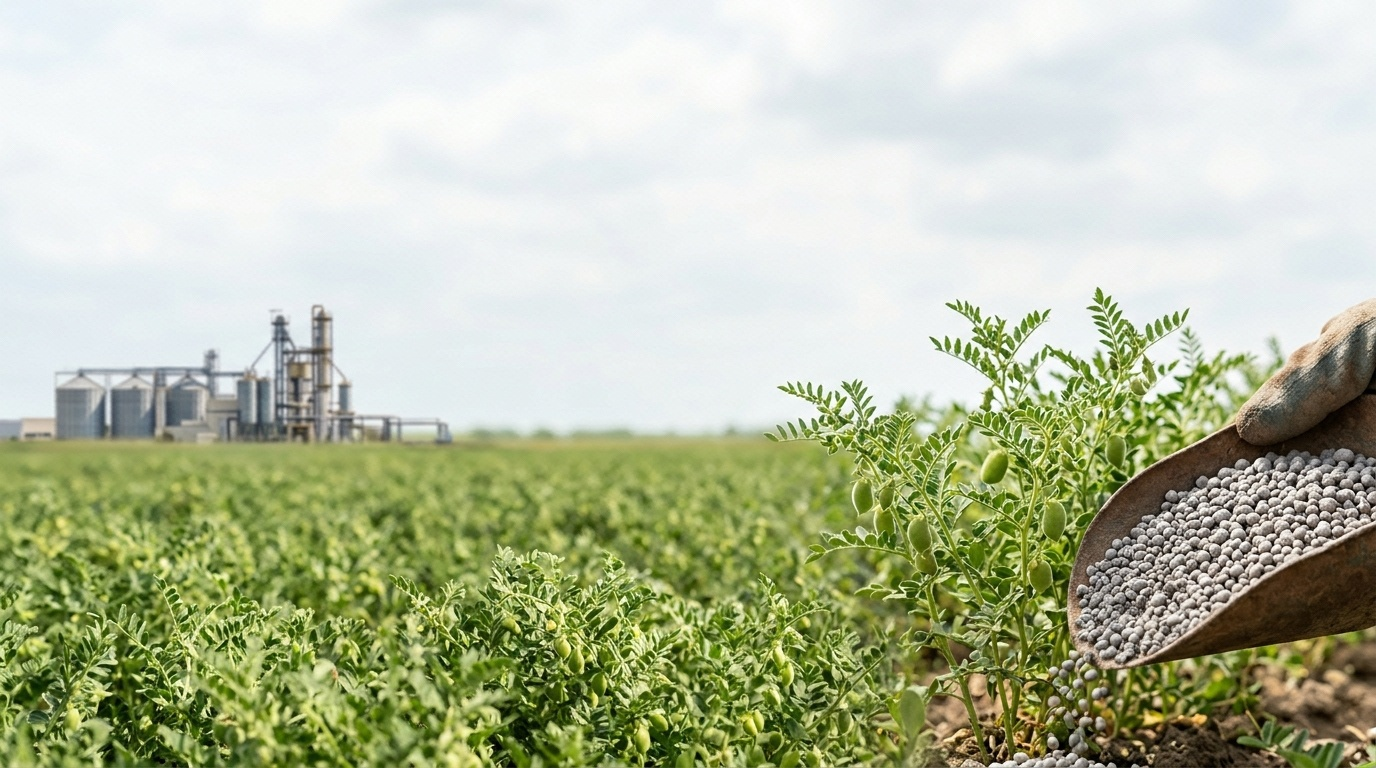
Pulses are not one uniform crop group. Chickpeas, lentils, dry peas, faba beans and common beans differ in nutrient demand, rooting patterns and sensitivity to starter fertilizers. SSP for pulses can be a practical phosphorus source where soil tests show a need for phosphorus and where sulfur or calcium is also required.
For fertilizer manufacturers and plant investors, however, the commercial question is more specific: can the plant produce consistent SSP with the nutrient composition and physical form that local pulse growers actually need?
The main advantage of SSP is its combination of phosphorus, sulfur and calcium. But it is not a complete NPK fertilizer, nor is it automatically suitable for every pulse crop or application method. Buyers should evaluate the agronomic market first, then decide which SSP grade and production configuration make commercial sense.
1. Why Is SSP for Pulses Worth Considering?
Phosphorus supports early root development, energy transfer, nodulation and crop maturity. Legumes can fix atmospheric nitrogen through their root nodules, but this biological process does not eliminate their phosphorus requirement.
When soil phosphorus is insufficient, an appropriate phosphorus fertilizer can support crop establishment and root development. This is one reason SSP for pulses is worth evaluating in regions where phosphorus deficiency is a limiting factor.
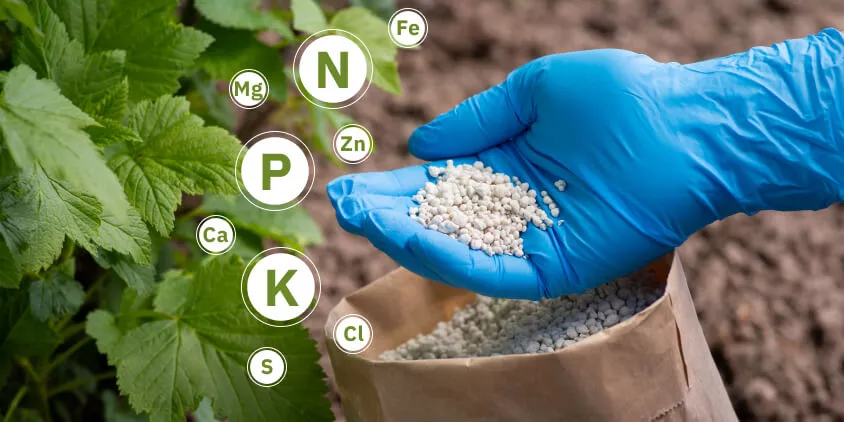
Single superphosphate contains monocalcium phosphate and calcium sulfate. The first supplies available phosphorus, while the gypsum fraction provides sulfur and calcium.
Many commercial SSP products are labelled around 16–20% P₂O₅, although actual grades vary according to product specifications and local standards. The nutrient contribution should always be checked against the supplier’s guaranteed analysis.
There is an important commercial qualification. If a field already has sufficient sulfur and calcium, SSP may not be the most economical way to supply phosphorus alone. More concentrated phosphate fertilizers can deliver more P₂O₅ per tonne of transported material.
Therefore, compare the cost per unit of plant-available phosphorus delivered to the farm, while accounting for the additional value of sulfur and calcium. Do not judge fertilizer competitiveness by the price per tonne alone.
2. Which Pulse Crops Are Suitable for SSP Fertilizer?
Chickpeas, lentils, field peas, faba beans, dry beans and soybeans are all pulses, but their fertilizer responses are not interchangeable.
Soil pH, available phosphorus, organic matter, texture, moisture, yield target and previous crop history all influence fertilizer recommendations.
SSP for pulses is most defensible when soil testing identifies a phosphorus requirement and sulfur or calcium is also beneficial. In acidic and calcareous soils, phosphorus availability can differ significantly, so local soil conditions must guide product selection.
| Pulse Crop | Nutrient Decision to Check | Practical Caution |
|---|---|---|
| Chickpea | Soil-test P and sulfur status | Seed is sensitive to concentrated fertilizer placed too close |
| Lentil | Phosphorus requirement and seed-row salt load | Avoid assuming high seed-placed rates are safe |
| Field Pea | P requirement and inoculation strategy | Excess starter nitrogen can interfere with effective fixation |
| Faba Bean | P and sulfur status | Assess seed-row placement separately |
| Dry Bean / Soybean | P requirement and local response data | Do not transfer chickpea recommendations without checking |
This table is a screening guide, not a fertilizer prescription.
For example, the Government of Saskatchewan notes that chickpea fertility requirements are not fully defined and recommends using soil tests. Research from the University of Saskatchewan also found that lentils, peas and chickpeas were among the pulse crops most sensitive to seed-row placed starter fertilizers.
The practical lesson is straightforward: SSP for pulses should be selected according to the crop and field, not simply because the product is marketed as a phosphorus fertilizer.
3. How Should SSP Be Applied Without Damaging Pulse Establishment?
The most easily overlooked issue is fertilizer placement.
A fertilizer can be suitable as a broadcast or banded phosphorus source and still cause emergence problems if concentrated directly beside the seed. Pulse seeds can be sensitive to soluble salts and ammonia in seed-placed fertilizer blends.
The risk is affected by:
- Fertilizer rate and nutrient concentration.
- Soil moisture at planting.
- Row spacing and opener spread.
- Soil texture and salinity.
- Fertilizer formulation and seed contact.
For SSP for pulses, the application plan should specify whether the fertilizer will be broadcast and incorporated, side-banded, mid-row banded or placed in the seed row.
Do not assume that suitability for pulse crops means direct seed placement is safe. Saskatchewan chickpea guidance specifically highlights seed sensitivity and recommends considering placement away from the seed when additional phosphorus is required.
A practical decision sequence is:
- Test the soil before planting.
- Calculate the crop’s phosphorus requirement.
- Check the guaranteed fertilizer analysis.
- Confirm a suitable placement method with local agronomic guidance.
- Monitor crop emergence and early root development.
Where sulfur is also required, check its chemical form and guaranteed content. SSP supplies sulfur through calcium sulfate, but buyers should verify the product label rather than relying on a generic description.
4. What SSP Product Specifications Should Buyers Check?
Fertilizer manufacturers selling into pulse-growing regions need a specification that can be tested, not just a marketing description.
SSP for pulses is not a separate chemical grade. It still needs to meet the nutrient and physical specifications agreed upon by the manufacturer and buyer.
| Specification | What to Request | Why It Matters |
|---|---|---|
| Total P₂O₅ | Guaranteed percentage and test method | Confirms total phosphorus content |
| Water-Soluble P₂O₅ | Guaranteed minimum | Helps evaluate soluble phosphorus |
| Sulfur (S) | Guaranteed percentage and reporting basis | Confirms sulfur contribution |
| Calcium | Guaranteed percentage and reporting basis | Important where calcium is part of the product value |
| Moisture | Maximum percentage at dispatch | Affects storage, caking and handling |
| Particle Size | Sieve range and tolerance | Influences spreading performance |
| Free Acid | Maximum limit and test method | Relevant to product quality and handling |
| Heavy Metals | Applicable market limits and test report | Supports market access and responsible sourcing |
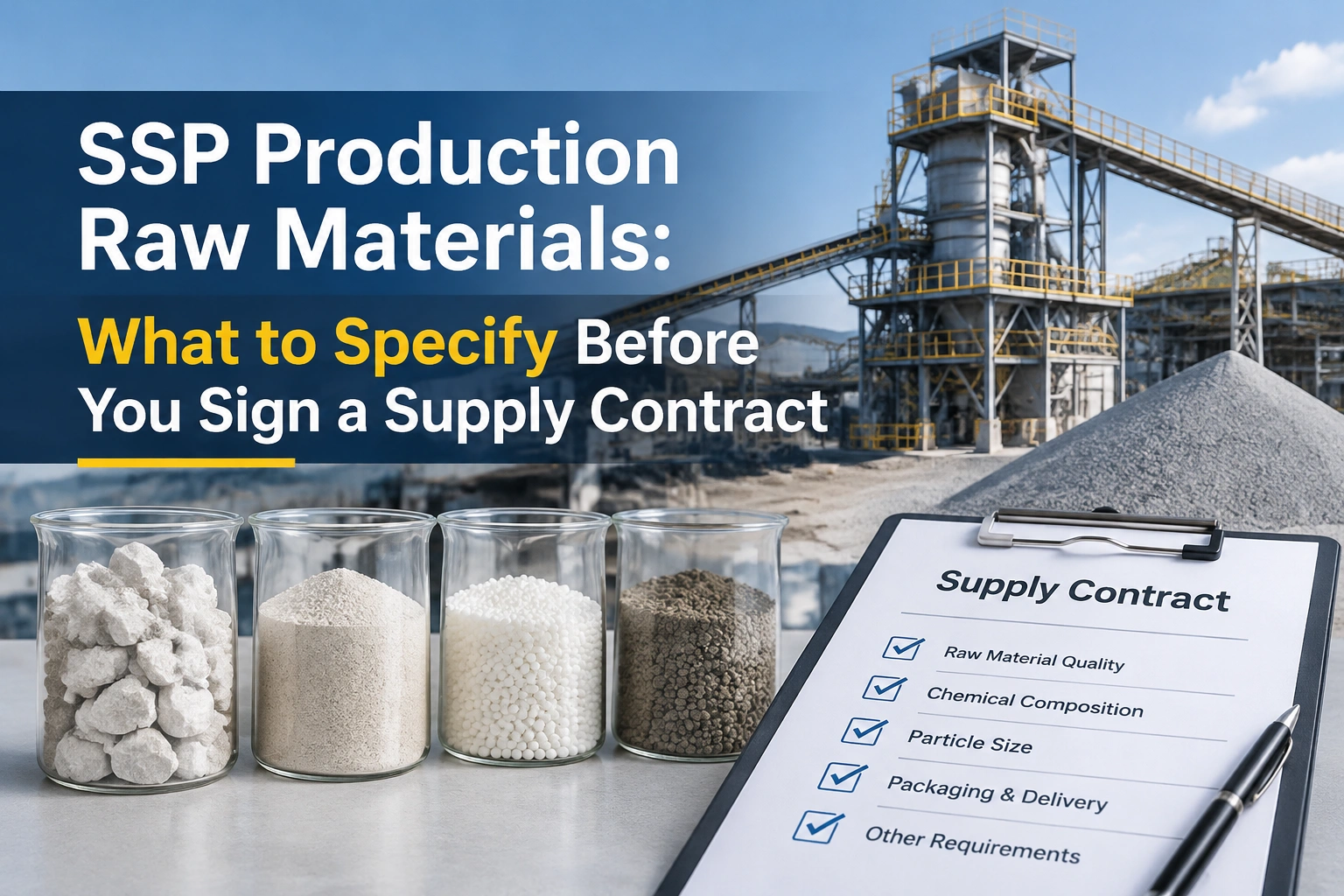
One common purchasing mistake is comparing two SSP quotations using P₂O₅ alone.
Check whether the supplier reports total or available P₂O₅, whether sulfur is expressed as S or SO₃, and whether moisture and particle size are measured on the same basis.
The FAO fertilizer specifications provide a useful reference for understanding fertilizer grades and the importance of stating commercial product specifications.
For manufacturers, these parameters should become part of the product guarantee and final acceptance criteria.

5. Granular or Powdered SSP: Which Product Form Should a Plant Produce?
The answer depends on the local market, not on which production process looks more modern.
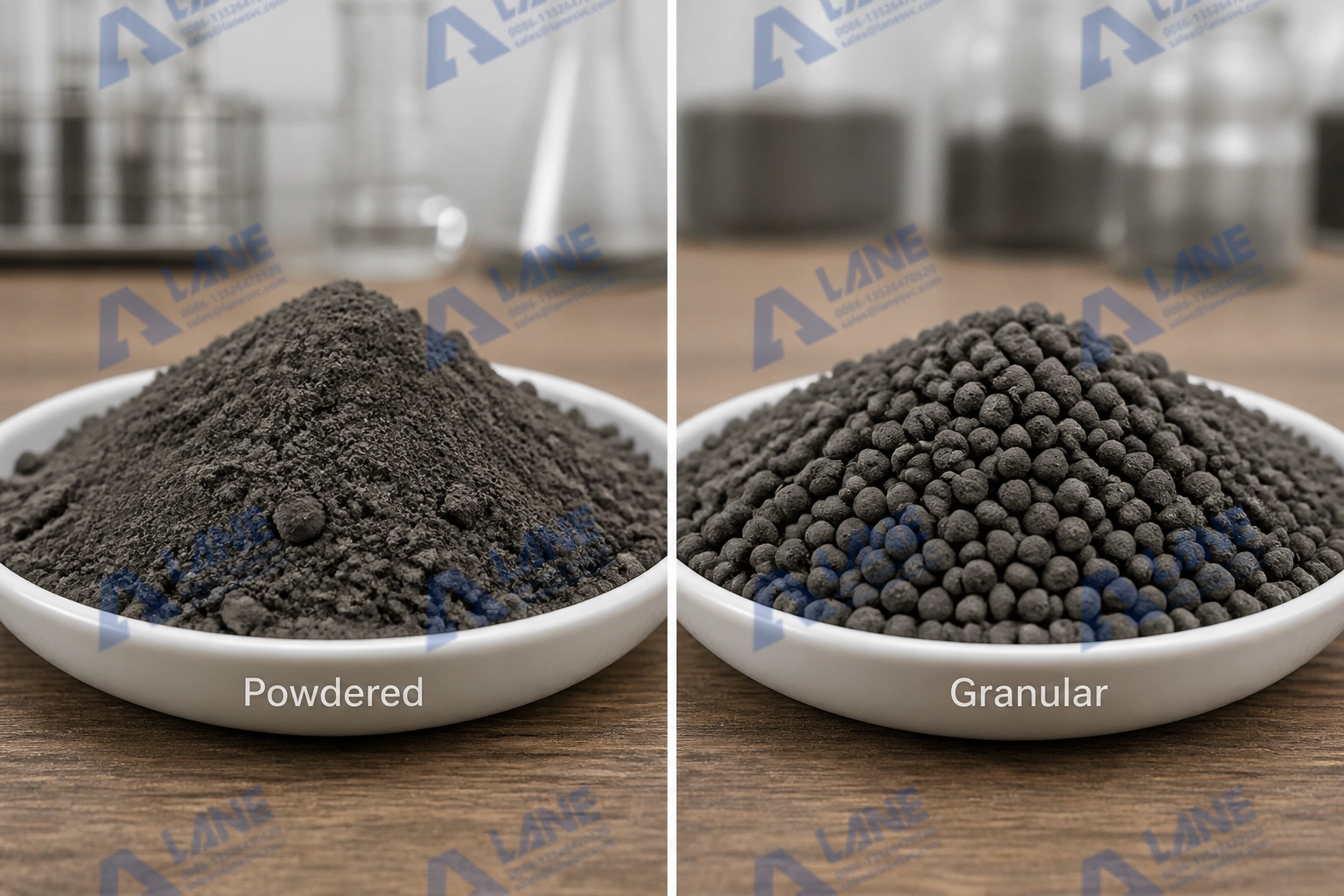
Powdered SSP can bypass the granulation section and may suit customers with established powder-handling and application systems. Its disadvantages include dust generation, handling losses and the need for careful storage management.
Granular SSP generally offers better flow and more convenient mechanical spreading. However, granulation adds equipment, recycle streams, drying and screening duties.
For SSP for pulses sold through distributors or supplied to farms using mechanical spreaders, granules may be commercially attractive. But a manufacturer should confirm the required particle-size range with actual customers before investing in additional equipment.
| Comparison | Granular SSP | Powdered SSP |
|---|---|---|
| Handling | Generally easier for bulk handling | More dust and handling considerations |
| Application | Suitable for many mechanical spreading systems | Depends on local application equipment |
| Storage | Physical stability depends on moisture and granule quality | Requires careful moisture and dust management |
| Production Route | Requires granulation and usually additional finishing equipment | Can bypass the granulation section |
| Investment | Higher equipment and utility requirements | Generally simpler finishing configuration |
The key point is that granular production is not automatically the better investment. If the local market mainly purchases powdered SSP, the additional granulation equipment may increase capital and operating costs without generating enough additional revenue.
6. What Equipment Is Required for an SSP Production Line?
A typical SSP manufacturing route begins with phosphate rock receiving, crushing and grinding. The prepared rock is metered and reacted with sulfuric acid in a mixer.
The reaction mass then moves through a den or setting conveyor, where it solidifies before being cut or disintegrated. The material is transferred for curing and subsequent finishing.
Depending on the final product specification, the plant can produce powder through milling and screening or add granulation, drying, cooling and screening to manufacture granular SSP.
The main equipment packages usually include:
- Phosphate rock receiving, crushing and grinding equipment.
- Raw material storage, weighing and conveying systems.
- Sulfuric acid storage, pumping and metering equipment.
- Acidulation mixer and den conveyor.
- Cutting, curing and reclaim systems.
- Optional granulator, dryer, cooler and screening equipment.
- Dust collection and acid-fume treatment systems.
- Finished-product storage and packaging equipment.
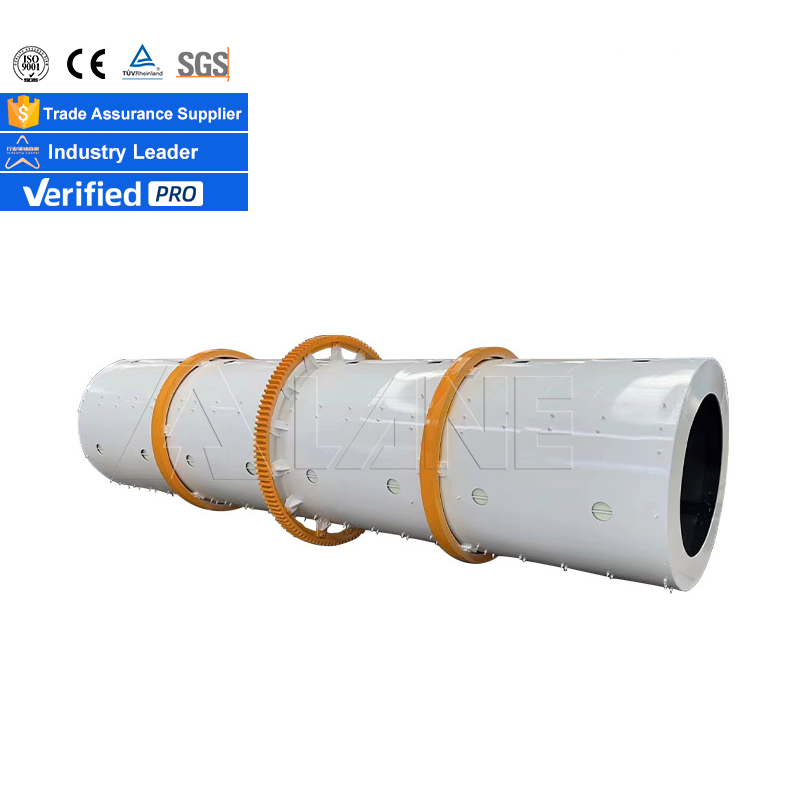
The basic chemical reaction involves phosphate rock and sulfuric acid, producing monocalcium phosphate and calcium sulfate. This process is described in the USDA/NRCS SSP technical reference.
For a plant targeting SSP for pulses, the equipment configuration should follow the required nutrient grade and physical product form.
7. How Should Buyers Evaluate SSP Plant Capacity and Investment?
Do not accept a capacity figure without defining its basis.
A supplier may quote tonnes per hour of raw material, wet intermediate, finished powder or saleable granules. These are not equivalent.
For SSP for pulses, the investment decision also depends on whether the plant can produce the product form required by regional customers, how much recycle material is generated and whether the market can absorb the planned output.
A low equipment quotation may become expensive if the plant has:
- High sulfuric acid consumption.
- Unstable reaction conditions.
- Excessive material losses.
- Poor curing capacity.
- High dust emissions.
- An undersized dryer or screening system.
- Frequent equipment maintenance requirements.
Before signing a contract, ask the supplier to provide:
- A process flow diagram and complete equipment list.
- Raw-material assumptions for phosphate rock and sulfuric acid.
- Guaranteed finished-product output and nutrient specifications.
- Expected utility consumption and recycle load.
- Dust and acid-fume collection scope.
- Installation boundaries and commissioning schedule.
- Operator training and spare-parts arrangements.
- A performance test protocol with defined sampling methods.
LANE’s SSP fertilizer production line website focuses on SSP and TSP production equipment. Its wider fertilizer machinery website also provides information about fertilizer production equipment and turnkey solutions.
Treat online capacity and performance claims as preliminary information. Require project-specific guarantees and reference checks before making a capital commitment.
8. FAQ About SSP for Pulses
1. Is SSP suitable for all pulse crops?
No. SSP can be suitable where phosphorus is needed and sulfur or calcium is also beneficial, but the application rate and placement depend on the crop and soil conditions.
2. Does SSP improve nitrogen fixation in pulses?
It can support the phosphorus nutrition required for healthy nodulation, but it does not replace appropriate inoculation or correct every limitation to biological nitrogen fixation.
3. Can SSP be placed directly with pulse seeds?
Not automatically. Chickpeas, lentils and peas can be sensitive to seed-row fertilizer, so placement and safe rates should follow local agronomic recommendations.
4. Does SSP supply nitrogen and potassium?
No. SSP mainly supplies phosphorus, sulfur and calcium. Nitrogen and potassium must be managed separately where required.
5. What is the usual P₂O₅ content of SSP?
Many commercial SSP grades contain approximately 16–20% P₂O₅, but buyers must confirm the guaranteed analysis and applicable local specifications.
6. Is granular SSP better than powdered SSP for pulses?
Not in every market. Granules are often easier to handle and mechanically spread, while powder may suit customers with appropriate powder-handling systems.
7. What capacity SSP production line should an investor choose?
Capacity should be based on verified regional demand, raw-material availability, operating days and the required product form. Compare guaranteed saleable output rather than nominal feed capacity.
8. What should an SSP plant quotation include?
It should include process design, equipment duties, raw-material assumptions, product guarantees, utility consumption, emission controls, installation scope, commissioning tests and after-sales support.
Conclusion: Build the SSP Project Around the Market
The strongest SSP project is not necessarily the one with the largest nominal capacity or the lowest equipment quotation. It is the one that matches local phosphate rock and acid supply, produces a grade customers can verify, controls dust and acid fumes, and makes the physical product form the market can handle.
For SSP for pulses, manufacturers should first confirm the agronomic demand in their target regions. They should then determine whether customers need powdered or granular products, establish realistic nutrient specifications and select equipment around those requirements.
For further product information, you can read our related guide: Is Single Superphosphate Good for Plants?.
For a project-specific equipment configuration, production capacity assessment or quotation, contact our team.
For more details, please feel free to contact us.
Henan Lane Heavy Industry Machinery Technology Co., Ltd.
Email: sales@lanesvc.com
Contact number: +86 13526470520
WhatsApp: +86 13526470520