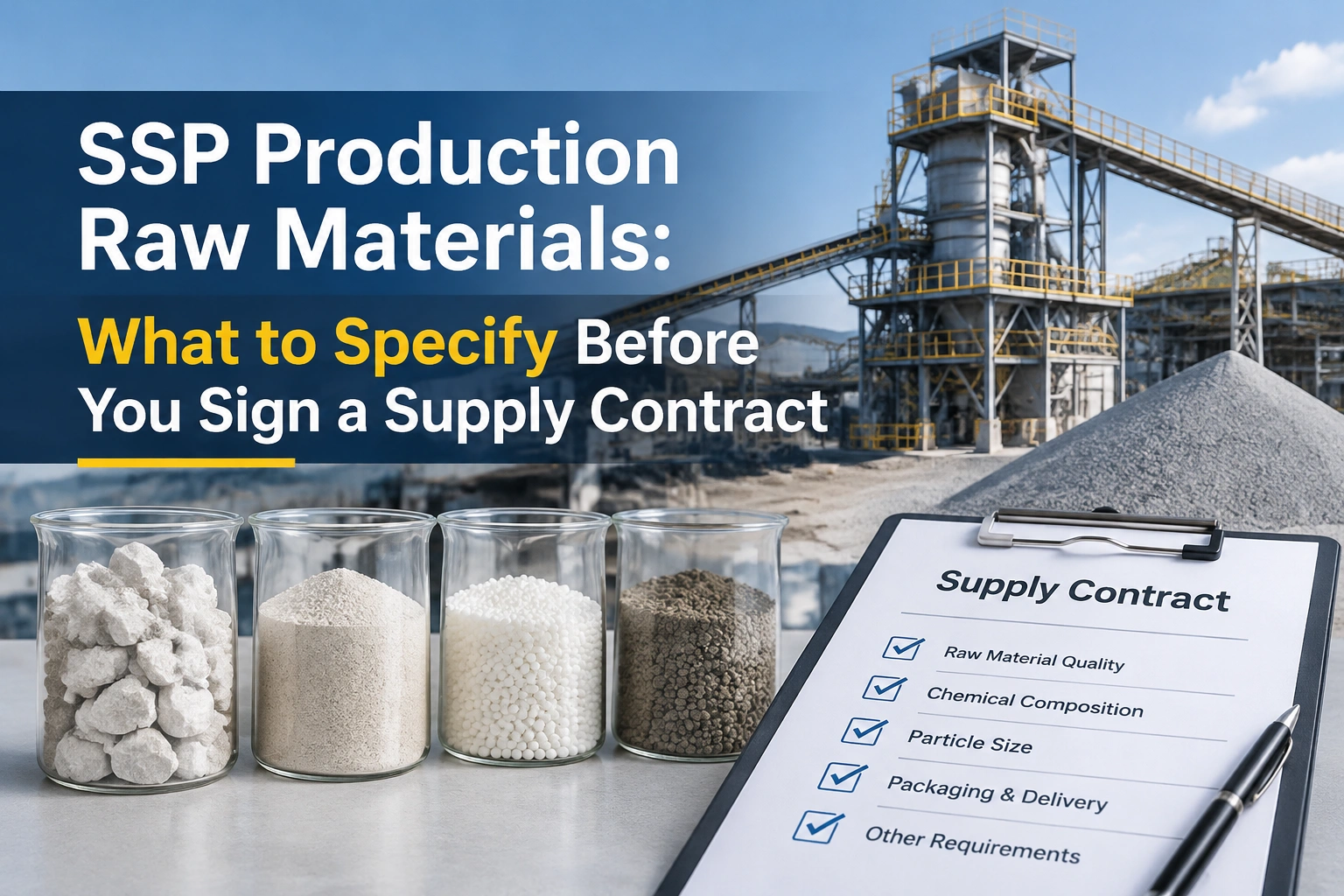
SSP Production Raw Materials: What to Specify Before You Sign a Supply Contract
- 2026-11-04
Two SSP plants can run the same equipment and produce different products, at different costs, from the same nominal “phosphate rock.” The difference is in the specification nobody wrote down.
SSP production raw materials are 60 to 70 percent of production cost, and they set the plant’s operating limits before the first bag is filled. Get the rock chemistry wrong and no amount of process tuning fixes the available P2O5. Get the acid concentration wrong and the reaction either scorches or stalls.
This guide covers SSP production raw materials in the order that decides money: what to specify, how each one affects the plant, and which numbers belong in the supply contract rather than in a certificate of analysis filed away after delivery.
Why SSP production raw materials decide the economics
SSP is a conversion business, and rock phosphate price is only half of it. You buy phosphate units, spend sulfuric acid to make them water-soluble, and sell a product at 16 to 20 percent P2O5. The margin sits in the spread between the cost of those units and the price of the finished ton.
That means three numbers dominate: the P2O5 content of the rock, the acid consumption per ton of rock, and the product yield. All three move with the phosphate rock specification and the acid contract, and all three are knowable before you order equipment.
A rock delivering 30 percent P2O5 with low carbonate and low iron will produce roughly 1.6 to 1.8 tons of SSP per ton of rock, at an acid rate around 0.6 tons per ton. A rock with the same headline P2O5 but 6 percent carbonate and 4 percent iron-aluminum will consume more acid, produce a stickier reaction mass, and give up part of its water-soluble phosphorus during curing.
Same purchase order. Different plant.
Phosphate rock specification: the six numbers that matter
P2O5 content. Commercial rock for SSP runs 28 to 32 percent, with higher grades available at a premium. The headline number sets the product analysis and the freight cost per nutrient unit.
Calcium oxide to P2O5 ratio. This is the specification most buyers never see. A ratio around 1.4 to 1.6 is comfortable. Above 1.6, the rock carries excess lime that consumes acid without making product, and the reaction mass gets difficult to handle.
Iron and aluminum oxides. Combined R2O3 above roughly 3 to 4 percent causes phosphorus reversion, where water-soluble P converts to a citrate-soluble form during curing and drying. The buyer pays for available P and receives less of it.
Carbonate content. Every percent of CO2 in the rock consumes sulfuric acid in a side reaction that produces gypsum and gas, not product. As a planning rule, one percent CO2 takes roughly 22 kilograms of acid per ton of rock. It also foams in the reactor.
Silica and hardness. Silica is abrasive and raises grinding cost. Hardness, expressed as a Bond work index, decides mill throughput and liner wear. A hard rock can halve the capacity of a mill sized on a softer one.
Cadmium and heavy metals. Sedimentary rocks carry more cadmium than igneous rocks. If the product is destined for the European Union, Regulation (EU) 2019/1009 sets cadmium limits for phosphate fertilizers, and the rock source becomes a market-access decision, not just a cost decision, and it belongs in the phosphate rock specification rather than in a footnote.
The rock property no certificate reports
Reactivity.
Two rocks with identical chemical analysis can react at different speeds depending on mineralogy and crystal structure. A certificate of analysis reports chemistry; it does not report how quickly that chemistry will give up its phosphate in your reactor.
The practical answer is a bench acidulation test on a representative sample before you commit to a supply contract. It takes a laboratory a few days and produces the numbers you actually need: acid requirement, conversion rate, product analysis, and physical behavior of the mass.
Suppliers who object to a bench test are telling you something about their confidence in the rock.
Sulfuric acid: concentration, impurities, and dilution
Sulfuric acid arrives at 93 to 98 percent and is diluted to roughly 68 to 72 percent before it meets the rock. Both the delivered concentration and the dilution step affect the plant.
Concentration. Acid that is too strong reacts violently and can scorch the mass, producing a hard, unworkable cake. Acid that is too dilute leaves the mixture wet and plastic, which carries moisture into curing and lowers conversion.
Impurities. Chloride and fluoride in the acid accelerate corrosion in the dilution skid and the reactor. Heavy metals in the acid end up in the product and count against the contaminant limits on the label.
Dilution heat. Dilution is strongly exothermic. A skid without proper heat removal will damage seals and instruments, and it is a common source of unplanned downtime in the first year.
Supply security. Acid is often the constraint that stops production, not the rock. A plant running at 80 percent capacity because acid deliveries slipped is a plant with a raw material strategy problem, not an equipment problem.
Water, fillers, and neutralizers
Process water. Chloride content matters in a plant handling acid, and hardness matters if the water is used in the scrubber. Specify it once, in the design basis.
Limestone or dolomite. Used to neutralize residual free acid after curing. The specification is fineness and carbonate content, and the dose is set by the free acid target, typically a few percent expressed as P2O5.
Coating agents. For granular product, an anti-caking coating is part of the raw material plan, not an aftermarket idea, especially in humid climates.
How rock choice changes the acid rate
Acid consumption is not a fixed number. It is a function of the rock.
The stoichiometric requirement for pure fluorapatite is about 0.68 tons of acid per ton of rock. Commercial rock needs less per ton because it carries less P2O5 and more gangue, but the gangue itself consumes acid when it is carbonate.
Work the number for your rock before you commit:
P2O5 content sets the stoichiometric base. Carbonate adds a side reaction. A small excess, typically 2 to 5 percent, is normal practice to drive conversion. Iron and aluminum do not consume much acid directly, but they cost you available P later.
This is also where rock phosphate price and rock quality meet. A cheaper rock with high carbonate can cost more per ton of finished product than a premium rock, because you are buying acid to neutralize impurities.
What belongs in the supply contract
A certificate of analysis is a snapshot. A contract is a commitment. Put six things in it, starting with the phosphate rock specification.
The P2O5 content with a tolerance and a penalty mechanism. The CaO to P2O5 ratio range. Maximum R2O3 and CO2. Cadmium and heavy metal ceilings by market. Particle size distribution and moisture at delivery. And the sampling and assay method, named explicitly, so that a dispute has a procedure rather than an argument.
For acid, specify concentration, chloride, and the delivery schedule with a reliability clause. For limestone, specify fineness and carbonate content.
Receiving control
A phosphate rock specification is only as good as the sampling behind it. Test every incoming lot, not every tenth.
Sampling matters more than people expect, because rock is heterogeneous and a grab sample from the top of a heap proves very little. Use an incremental sampling procedure and composite the sample before assay.
Test P2O5, CO2, R2O3, moisture, and fineness at minimum. Keep the results against the supplier lot number, and review the trend monthly. A supplier whose CO2 creeps up over six months is quietly raising your SSP production raw materials bill.
Cost exposure to plan for
Rock phosphate price is not the same as raw material cost. Three exposures sit around it.
Freight per nutrient unit. Rock moves by sea and then by truck, and the freight cost per ton of P2O5 changes the ranking of suppliers. A rock phosphate price quoted per ton tells you nothing until it is converted to cost per ton of P2O5 delivered.
Currency. Rock and acid are usually dollar-denominated. If the product sells in local currency, the spread moves with the exchange rate, and that exposure belongs in the financial model.
Working capital. Sixty to ninety days of raw material inventory is normal for a plant that cannot afford to stop. That is cash tied up before the first sale.
FAQ
What are the main SSP production raw materials?
Phosphate rock at 28 to 32 percent P2O5 and sulfuric acid at 93 to 98 percent, plus dilution water, limestone or dolomite for neutralization, and a coating agent for granular product.
What phosphate rock specification is best for SSP?
A rock with 28 to 32 percent P2O5, a CaO to P2O5 ratio near 1.4 to 1.6, R2O3 below 3 to 4 percent, and low carbonate. Reactivity has to be confirmed by a bench acidulation test.
How much sulfuric acid does a ton of SSP need?
Roughly 0.6 tons of acid per ton of rock at 30 percent P2O5, before adjusting for carbonate. Carbonate adds consumption: about 22 kilograms of acid for every percent of CO2 in the rock.
Does rock quality affect product quality?
Yes. High iron and aluminum cause phosphorus reversion, reducing water-soluble P. High carbonate consumes acid and produces more gypsum per ton of product.
What is the typical rock phosphate price?
Rock phosphate price is quoted per ton and moves with P2O5 content, origin, and freight. The useful comparison is cost per ton of P2O5 delivered, not cost per ton of rock.
How do I test a new rock source?
Run a bench acidulation test on a representative composite sample. It returns acid requirement, conversion, product analysis, and physical behavior before you commit to a shipment.
What about cadmium limits?
The European Union sets cadmium limits for phosphate fertilizers under Regulation (EU) 2019/1009. Check the rock source against your target market before signing a long-term contract.
Can I blend rocks from two sources?
Yes, and many plants do to control cost and chemistry. Blend on paper first, using weighted analysis, then confirm with a bench test before running the blend through the plant.