SSP Fertilizer Plant Investment Cost Analysis & ROI Guide
- 2026-06-06
If you’ve been researching single superphosphate production, you already know the question every prospective investor asks first: how much does it actually cost? And more to the point — when do you start making your money back? This guide delivers a complete SSP fertilizer plant investment cost analysis, covering raw material sourcing, equipment requirements, operating overhead, and realistic ROI timelines. No filler. Just the numbers and strategic decisions that move a project forward.
What Is an SSP Fertilizer Plant?
Single superphosphate (SSP) is one of the oldest phosphate fertilizers still in widespread commercial use — and for good reason. It delivers both phosphorus and sulfur in one product, which makes it especially valuable in sulfur-deficient soils across Sub-Saharan Africa, South Asia, and parts of Latin America. An SSP fertilizer plant is a chemical processing facility that reacts phosphate rock with sulfuric acid to produce a water-soluble fertilizer containing roughly 16–20% P₂O₅.
What tends to surprise first-time investors is how relatively accessible the chemistry is. The reaction is exothermic, feedstocks are globally available, and demand is stable and well-understood. Compared to DAP or MAP production — which involve stricter raw material purity requirements and more capital-intensive process infrastructure — an SSP fertilizer plant represents one of the more practical entry points into industrial fertilizer manufacturing. That said, succeeding commercially requires the same disciplined planning as any large-scale industrial investment. Scale, site selection, and supply chain structure all matter enormously.
SSP Fertilizer Production Process
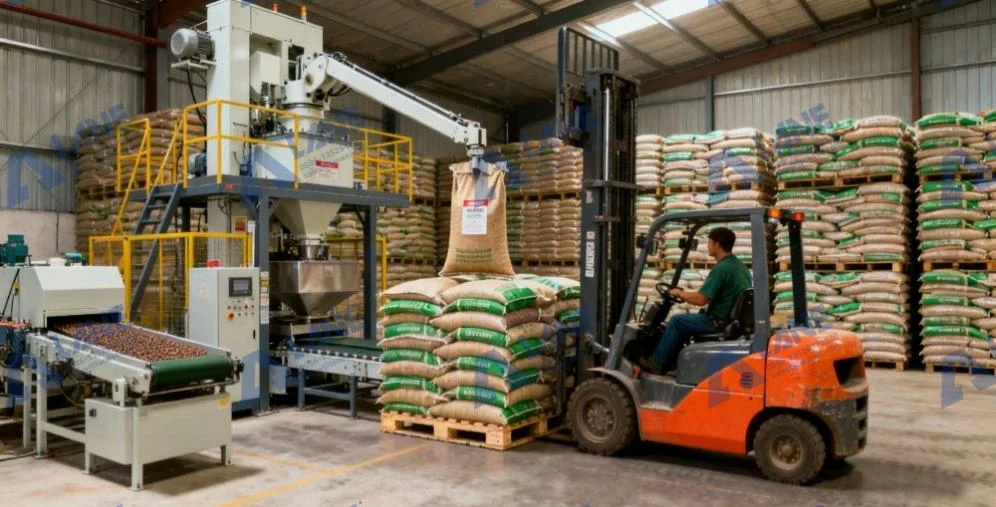
The core production sequence runs like this: phosphate rock is milled to a fine particle size, then reacted with dilute sulfuric acid in a den mixer. The resulting slurry enters a curing phase before being granulated, dried, cooled, screened, coated where required, and finally packaged for distribution.
From what I’ve seen in the field, the curing stage is where underprepared operations consistently run into trouble. Insufficient curing time means an incomplete chemical reaction, which directly depresses your P₂O₅ availability readings and undermines product quality at point of sale. Any responsible SSP fertilizer plant investment cost analysis must budget for adequate curing pit capacity. The temptation to shrink this footprint to save on civil construction is real, but it’s a cost-cutting decision that shows up in every bag you sell downstream.
Main Equipment Required
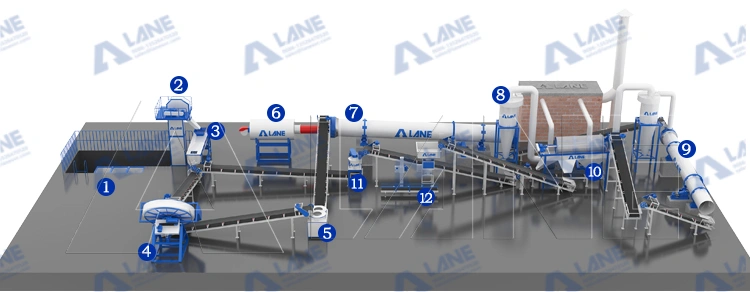
A fully operational SSP fertilizer plant depends on a well-matched set of processing units. Each piece plays a defined role in throughput, product consistency, and regulatory compliance:
Raymond mill — Fine grinding to target particle size, typically 80–100 mesh
Acid mixing reactor — The core chemical reactor where phosphate rock and sulfuric acid combine
Chain crusher — Breaking down cured SSP slabs ahead of granulation
Rotary drum granulator — Converting SSP powder into uniform, market-ready granules
Rotary drum dryer — Removing post-granulation moisture from finished granules
Rotary drum cooler — Reducing granule temperature prior to screening and bulk storage
Vibrating screen — Classifying product into on-spec, oversize, and fines fractions
Coating machine — Applies anti-caking agents or functional micronutrient coatings where specified
Automatic packing machine — Final bagging in 25 kg, 50 kg, or bulk formats
Dust collection system — non-negotiable for regulatory compliance and worker safety
SSP Fertilizer Plant Investment Cost Analysis
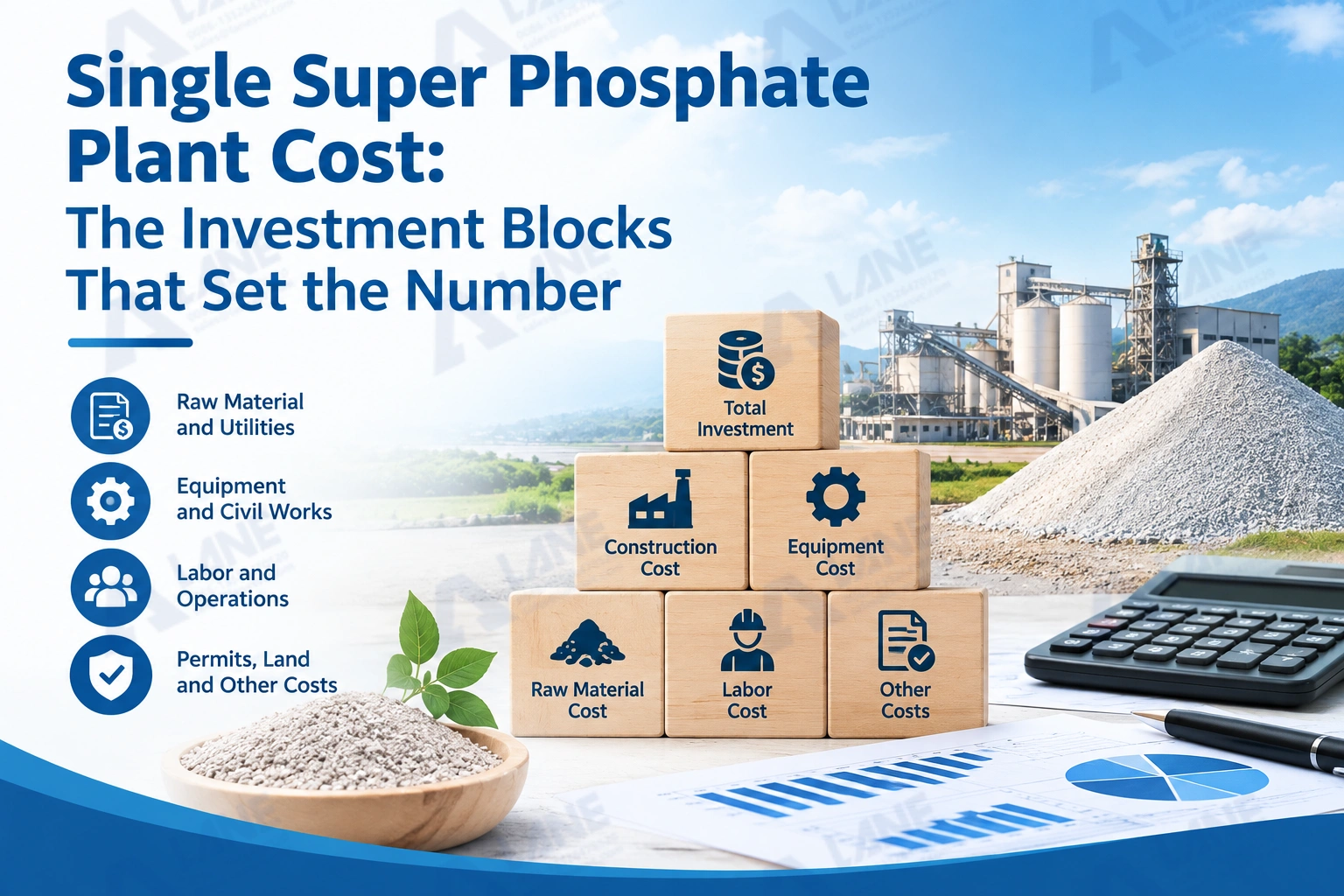
There is no universal figure. A thorough SSP fertilizer plant investment cost analysis always depends on production scale, site location, automation level, and whether you’re building greenfield or adapting an existing industrial site.
For a small-scale SSP fertilizer plant producing 10,000–30,000 MT per year, total capital expenditure typically falls between USD 800,000 and USD 2.5 million. A mid-scale SSP fertilizer plant targeting 50,000–100,000 MT per year generally requires USD 3 million to USD 7 million. Large industrial-scale facilities above 150,000 MT per year can reach USD 10 million or more, depending heavily on civil construction scope and sulfuric acid supply infrastructure.
These figures cover equipment procurement, installation, electrical and utility systems, basic civil works, and initial working capital. They exclude land acquisition and permitting costs, which vary too widely across markets to generalize reliably.
Factors Affecting Project Cost
Location and logistics — An SSP fertilizer plant built near phosphate rock sources saves substantially on inbound freight costs.
Automation level — Fully automated lines with PLC-controlled batching and remote monitoring carry higher upfront costs but reduce labor dependency and quality variance.
Sulfuric acid supply — Externally sourced acid requires substantial storage infrastructure and a dependable supply chain.
Regulatory compliance — Acid fume scrubbing systems, effluent treatment, and occupational health monitoring requirements vary by jurisdiction.
Raw Material Requirements
Per metric ton of SSP product, standard process input ratios run approximately 650–700 kg of phosphate rock at 28–32% P₂O₅ grade and 280–320 kg of dilute sulfuric acid at 65–75% concentration.
Operating Costs
Annual operating costs for a 50,000 MT per year SSP fertilizer plant break down approximately as follows:
Raw materials: 55–65%
Energy: 10–15%
Direct labor: 8–12%
Maintenance and consumables: 5–8%
Overhead, logistics, and quality management: remaining percentage
Estimated Revenue
SSP fertilizer trades between USD 150 and USD 280 per metric ton globally, depending on destination market, product grade, and packaging format.
A 50,000 MT per year SSP fertilizer plant at USD 200 per ton average realization generates approximately USD 10 million in annual gross revenue.
ROI Calculation
Using the 50,000 MT per year scenario as a working model:
Capital investment: USD 5 million
Annual operating cost: USD 7.5 million
Gross margin: approximately USD 2.5 million
Simple payback period: around 2 years
Full ROI window: typically, 3–5 years
How to Reduce Investment Costs
Phase production capacity rather than building maximum capacity immediately.
Standardize equipment specifications to reduce spare parts and maintenance costs.
Work with suppliers who understand SSP-specific process chemistry and equipment requirements.
Why Choose LANE Heavy Industry
For investors conducting a serious SSP fertilizer plant investment cost analysis, equipment supplier selection carries real long-term consequences for project economics. LANE Heavy Industry provides complete SSP fertilizer production solutions, including crushing, milling, granulation, drying, cooling, screening, and packaging systems. With project experience across Africa and Asia, LANE helps clients reduce procurement complexity and lower long-term operating costs.

FAQ
Q1: What is the minimum investment required to start an SSP fertilizer plant?
A: Entry-level projects producing 10,000–20,000 MT per year typically require USD 800,000 to USD 1.5 million.
Q2: How long does an SSP fertilizer plant project take to complete?
A: Most projects require approximately 8–14 months from equipment ordering to commissioning.
Q3: What phosphate rock grade is suitable for SSP production?
A: Rock containing 28–32% P₂O₅ is generally considered ideal.
Q4: Is SSP fertilizer production profitable in African markets?
A: Yes. Demand remains strong due to phosphorus-deficient soils and government fertilizer support programs.
Q5: What are the primary environmental compliance requirements?
A: Acid fume scrubbing, wastewater treatment, dust suppression, and occupational safety monitoring.
Q6: How does SSP compare to TSP or DAP as an investment opportunity?
A: SSP requires lower capital investment and has simpler process requirements, making it an attractive option for regional fertilizer markets.
For more details, please feel free to contact us.
Henan Lane Heavy Industry Machinery Technology Co., Ltd.
Email: sales@lanesvc.com
Contact number: +86 13526470520
Whatsapp: +86 13526470520