Wet Process SSP Fertilizer Production Line: The Complete Guide for Fertilizer Manufacturers
- 2026-07-23
A fertilizer plant owner in Uttar Pradesh told me something last year that stuck. He’d spent eighteen months researching SSP lines, talked to seven suppliers across three countries, and still couldn’t get a straight answer about which process — wet or dry — actually made sense for his raw material.
He’s not alone.
The wet process SSP fertilizer production line (also called the concentrated acid rock paste method) has been around since the 1960s. It’s proven technology. But most of what’s written about it online is either a supplier brochure that skips the hard parts, or a regulatory filing that reads like a chemistry textbook had a baby with a legal contract.
This guide is different. It’s written for someone who needs to make a real purchasing decision — whether you’re a factory owner evaluating a greenfield plant, an engineer comparing equipment configurations, or an investor sizing up a fertilizer project. No fluff. Just what actually matters.
What Is the Wet Process SSP Production Method?
Single Super Phosphate is the oldest phosphate fertilizer in commercial use. The chemistry is straightforward: you react phosphate rock with sulfuric acid, and the insoluble tricalcium phosphate in the rock converts to water-soluble monocalcium phosphate — the form plants can actually absorb.
The reaction:
2Ca₅(PO₄)₃F + 6H₂SO₄ + 3H₂O → 6CaSO₄ + 3Ca(H₂PO₄)₂·H₂O + CaF₂
What separates the wet process from the dry method is how you prepare the rock before that reaction happens.
In the dry method, you grind phosphate rock into a fine dry powder (90% passing 147μm sieve), then react it with dilute sulfuric acid at 60–78% concentration. Fine. It works. But the grinding step kicks up enormous amounts of dust — silica-heavy, respiratory hazard level dust. You need serious containment. You’ll spend real money on dust collection alone.
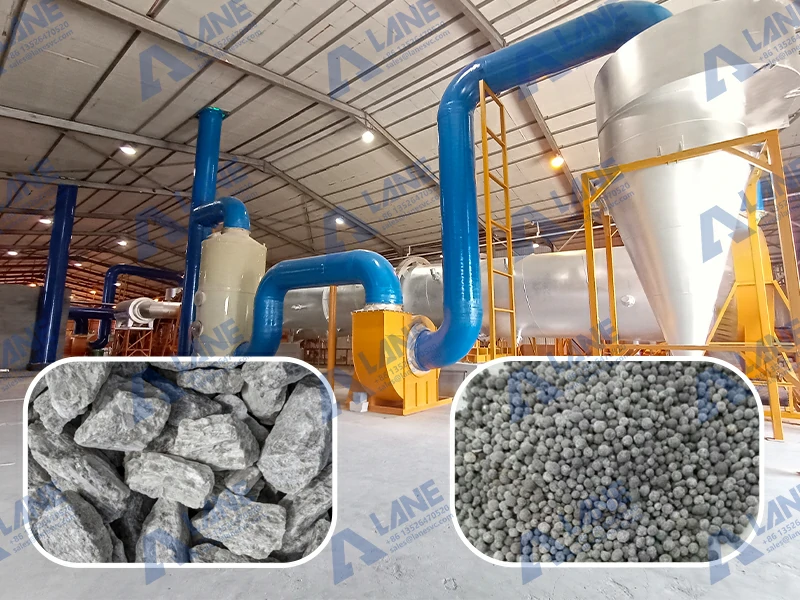
The wet process takes a different approach. You add water to the rock phosphate during grinding, milling it into a flowable paste at 26–28% moisture. Then you react that paste with concentrated sulfuric acid at 93–98%. No dust. None. The rock paste flows through enclosed equipment from grinding to mixer without ever going airborne.
That single difference — grinding wet instead of dry — cascades through the entire plant design. It changes your equipment choices, your environmental compliance path, your operating costs, and the capital you need upfront. If you’re comparing quotes from different suppliers and one is $200K cheaper, check which process they’re quoting. The dry method equipment costs less. The wet method costs less to operate and comply. Pick your trade-off with your eyes open.
| Parameter | Wet Process (Concentrated Acid Paste) | Dry Process (Dilute Acid Ground Rock) |
|---|---|---|
| H₂SO₄ concentration | 93–98% | 60–78% |
| Rock preparation | Wet-ground paste, 26–28% moisture | Dry-ground powder, 90% < 147μm |
| Dust generation | Near zero | Significant — requires containment |
| Mixer temperature | ~110°C (exothermic) | ~110°C (exothermic) |
| Curing time | 5–21 days (rock-dependent) | 5–21 days (rock-dependent) |
| Fluorine loss | Often below 5% | Higher without equivalent scrubbing |
| Environmental compliance cost | Lower | Higher |
How a Wet Process SSP Fertilizer Production Line Works: Step by Step
A single-series wet process SSP line can produce anywhere from 30,000 to 400,000 metric tons per year. The process has been scaled and de-risked across hundreds of plants, mostly in China, India, and Southeast Asia. Here’s how it works end to end.
Step 1: Rock Phosphate Receiving and Storage
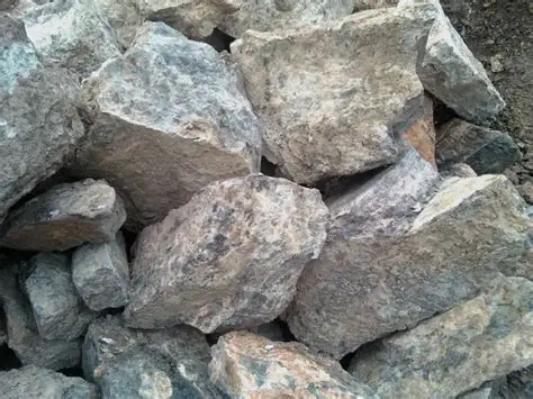
Rock phosphate arrives by truck or rail. Quality matters here more than anywhere else in the process. You want rock with P₂O₅ content at or above 31%. Lower-grade rock still works, but your acid consumption goes up and your product grade drops. For a 50,000 MT/year plant, budget for roughly 12,000 MT of covered rock storage — wet rock is miserable to grind, even in the wet process.
“Covered” is the operative word. Rain hitting your rock pile before grinding throws off the moisture balance in your paste preparation. I’ve seen plants lose 2–3% conversion efficiency because their rock storage was open to weather. The fix is simple: a roof. The cost of not having one shows up in your P₂O₅ recovery for the life of the plant.
Step 2: Wet Grinding — The Heart of the Process
This is where the wet process earns its name. Rock phosphate enters a ball mill or vertical roller mill along with a controlled water feed. The mill grinds the rock to 90–93% passing a 100-mesh (147μm) sieve while simultaneously creating a pumpable slurry at 26–28% moisture.
Key equipment in this section:
- Ball mill or vertical roller mill — 5–8 MT/hr per unit for a mid-size line. Vertical roller mills use less power per ton but cost more upfront. Ball mills are simpler, cheaper, and more forgiving with maintenance teams that aren’t PhD-level.
- Ground rock hopper — 30–40 MT buffer capacity. The hopper feeds the mixer, and you don’t want the mixer waiting on the mill.
- Bucket elevators and screw conveyors — Material transfer. Size these for 30–40 MT/hr to avoid bottlenecks.
A detail most spec sheets skip: the rock paste’s flowability isn’t automatic. Some rock types produce a paste that’s too viscous to pump reliably. Additives (activating foaming agents, developed largely by Zhengzhou University’s research group) can improve flowability and simultaneously boost conversion rates by 3–15%. Whether you need them depends on your rock source. Ask your supplier to run a bench-scale test on your actual phosphate rock before they finalize the equipment sizing. If they won’t do that, find a different supplier.
Step 3: Acid Storage and Handling
Concentrated sulfuric acid (93–98%) needs serious storage infrastructure. For a medium-scale plant, that means:
- Mild steel horizontal cylindrical storage tanks — 4,000 MT capacity isn’t unusual for plants with on-site acid production. If you’re buying acid by tanker, 500–1,000 MT is more typical.
- Acid day tank — 10–15 MT. This is your working reservoir that feeds the mixer.
- Acid dilution unit — Because even in the wet process, you don’t feed 98% acid directly. Most plants dilute to 68–75% before the mixer. The dilution step generates heat — design your piping accordingly.
- Rotameter and control valves — Precision acid metering. Get this wrong and your entire stoichiometric ratio collapses.
Acid handling is the part of the plant where safety protocols aren’t optional. Every joint, every valve, every pump seal needs a written inspection schedule. Sulfuric acid leaks don’t announce themselves politely.
Step 4: Mixing — Where the Reaction Happens
Ground rock paste and dilute sulfuric acid meet in the mixer. This is the single most important piece of equipment in your line.
The standard choice is a paddle mixer, lead-lined and AHR (acid/heat-resistant) brick-lined for corrosion protection. Retention time is roughly 2.5 to 4 minutes. The reaction is violently exothermic — temperatures spike to about 110°C. In those few minutes, roughly 70% of the P₂O₅ conversion completes. The slurry that comes out thickens rapidly as it moves toward the den.
There’s a newer alternative worth knowing about: the jet mixer, designed by Yang Kedun’s team, which uses the kinetic energy of the acid stream itself for mixing — no motor, no paddles, zero mixing energy consumption. It’s not yet the industry default, but plants that use it report lower maintenance costs because there’s simply less that can break. If your electricity costs are high, it’s worth asking suppliers about.
The gases released during mixing — mainly silicon tetrafluoride (SiF₄) and hydrogen fluoride (HF) — get pulled by an ID fan into the scrubbing system. This isn’t optional. Fluorine gas is toxic. Your environmental permit depends on capturing it.
Step 5: The Den — Solidification Under Control
The slurry discharges onto a slow-moving enclosed conveyor called a den. Think of it as a continuous reaction chamber on a belt. Over the next 35–45 minutes, the material solidifies from slurry into a porous cake while another 15–20% of the reaction completes.
Den configurations:
- Broadfield Den (reciprocating) — Capacities from 10 to 100 TPH. The reciprocating motion prevents the cake from sticking to the sides as it expands during solidification. This is the workhorse for mid-to-large plants.
- Belt Den — Capacities from 1 to 50 TPH. Simpler design, lower capital cost, fine for smaller operations.
- Slat Conveyor Den — Horizontal or circular travel. Less common but works for constrained layouts.
At the discharge end, a rotary cutter slices the solidified cake into chunks small enough for the curing pile. The den is fully enclosed and connected to the scrubbing system — more gases evolve here, and they need the same treatment as the mixer gases.
Step 6: Curing — Patience Pays
The cut material gets heaped in a covered curing shed via EOT crane with a grab bucket. Curing lasts 5 to 21 days. The range is wide because it depends entirely on your rock phosphate’s reactivity. Moroccan rock generally cures faster; Chinese and Indian rock sources can take longer.
What happens during curing? The remaining 10–15% of the reaction completes. Free acid content drops. The product stabilizes. Regular reshuffling and aeration of the heaps — done by the same EOT crane — evens out the curing and prevents hot spots where unreacted acid can concentrate.
A 50,000 MT/year plant needs about 20,000 MT of curing shed capacity. That’s a lot of covered space. Don’t skimp on it. Under-cured SSP bags hot, cakes in storage, and eats through woven PP bags. Your customers notice. They don’t reorder.
Step 7: Gas Scrubbing — The Zero-Effluent Loop
The wet process has a built-in environmental advantage: a properly designed scrubbing system can achieve zero liquid effluent discharge.
Here’s how it works. Gases from the mixer, den, and curing areas get pulled by an ID fan through a multi-stage scrubbing system — typically 3 to 4 venturi scrubbers in series, followed by cyclones and water scrubbers. The scrubbing liquor converts SiF₄ and HF into hydrofluorosilicic acid (H₂SiF₆) at 8–15% concentration.
That H₂SiF₆ solution doesn’t become waste. It gets recycled back to the mixer, where it dilutes the incoming sulfuric acid. The loop closes. Silica precipitates out and can be filtered off as a saleable by-product (used in water fluoridation, aluminum production, and ceramics).
If your plant location has strict fluoride emission limits — and most do now — the wet process’s scrubbing efficiency (90–95%+ capture) becomes a major selling point during permitting. Some jurisdictions won’t even approve dry process plants without equivalent retrofits, which erases the dry method’s capital cost advantage.
Step 8: Finishing — Powder or Granules
After curing, you have Powder SSP (PSSP). It screens for lumps, goes through a lump breaker, and gets bagged in 50 kg PP or HDPE woven bags. Done. This is the simplest product form and the majority of SSP sold in South Asia is powder.
But if your market wants Granulated SSP (GSSP) — and increasingly, it does, because granules blend better with other fertilizers and don’t dust during application — you add a granulation section:
- Rotary drum granulator or disc granulator — Water sprayed onto tumbling powder forms 2–5 mm spherical granules. Disc granulators give you better sphericity and are easier to operate for small-to-medium lines; drum granulators handle higher throughput.
- Rotary dryer — Hot air at 100–200°C reduces moisture from ~12% to below 5%. The exhaust goes through a cyclone and wet scrubber before the stack.
- Rotary cooler — Counterflow cooling to below 40°C. Hot granules cake. Cool granules don’t.
- Double-deck vibrating screens — Separate product (2–4 mm) from oversize (crushed and recycled) and undersize (returned to granulator).
- Rotary coater — Anti-caking coating. Without it, your granules turn into a solid block in the customer’s warehouse.
Adding granulation roughly doubles the capital cost of the finishing section but commands a 15–25% price premium in most markets. Run the numbers against your target buyers before deciding.
Key Equipment Summary: What You’re Actually Buying
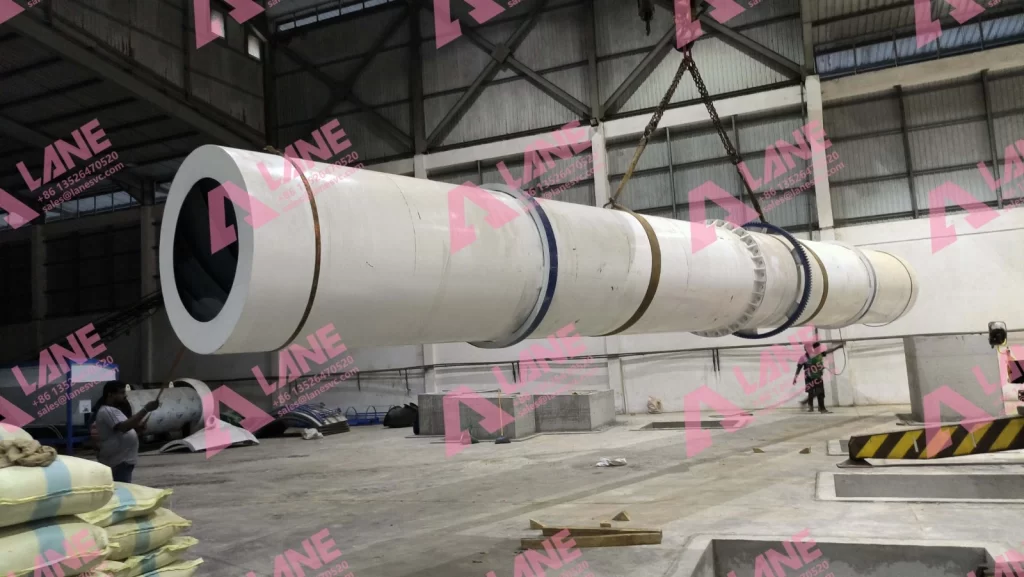
Here’s the full equipment roster for a wet process SSP fertilizer manufacturing plant, organized by section. This is what your supplier’s quotation should itemize:
| Section | Equipment | Notes |
|---|---|---|
| Raw Material | Rock phosphate hopper, rotary table feeder, belt conveyors, bucket elevators | Size for peak throughput + 20% margin |
| Grinding | Ball mill or vertical roller mill, cyclone separator, bag filter | 90–93% passing 100 mesh target |
| Acid System | H₂SO₄ storage tanks, day tank, acid pumps, dilution unit, rotameter | MS construction, special lining for spent acid |
| Mixing | Paddle mixer (lead/AHR brick lined), rotary airlock, weight feeder | 2.5–4 min retention, ~110°C operating temp |
| Den | Broadfield or belt den, den cutter, buffer hopper | 35–45 min retention, enclosed with gas extraction |
| Scrubbing | 3–4 stage venturi scrubbers, cyclones, water scrubbers, ID fan, 30–50m stack, filter press | 90–95%+ capture efficiency, H₂SiF₆ recovery loop |
| Curing | EOT crane (7.5T SWL) with grab bucket, covered curing shed | 20,000 MT+ storage for 50K MT/yr plant |
| Finishing (PSSP) | Vibrating screen, lump breaker, bagging machine | 50 kg bags, 20 MT/hr semi-auto |
| Granulation (GSSP, optional) | Granulator drum/disc, dryer, cooler, double-deck screens, chain mill, coater | 2–4 mm product, <5% moisture after drying |
| Control | PLC/DCS (Siemens or Schneider), sensors, optional IoT remote monitoring | Full-process automation available |
What Does a Single Super Phosphate Production Line Cost?
Let’s talk numbers — real ones, not the “contact us for a quote” variety.
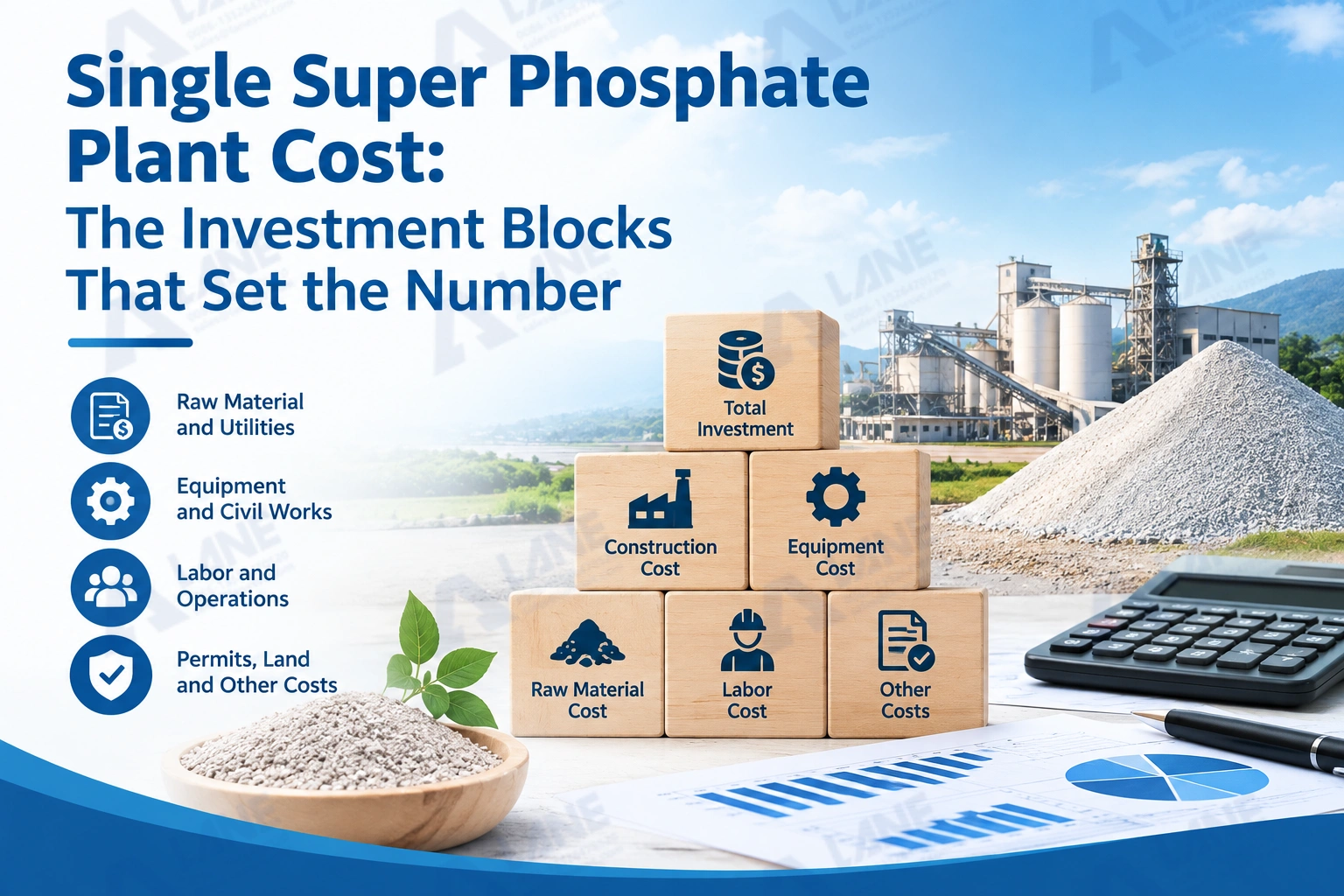
A wet process SSP fertilizer manufacturing plant involves two cost layers: the equipment package and the full turnkey project. They’re not the same thing, and confusing them is the most expensive mistake first-time buyers make.
Equipment-only costs (ex-works, typical Chinese/Indian suppliers):
- Small line (10,000–30,000 MT/year): $240,000–$500,000
- Mid-size line (50,000–100,000 MT/year): $500,000–$1.5 million
- Large line (150,000–400,000 MT/year): $1.5–$4 million
These are the numbers you’ll see on initial quotations. They cover machinery, basic controls, and sometimes installation supervision. They do not cover land, civil works, acid storage infrastructure, curing shed construction, permits, or commissioning.
Full turnkey project costs (greenfield, all-in):
Lankem Ceylon PLC invested approximately Rs. 2.5–3 billion (roughly $8–10 million) for a 50,000 MT/year greenfield SSP plant in Sri Lanka, utilizing domestic Eppawala rock phosphate. That’s a realistic benchmark for a fully permitted, commissioned, operating plant in a mid-cost jurisdiction.
In India, a comparable 50,000–100,000 MT/year greenfield project typically lands between $3 million and $7 million, depending on land costs, automation level, and whether you’re building acid storage from scratch or buying acid by tanker.
Operating cost breakdown (per metric ton of SSP):
Raw materials eat 70–80% of your operating costs:
- Rock phosphate (0.56–0.58 MT per MT SSP): your single biggest line item. A $5/MT difference in rock price changes your margin by ~$3/MT.
- Sulfuric acid (0.36–0.37 MT per MT SSP): the second-biggest. Plants with on-site acid production have a structural cost advantage.
- Utilities (electricity, water): 10–15% of OpEx
- Labor, packaging, maintenance, depreciation: the rest
Gross margins in a well-run plant run 20–30%. Net margins of 8–15% are achievable. The difference between top-quartile and bottom-quartile profitability almost always comes down to two things: rock phosphate sourcing and plant uptime.
Wet vs. Dry: How to Choose
I’ve seen buyers spend weeks agonizing over equipment brands while skipping the one decision that actually determines plant economics: wet or dry.
Choose the wet process when:
- Environmental compliance costs are high in your jurisdiction. The near-zero dust and closed-loop scrubbing make permitting faster and operating within limits easier.
- You’re producing at scale. Above 50,000 MT/year, wet process operating economics pull ahead.
- Worker safety and community relations matter (and they always do). No dust means fewer respiratory complaints from your workforce and fewer complaints from neighbors.
- Your rock phosphate responds well to wet grinding. Not all rock does. Test it first.
Choose the dry process when:
- Capital is extremely tight and you need the lowest upfront equipment cost.
- You’re running a small plant (under 30,000 MT/year) where wet process operating savings don’t offset the higher equipment cost.
- Your regulatory environment has minimal dust control requirements. These jurisdictions are vanishing, but they still exist.
One more thing: some suppliers will tell you the dry process is “simpler.” It is — mechanically. But simpler equipment doesn’t mean simpler operations. The dust control you skip in equipment cost, you pay for in maintenance headaches and regulatory risk. Factor that in.
Maintenance: What Breaks, When, and What to Do About It
SSP plants are tough environments. Sulfuric acid. Abrasive rock paste. Temperatures over 100°C. Things will break. Here’s what to expect.
Mixer — every 6–12 months: The paddle mixer’s lead lining and AHR bricks are consumable wear items. Inspect every quarter. Replace on condition, not on schedule — but don’t push past 12 months. A lining failure mid-campaign means a full plant shutdown during peak demand season.
Scrubber nozzles — every 3–6 months: Venturi scrubber nozzles clog with silica deposits. Keep spares on the shelf. Clean during scheduled downtime. If your scrubbing efficiency drops, check the nozzles first.
Den belt/conveyor — every 2–3 years: The den operates in a hot, acidic environment. Belt replacement is a major job. Budget for it in year 2 and every 2–3 years after.
Ball mill liners and grinding media — annual: Abrasive wear is normal. Track throughput vs. power draw. When the curve shifts, it’s time to reline.
EOT crane — quarterly inspection: The crane lives above the curing pile, which off-gases trace fluorine compounds. Corrosion of electrical contacts and structural elements is real. Inspect quarterly, lubricate monthly.
Preventive maintenance schedule that works:
| Frequency | Task |
|---|---|
| Daily | Check mixer temperature and motor current; inspect scrubber liquor pH; verify acid metering accuracy |
| Weekly | Inspect all conveyor belt tracking and tension; clean scrubber nozzle tips; check den cutter blade wear |
| Monthly | Lubricate all bearings and gearboxes; test emergency shutdown systems; calibrate weighing systems |
| Quarterly | Full mixer lining inspection; EOT crane structural check; scrubber efficiency test; baghouse pressure drop measurement |
| Annual | Complete plant shutdown: mill reline, conveyor belt replacement assessment, tank inspections, DCS/PLC backup verification |
How to Buy a Wet Process SSP Production Line Without Getting Burned
After watching dozens of fertilizer projects go through procurement, here’s what separates the ones that commission on time from the ones that spend an extra year in dispute resolution.
1. Test your rock before you sign anything.
Every reputable supplier should run a bench-scale acidulation test on your specific phosphate rock. Not “similar rock from the same region.” Your rock. From your mine or your supplier. The test tells you conversion rate, acid consumption, curing time, and whether additives are needed. If a supplier quotes you without this test, walk away. They’re guessing.
2. Define the scope. In writing. With penalties.
Equipment supply? Equipment + installation supervision? Full turnkey including civil works and commissioning? Nothing is obvious. A “complete production line” means different things to a Chinese supplier, an Indian supplier, and a European supplier. Get a scope document that lists every deliverable. Tie milestone payments to defined acceptance criteria. Performance guarantees should specify P₂O₅ conversion rate, throughput, and product quality — with testing protocols attached.
3. Visit a reference plant. Not the one they suggest.
Suppliers always have a showcase plant. Ask for three references. Then ask for three more. Visit the one they didn’t volunteer. Talk to the plant manager without the supplier’s salesperson in the room. Ask about downtime. Ask about spare parts delivery times. Ask what they wish they’d known before signing.
4. Spare parts strategy starts at purchase.
Negotiate a two-year critical spares package as part of the initial order. At a minimum: mixer paddles and linings, scrubber nozzles, den cutter blades, mill liners, conveyor belts, and bearing sets. Lead times on proprietary parts from overseas suppliers can stretch to 12+ weeks. A $50,000 spares package is cheap compared to three weeks of unplanned downtime during fertilizer season.
5. Don’t underestimate civil works.
The equipment is half the project. Foundations, curing shed, acid storage bund walls, drainage, effluent containment — these eat 30–40% of a turnkey budget and are where most projects blow their timeline. Get a local civil engineering firm involved early. Don’t let your equipment supplier handle civil works unless they have verifiable local experience.
6. Training is not a checkbox.
Three days of classroom training before handover won’t cut it. Negotiate for: operator training during commissioning (minimum two weeks of hands-on), maintenance training separately (one week), and a process engineer on-site for the first 30 days of commercial production. The difference between a plant that hits 90% nameplate capacity in month one versus month six is almost always operator skill, not equipment quality.
Where Wet Process SSP Plants Make the Most Sense
The wet process dominates in certain markets for reasons that go beyond technology:
India — The world’s largest SSP market by volume. Government subsidy policies (NBS scheme) favor SSP because it delivers both phosphorus (P₂O₅) and sulfur (S) in one product. Most new Indian plants above 50,000 MT/year are wet process. The regulatory environment around industrial dust emissions has tightened significantly since 2020.
China — Where the wet process was developed in the 1960s. Single-series capacities have reached 400,000 MT/year. Chinese EPC contractors offer wet process lines at the most competitive capital costs globally. The technology is mature, standardized, and well-documented.
Southeast Asia and Africa — Growing markets where phosphate fertilizer demand is rising faster than domestic production capacity. Turnkey wet process plants from Chinese and Indian suppliers are the default choice for new entrants. Rock phosphate availability (rather than technology preference) usually determines plant location.
Sri Lanka — The Lankem Ceylon project demonstrated that domestic rock phosphate (Eppawala) can support a commercially viable SSP plant, reducing import dependence. Similar logic applies in any country with phosphate rock deposits and heavy fertilizer import bills.
FAQ: Wet Process SSP Fertilizer Production Line
What is the difference between wet process and dry process SSP production?
The wet process grinds phosphate rock with water into a paste (26–28% moisture) and reacts it with concentrated sulfuric acid at 93–98%. The dry process grinds rock into dry powder and uses dilute acid at 60–78%. The wet process eliminates grinding dust completely and offers superior environmental performance. The dry process costs less upfront but generates significant dust that requires containment.
How long does it take to build and commission a wet process SSP plant?
From contract signing to commercial production: 8–18 months. Equipment manufacturing takes 3–5 months, shipping and civil works 3–6 months, installation 2–3 months, commissioning 1–2 months. Fast-track projects using modular/prefabricated designs can hit 5–8 months. Greenfield projects with extensive civil works take the full 12–18 months.
What capacity should I choose for my first SSP plant?
The most common entry point is 50,000 MT/year. Below 30,000 MT/year, fixed costs per ton get difficult to absorb. Above 100,000 MT/year, the raw material supply chain and working capital requirements become the constraint, not the equipment. A 50,000 MT/year plant balances manageable investment with viable unit economics.
What product quality can I expect from a wet process SSP line?
Standard powder SSP: 14.5–16% minimum water-soluble P₂O₅, 16% minimum citrate-soluble P₂O₅, 11% minimum sulfur (as S), maximum 12% moisture, maximum 4% free phosphoric acid. Granulated SSP tightens moisture to below 6% with the same nutrient specs. These numbers meet Indian FCO standards, which are broadly referenced across South Asia and Africa.
Is the wet process more environmentally friendly?
Yes — and in ways that matter for permitting. Near-zero dust during grinding, multi-stage scrubbing capturing 90–95%+ of fluorine emissions, and a closed-loop H₂SiF₆ recovery system that eliminates liquid effluent. If you’re permitting in a jurisdiction with strict air quality rules, the wet process is easier to approve and easier to stay compliant with.
Can I add granulation later, or should I include it from the start?
You can add granulation later. It’s a separate section downstream of curing and doesn’t require changes to the core acidulation line. However, including it from the start saves on civil works (shared foundations, utility connections) and avoids a second round of permitting. If you’re confident your market wants granules within 3 years, build it now.
What type of phosphate rock works best in the wet process?
Rocks with P₂O₅ content above 31% and good reactivity (high citrate solubility) give the best conversion rates. Moroccan, Jordanian, and some Chinese phosphate rocks perform well. Higher iron and aluminum content is problematic — these elements consume acid without producing available P₂O₅. Always run a bench-scale test on your specific rock source before finalizing equipment selection.
Contact our engineering team for a project-specific quotation →