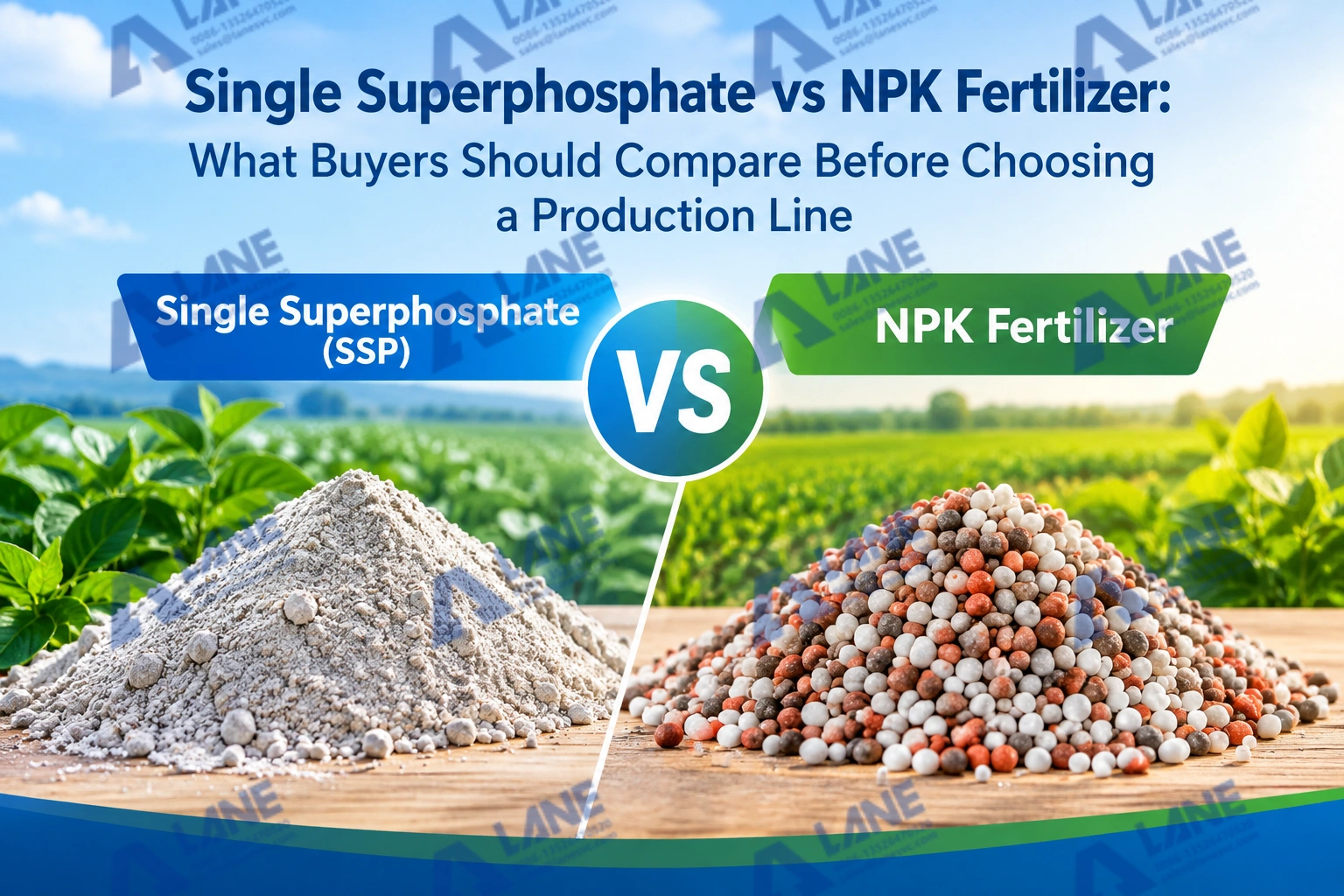
Single Superphosphate vs NPK Fertilizer: What Buyers Should Compare Before Choosing a Production Line
- 2026-09-28
A fertilizer project rarely fails because the chemistry is unknown. It fails because the plant was built for a product the local market will not buy at the volume the plant can produce. When a buyer weighs single superphosphate vs NPK fertilizer, the deciding question is which route fits the phosphate rock, acid, intermediates, working capital, and customers actually available. This guide follows both routes the way an engineering and procurement team evaluates them.
What each product actually is
The short version of single superphosphate vs NPK fertilizer comes down to this: one route sells a single nutrient package, and the other sells a formulation business.
Single superphosphate: one nutrient with sulfur and calcium
Single superphosphate (SSP) is produced by reacting finely ground phosphate rock with sulfuric acid. The reaction yields monocalcium phosphate and calcium sulfate, so the finished fertilizer carries phosphorus with sulfur and calcium that the process supplies. Commercial granular SSP usually grades around 16 to 20 percent P2O5, with roughly 11 to 12 percent sulfur and a similar order of calcium, and most of that phosphorus is water soluble.
NPK: a formulation portfolio, not one product
NPK fertilizer covers a family of products defined by nutrient ratio. Grades such as 15-15-15, 20-10-10, and 12-24-12 are familiar. Producers make them by chemical granulation, by steam and water granulation in a rotary drum, by melt granulation, or by dry blending purchased granules. SSP is one product with one recipe, while NPK is a family the producer can re-formulate as crop demand and raw material prices move.
Why the comparison ends up being a plant design decision
Both products pass through crushing and grinding, mixing, granulation, drying, cooling, screening, coating, and bagging. They separate at the reaction stage, in fuel and utility demand, and in storage footprint. Settling the question before commissioning a mass balance costs less than learning the answer afterward.
Comparing the two production routes
A side-by-side look at single superphosphate vs NPK fertilizer at plant level starts with the sequence of unit operations, because that sequence sets the equipment list and the site plan.
The single superphosphate production process
The single superphosphate production process follows a fixed order.
- Rock grinding. Phosphate rock is milled to support fast reaction, commonly to around 80 percent passing 100 mesh.
- Acidulation. Ground rock and sulfuric acid meet in a controlled mixer. The reaction is fast and strongly exothermic, so temperature and the acid-to-rock ratio decide how much phosphorus converts into available form.
- Den and curing. Material leaves the den and cures for roughly two to four weeks while residual free acid finishes reacting and the material stabilizes.
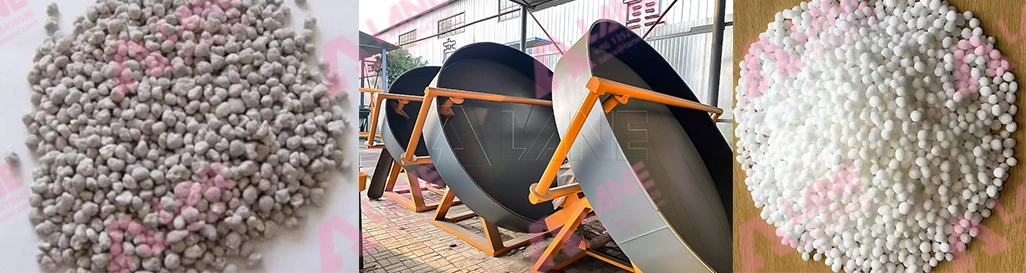
- Granulation. Cured SSP is granulated with water and binder in a rotary drum, then dried and cooled.
- Screening, coating, and bagging. Oversize returns to a crusher, undersize returns to the granulator, and the on-size fraction is coated and packed.
- Gas scrubbing. Fluoride gases, mainly hydrogen fluoride and silicon tetrafluoride, must be captured and scrubbed before release. Sizing depends on the fluorine content of the ore.
Curing is the step buyers underestimate most. A warehouse holding two to four weeks of production ties up floor area and working capital at the same time, and it has to handle acid vapors, moisture, and material reclaiming.
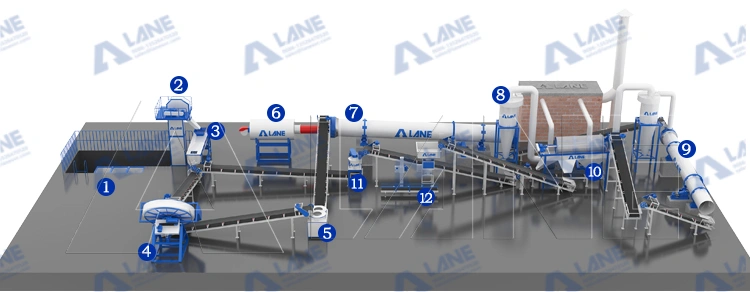
Inside an NPK fertilizer production line
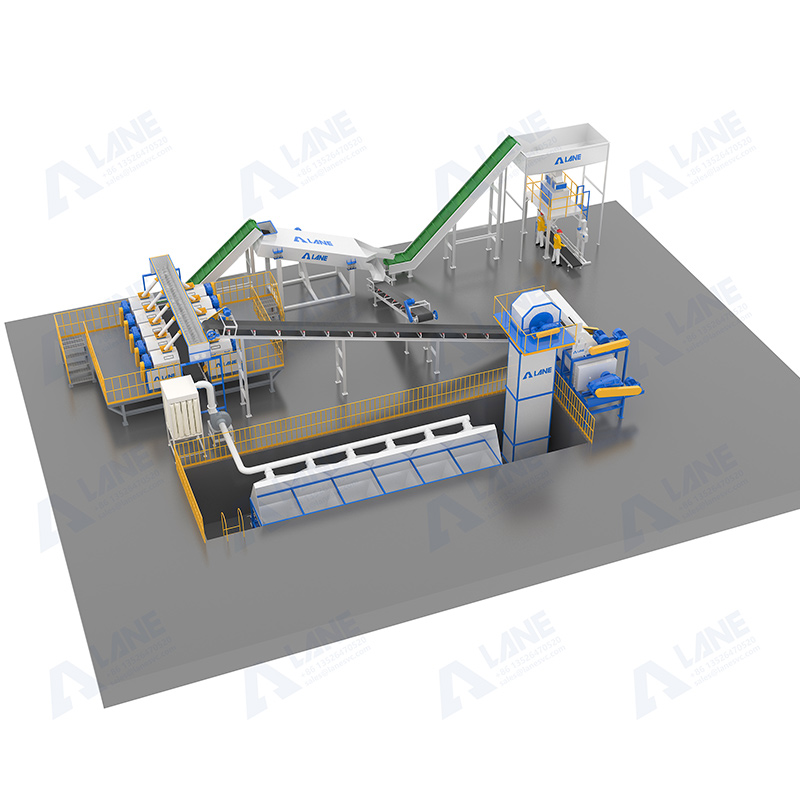
An NPK fertilizer production line starts with proportioning. Belt scales or loss-in-weight feeders dose urea, MAP or DAP, potassium chloride or potassium sulfate, ammonium sulfate, and fillers into a mixer. Material then enters a rotary drum granulator, where steam, water, or a chemical binder build granules in the 2 to 4 mm range. Granules pass through a rotary dryer, a rotary cooler, a coating drum, and a double-deck vibrating screen, and oversize returns to the mixer through a crusher.
Dust collection does more work on this route than most buyers expect. Dryers and coolers discharge large air volumes loaded with fines, and the bag filters on those streams decide whether the plant meets its emission limits.
Where the two lines differ most
| Dimension | Single superphosphate | NPK fertilizer |
|---|---|---|
| Core unit operation | Acidulation reaction, then curing | Proportioning, granulation, drying |
| Main raw materials | Phosphate rock, sulfuric acid | Urea, MAP or DAP, MOP or SOP, fillers |
| Fuel and utilities | Moderate drying load, scrubbing water | Heavy drying and cooling load, granulation steam |
| Storage footprint | Curing warehouse plus product warehouse | Intermediate silos plus product warehouse |
| Product flexibility | One product, narrow grade range | Wide formulation range, quick grade changes |
| Quality control focus | P2O5 availability, free acidity, moisture | Nutrient accuracy, granule hardness, caking |
| Working capital cycle | Inventory held in curing for weeks | Shorter cycle, set by intermediate delivery |
| Environmental controls | Fluoride scrubbing, acid containment, dust | Dust collection, burner emissions, caking control |
Raw materials, supply chain, and cost structure
Phosphate rock and sulfuric acid set SSP economics
Rock grade and acid price set the economics of the single superphosphate production process. As a planning benchmark, one tonne of granular SSP consumes roughly 0.55 to 0.6 tonnes of phosphate rock and 0.35 to 0.4 tonnes of sulfuric acid. Treat that as a starting point, because ore analysis, acid concentration, and recovery in the mixer and den move the real balance. A supplier that issues a firm consumption figure without an ore sample is guessing, and acid storage, dosing, and spill containment shape both the site plan and the permit application.
Intermediates drive the NPK cost model
On an NPK fertilizer production line, the operator buys nutrients instead of making them. Urea, DAP, MAP, MOP, and SOP prices flow straight into product cost, which turns batching accuracy and formulation discipline into cost controls.
Where the money actually goes
Two cost buckets decide most projects. Capital cost covers the equipment package, civil works, electrical and instrumentation, erection, and commissioning. Working capital covers raw material inventory and the product sitting in the curing warehouse or in intermediate silos.
The trap is comparing quotations that cover different scope. One vendor quotes process equipment only, while another includes steel structures, civil works, dust collection, and commissioning. The second number looks higher and frequently delivers a plant for less. Agree on battery limits in writing, including compressed air, steam, water, effluent treatment, foundations, spare parts, and training.
What buyers are responding to in the market
Sulfur deficiency in intensive cropping systems has increased demand for phosphorus products that also carry sulfur, which favors SSP in several export markets. On the compound side, distributors ask for tighter granule size control and better anti-caking performance, because poor granule quality reaches the farm gate as a complaint long before it shows up as a nutrient shortfall.
Equipment selection when the product changes
Crushers, mixers, granulators, rotary dryers, coolers, vibrating screens, coating drums, conveyors, and automatic bagging machines appear on both routes. Buying them together for one site lowers unit cost and simplifies spares.
Equipment specific to single superphosphate
The single superphosphate production process adds acid dosing and metering, an acidulation mixer, a den, curing and reclaiming equipment, and a fluoride scrubbing system with its pumps and effluent handling. Acid contact points need corrosion-resistant alloys, rubber lining, or suitable coatings, and the mixer and den wear from acidity and abrasion at the same time.
Equipment specific to NPK granulation
An NPK fertilizer production line adds multi-ingredient batching with tight tolerances, a granulator with steam sparger and water nozzles, a hot air furnace and burner for the dryer, a counter-current cooler, a coating drum, and dust collection on the dryer and cooler discharge. Formulation control software is worth specifying, because a batching error here becomes a failed regulatory sample rather than a small production loss.
Quality control, standards, and permitting
SSP buyers test total and available P2O5, water-soluble phosphorus, free acidity, moisture, granule size, and crushing strength. The certificate of analysis should also report sulfur and calcium, since free acidity and moisture decide whether the product stores well. On an NPK fertilizer production line, the tests are declared nutrient content against the label, batching tolerance, granule size, hardness, moisture, and caking tendency. Both routes need a sampling plan, a laboratory able to run the methods, and retention samples for traceability.
Product compliance follows the destination market. Fertilizers sold in the European Union fall under Regulation (EU) 2019/1009, which sets contaminant limits for phosphate fertilizers, including a cadmium limit of 60 mg per kg of P2O5. In the United States, state registration follows the AAPFCO model bills and rules, and ISO 8157 provides the international vocabulary for fertilizers and soil conditioners.
Equipment and emissions compliance is the other half. Lines shipped to Europe need to satisfy the EU Machinery Directive 2006/42/EC and carry CE marking, and the European Commission BAT reference document for the manufacture of large volume inorganic chemicals is a practical reference for fluoride abatement in the single superphosphate production process. For feasibility work, use public data rather than vendor marketing: USGS Mineral Commodity Summaries publishes phosphate rock production and reserve figures, and the International Fertilizer Association publishes supply and demand statistics.
Maintenance and operating reality
Downtime in the single superphosphate production process concentrates in the acidulation line. Expect wear on mill liners, mixer paddles, den components, pumps, and scrubber internals, and design inspection ports into the original layout, because acid corrosion appears where inspection is difficult. On an NPK fertilizer production line, the dryer and cooler circuit absorbs most maintenance time: burner service, refractory repair, granulator scrapers, screen mesh, filter bags, and belt scale calibration.
On both routes, a wear parts list with expected service life and a local availability plan prevents the most common cause of extended downtime. Two items are worth negotiating: a first-year wear parts kit, and operator training in the language the team uses in the field.
Which route fits your project
Buyers arrive in different positions, and the answer to single superphosphate vs NPK fertilizer changes with each one. If you control phosphate rock or can contract it at a workable price, and your market pays for a phosphorus product with sulfur and calcium, a granular SSP line fits. Size the curing and reclaiming section for peak production, since the bottleneck usually appears there.
If you buy intermediates and sell branded, crop-specific blends through distributors, an NPK fertilizer production line fits better. It costs more in drying and cooling equipment and responds faster to formulation demand.
Running both products on one site is common. A granular SSP line and an NPK fertilizer production line share crushing, screening, utilities, and bagging, and a blending line can sit alongside either. SSP granules act as a phosphate source in blends and contribute sulfur and calcium. Keep free acidity and moisture under control, because aggressive SSP makes everything stored near it cake.
Questions to ask an equipment supplier
- Can you issue a mass balance and heat balance based on my ore analysis or intermediate specifications?
- Which reference plants are closest to my climate, capacity, and market, and can I contact them?
- How is the capacity guarantee defined, including granule size, moisture, and nutrient accuracy?
- What are the battery limits, and what do I supply?
- What does commissioning include, how long does it last, and who pays for delays?
- Which spare parts are proprietary, and what is the lead time after the warranty ends?
FAQ
These are the questions buyers raise most often when comparing single superphosphate vs NPK fertilizer.
Is single superphosphate better than NPK fertilizer?
Neither is universally better. SSP supplies phosphorus with sulfur and calcium and suits acidic soils. NPK products deliver balanced nutrition matched to a crop plan. Raw material access, customer demand, and price decide the answer.
Can single superphosphate and NPK fertilizer be produced in the same plant?
Yes. An NPK fertilizer production line and a granular SSP line share crushing, screening, conveyance, utilities, and bagging, which lowers capital cost. The extra investment goes into acidulation and scrubbing for SSP, and into batching, drying, and cooling for NPK.
What is the P2O5 content of single superphosphate?
Granular SSP usually grades 16 to 20 percent P2O5, with 18 percent the most common grade. Sulfur runs about 11 to 12 percent, and calcium sits in a similar range. Values depend on rock grade and conversion in the mixer and den.
How long does single superphosphate need to cure?
Two to four weeks is typical, depending on rock fineness, acid ratio, ambient temperature, and how the material is stacked and turned. Shortening curing to save warehouse space tends to surface later as granulation and storage problems.
What does an SSP plant cost compared with an NPK fertilizer production line?
No reliable published price exists for either plant. Cost depends on capacity, specifications, automation, civil works, local labor rates, and scope of supply. Compare vendors on scope before comparing totals, and ask each one for a mass balance based on your inputs.
What are the main steps in the single superphosphate production process?
Rock grinding, acidulation, curing in the den, granulation, drying and cooling, screening and coating, and fluoride gas scrubbing. Curing sets plant size and working capital, because it holds finished material for two to four weeks.
Can single superphosphate be used in NPK blends?
Yes. Granular SSP is a common phosphate carrier in bulk blends and also contributes sulfur and calcium. Keep free acidity and moisture within specification, or the blend will cake in storage.
What capacity should I plan for?
Start from the volume your market can absorb, then size the line to reach it in one or two shifts. Most commercial granulation lines run between roughly 1 and 20 tonnes per hour.
Conclusion
The choice between single superphosphate vs NPK fertilizer comes down to what you can source, what your customers will buy, and how much working capital you can hold in inventory. SSP rewards buyers with access to phosphate rock and acid, and it demands a curing strategy. NPK rewards buyers who can work the intermediate market and want formulation flexibility.
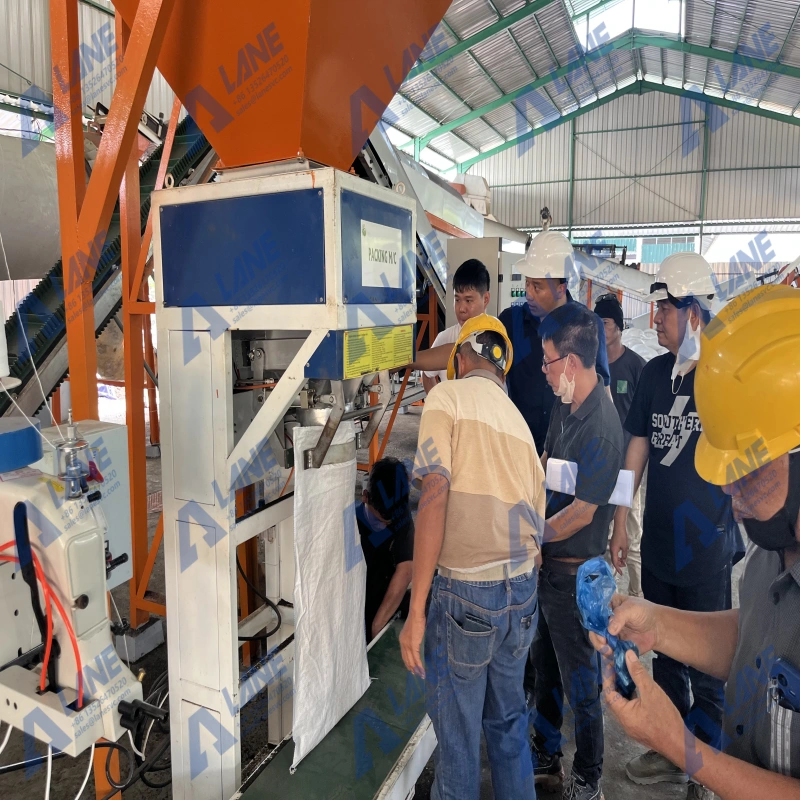
Before requesting quotations, define the product, grade, and capacity in writing, then ask each supplier for a mass balance built on your own ore analysis. LANE Machinery supplies both granular SSP equipment and NPK fertilizer production line systems, and the most useful first deliverable from any vendor is a scope document you can compare line by line.