How to Produce Single Super Phosphate Fertilizer at Scale: Equipment, Process & Cost Breakdown
- 2026-04-23
Scaling fertilizer output isn’t just a chemistry problem — it’s an engineering and logistics challenge. If you’ve been researching how to produce single super phosphate fertilizer at a commercial level, you already know there’s a wide gap between lab-scale reactions and a fully operational production line. This guide covers the equipment, process sequence, and cost realities that determine whether an SSP fertilizer production project succeeds or stalls.
What Makes SSP Worth Producing
Single super phosphate delivers 16–20% available P₂O₅ alongside calcium and sulfur — a nutrient combination that works particularly well in sulfur-deficient soils across South Asia, Sub-Saharan Africa, and the Middle East. It’s one of the more accessible phosphate fertilizers to manufacture. No phosphoric acid concentration step, no ammonia handling. That simplicity is exactly why SSP fertilizer production remains commercially attractive for producers entering developing markets.
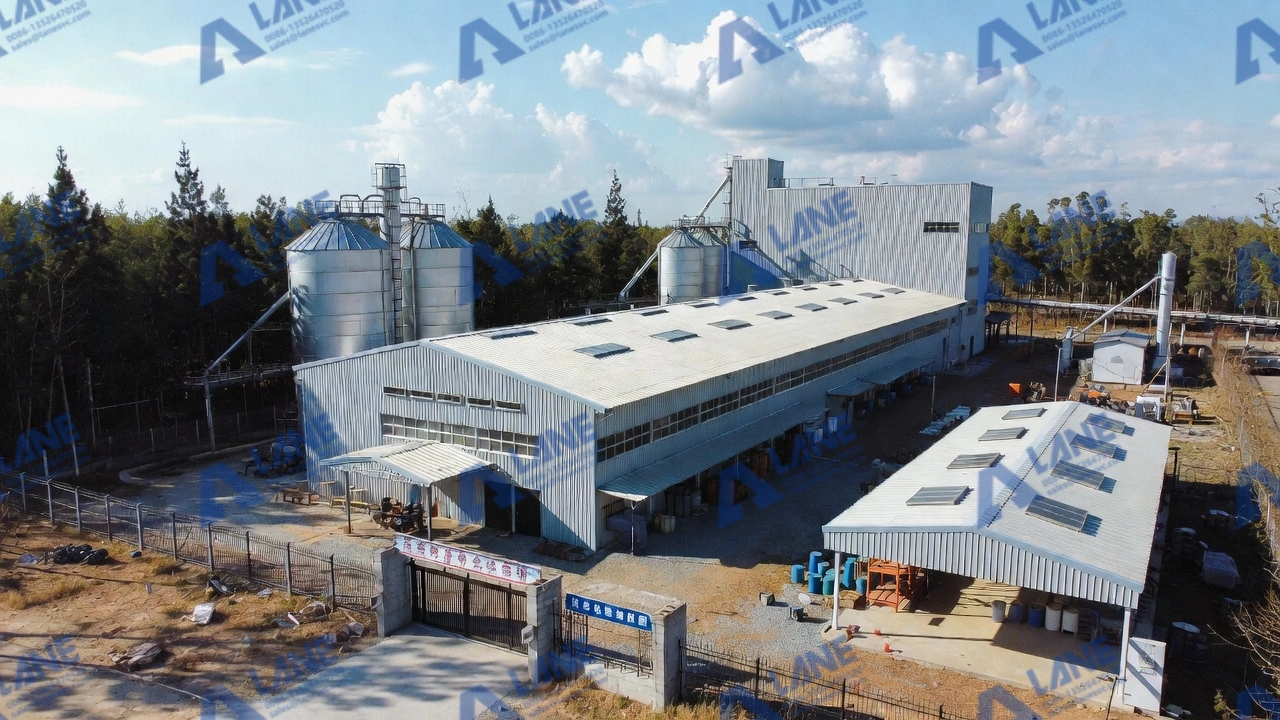
Core Equipment Required
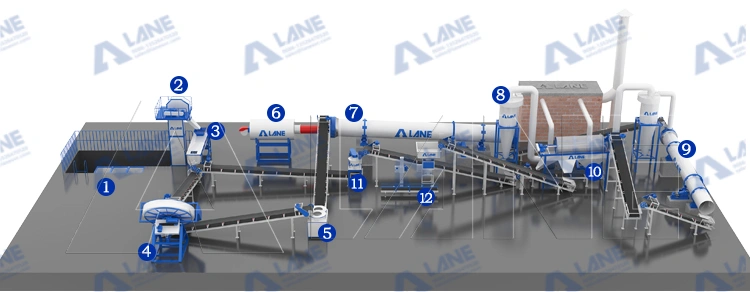
To understand how to produce single super phosphate fertilizer efficiently, start with the equipment lineup. Each unit plays a defined role in the conversion chain:
- Phosphate rock grinding mill— Grinds raw rock to 80–100 mesh fineness to maximize acid reactivity. Particle size here directly affects conversion efficiency downstream.
- Sulfuric acid storage and metering system— Precise dosing is critical. Underdosing reduces P₂O₅ availability; overdosing creates safety and corrosion issues.
- Curing conveyor or curing building— The exothermic reaction continues post-den. Proper curing over 2–6 weeks completes conversion and stabilizes the material.
- Rotary drum granulator— The industry standard for high-volume SSP lines. Recirculating fines serve as seed granules, and controlled moisture drives agglomeration into uniform particles.
- Rotary dryer and cooler — Dries granules to below 5% moisture and cools them to avoid caking and preserve integrity before storage and bagging.
- Screening system— On-spec granules proceed to bagging; oversized material crushes and recycles, fines return to the granulation loop.
- Dust collection and wet scrubbing system— SSP fertilizer production generates fluoride-containing fumes. Proper scrubbing is both a regulatory requirement and a basic operational necessity.
- Automated bagging system— Manual bagging becomes the bottleneck on any serious production line. Automated systems with inline weight verification are the practical standard.
The Production Process in Practice
The sequence for how to produce single super phosphate fertilizer follows a clear logic, but execution is where most operations succeed or struggle.
Phosphate rock enters the grinding circuit first. Getting fineness right is non-negotiable — I’ve seen operations underspec their mills and pay for it in poor conversion throughout the entire downstream process. Ground rock and metered sulfuric acid combine in the acidulation den. The reaction is fast and exothermic, generating fluoride gases that the scrubbing system must handle.
Post-den, the material enters curing. This is where first-time producers consistently underestimate the timeline. You cannot compress the chemistry beyond a point. Mechanical curing systems with periodic turning reduce the wait, but the reaction sets its own floor.
After curing, the granulation loop takes over. In a rotary drum granulator system, the recycle ratio — the proportion of fines returned relative to new feed — is the key control variable. Getting it dialed in takes operational experience. From what I’ve seen in the field, it’s the kind of thing operators develop a feel for after a few production campaigns, and no technical manual fully substitutes for that.
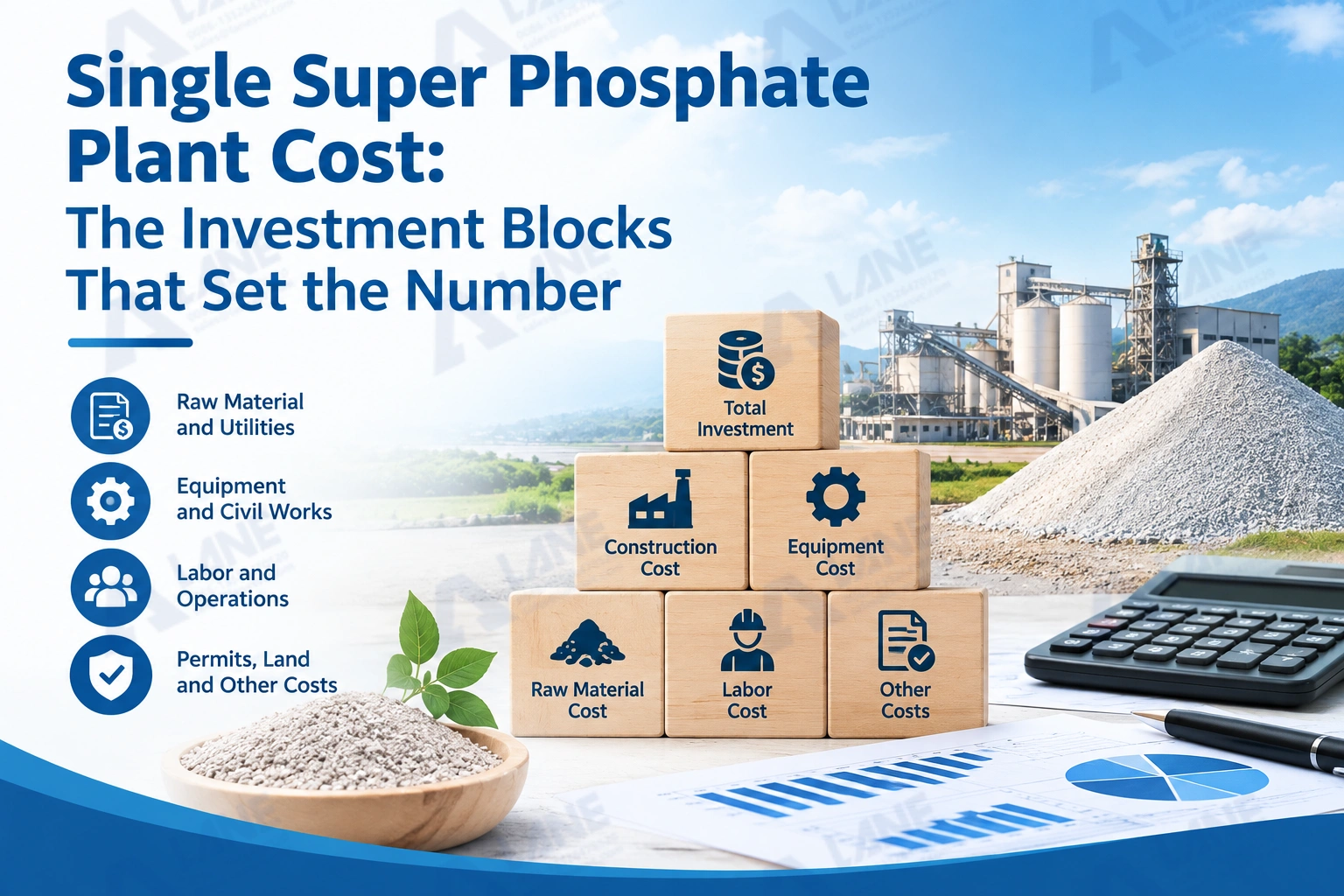
Cost Drivers in SSP Fertilizer Production
SSP fertilizer production economics vary by region, but the same cost categories dominate everywhere:
Raw materials account for the largest share. Phosphate rock quality — specifically P₂O₅ grade — determines how much rock you consume per ton of finished product. Sulfuric acid pricing tracks the sulfur market and can swing significantly.
Energy hits hardest in the drying circuit. Rotary dryer fuel consumption is the most significant energy variable in a typical SSP line.
Capital expenditure for a complete 10–20 t/h SSP fertilizer production line from an established supplier like LANE typically ranges from $600,000 to over $1.2M, depending on automation level and civil requirements. That range reflects real variation — not a marketing hedge.
Operating costs per ton, under normal conditions, run $35–60 in well-positioned operations. Markets with imported acid or expensive utilities sit at the higher end.
What Experience Actually Teaches You
Let me be direct about something: the producers who struggle most with SSP fertilizer production aren’t failing on chemistry — they’re failing on process reliability. A 15 t/h line running at 80% availability consistently outperforms a 20 t/h line with chronic downtime. Equipment integration quality, particularly across the acid handling and granulation sections, makes the difference.
Suppliers like LANE have shifted toward pre-engineered line packages in recent years, which reduces field integration risk for producers without deep in-house engineering teams. That’s a practical advantage worth factoring into supplier selection.
Summary
Learning how to produce single super phosphate fertilizer at commercial scale comes down to three things: the right equipment for your target capacity, disciplined process control through granulation and curing, and honest cost modeling against your specific input markets. The chemistry is proven. Execution is where projects win or lose.
Planning an SSP fertilizer production line? Contact our engineering team for a capacity-specific equipment proposal and process layout.
FAQ
Q1: What scale is commercially viable for SSP fertilizer production?
Most operations become competitive at 5 t/h and above. For new SSP fertilizer production lines, the 10–20 t/h range is the typical commercial entry point — below that, fixed costs per ton make pricing difficult against larger producers.
Q2: How long does curing take in SSP production?
Open-pile curing typically requires 4–6 weeks. Mechanical curing systems with controlled turning and airflow can reduce this to 2–3 weeks without compromising conversion quality.
Q3: Is granulation required when producing SSP?
No. Powdered SSP is a valid product in markets where broadcast application is common. Granular SSP commands a premium where ease of handling and blending compatibility matter to buyers.
Q4: What phosphate rock grade works best for SSP production?
Rock with 28–32% P₂O₅ is the practical standard. Lower-grade material increases raw material consumption per ton of output and may reduce the final product’s P₂O₅ content below market specification.
Q5: How does SSP compare to TSP or DAP in production complexity?
SSP is significantly simpler. It requires only sulfuric acid — no phosphoric acid concentration, no ammonia systems. That makes it accessible to producers who cannot justify TSP or DAP infrastructure investment.
Q6: What are the key environmental compliance requirements?
Fluoride emissions management is the primary area. Wet scrubbing systems are the standard control technology. Scrubber effluent circuits are also regulated in many jurisdictions. Engaging local environmental authorities early in project planning avoids costly post-construction modifications.
For more details, please feel free to contact us.
Henan Lane Heavy Industry Machinery Technology Co., Ltd.
Email: sales@lanesvc.com
Contact number: +86 13526470520
Whatsapp: +86 13526470520