SSP Fertilizer Plant Cost: What Buyers Should Know Before They Budget
- 2026-08-11
The first question most investors ask about a phosphate fertilizer project is simple: what does an SSP fertilizer plant cost? The useful answer is not a single number. It is a cost framework that separates equipment from civil works, raw materials from energy, and construction from the working capital a plant needs before it produces its first bag.
This guide is written for fertilizer manufacturers, plant investors, engineers, procurement managers, and project contractors. It covers the process and equipment scope, capital and operating cost drivers, realistic payback planning, and the supplier questions that protect a project from an optimistic quote.
Why SSP remains a practical phosphate investment
Single superphosphate has been a commercial phosphate fertilizer for more than a century, and the market case has not disappeared. SSP delivers both phosphorus and sulfur in one product, which makes it valuable in sulfur-deficient soils across Sub-Saharan Africa, South Asia, Latin America, and parts of the Middle East. It is also less capital intensive than DAP, MAP, or phosphoric acid routes, which makes it a practical entry point for regional fertilizer production.
ICL still markets granular SSP as a source of phosphorus and soluble sulfur, and Casale was awarded a Process Design Package contract for a 350,000 tons per year granular SSP facility in Turkmenistan. Those signals show that SSP is a proven commercial route, not an experimental process.
The practical question is not whether SSP works. It is how the SSP fertilizer plant cost estimate changes with the rock, the site, the capacity, and the market the buyer actually has.
What drives SSP fertilizer plant cost
SSP fertilizer plant cost is not a single number because five variables move it independently: capacity, process route, raw material, site, and automation. A buyer who compares only equipment prices misses the other four.
Capacity and process route
Capacity is the first cost driver. A 100 tons per day plant costs less than a 500 tons per day facility, but the relationship is not linear. Larger plants benefit from economies of scale in automation, material handling, and civil works, so the cost per ton of annual capacity usually falls as the plant gets bigger.
The process route matters too. A powder SSP plant can stop after curing, crushing, screening, and packaging. A granular plant adds granulation, drying, cooling, and recycle handling, which raises both capital and energy cost. A dry extrusion route can skip drying and cooling, which reduces energy use but changes the granule shape and adds roller wear.
Raw material and site
Phosphate rock and sulfuric acid dominate the operating budget. Per ton of SSP, published LANE guidance uses approximately 650 to 700 kg of phosphate rock at 28 to 32 percent P2O5 grade and 280 to 320 kg of dilute sulfuric acid at 65 to 75 percent concentration. Rock grade, moisture, and impurities affect conversion and operating cost, so a plant designed around one deposit can struggle when the operator switches to another.
Site location changes both capital and operating cost. Freight for rock and acid can swing the operating budget significantly. Sites near a port, mine, or acid supplier reduce inbound logistics, while remote sites need larger acid storage and longer raw material lead times.
Automation and compliance
PLC-controlled plants cost more upfront but reduce labor dependency and product variability. Manual plants are cheaper to build and harder to run consistently. The right level depends on labor cost, product quality requirements, and the operator’s technical capacity.
Environmental compliance is part of capital cost, not an afterthought. Acid fume scrubbing, dust collection, wastewater handling, and chemical-resistant flooring are required in most jurisdictions. Retrofitting them after commissioning is more expensive than designing them into the original SSP fertilizer plant cost estimate.
Civil works and installation
Equipment pricing gets the attention, but site preparation, structural steel, foundations, utility connections, and acid-resistant buildings can represent 15 to 25 percent of total project cost. In higher-cost construction markets, that share can go higher. Installation and commissioning typically add another 8 to 12 percent on top of equipment cost.
How to build a single superphosphate plant setup cost estimate
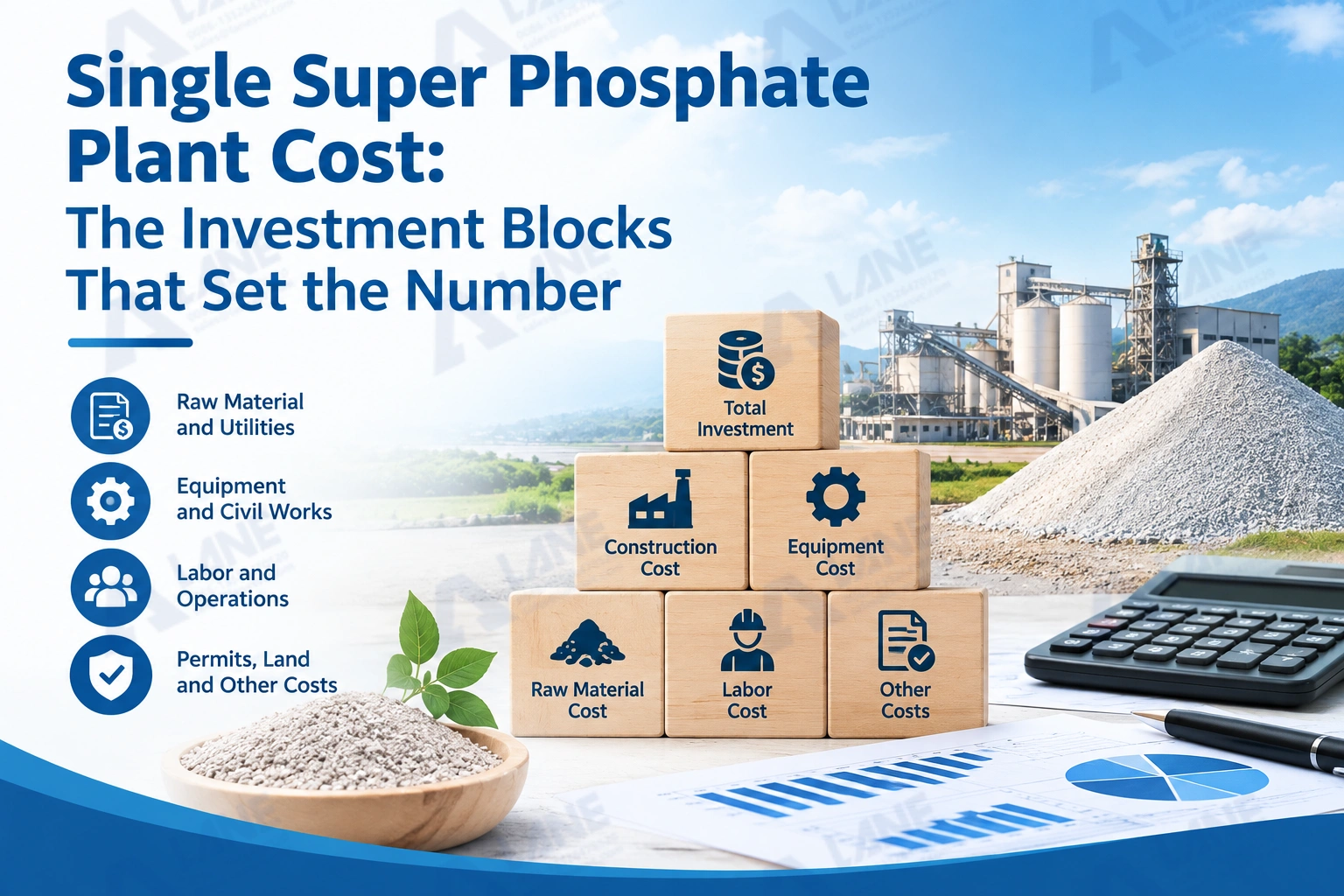
A realistic single superphosphate plant setup cost estimate has five layers. Leaving one out creates a budget that looks good on paper and fails during implementation.
Equipment procurement
Equipment typically accounts for 45 to 60 percent of total project cost. The core equipment list includes:
- Phosphate rock crusher and ball mill or Raymond mill.
- Sulfuric acid storage, dilution, and dosing system.
- Acid mixer or reactor with acid-resistant lining.
- Curing area or curing system with controlled airflow.
- Lump breaker and conditioning equipment.
- Granulator for granular product.
- Dryer and cooler for wet granulation routes.
- Screening machine with fines and oversize recycle.
- Dust collection and acid mist scrubbing system.
- Automatic packaging machine.
- PLC-based process control and monitoring.
A supplier that offers an integrated line can reduce procurement complexity and make the SSP fertilizer production line cost easier to compare.
Civil works and buildings
The plant needs an acidulation building, acid storage area, curing space, granulation hall, product warehouse, and utilities. Acid-resistant flooring, ventilation, and containment are not optional in a plant that handles concentrated sulfuric acid. Published guidance puts civil works in the 15 to 25 percent range of the single superphosphate plant setup cost.
Installation and commissioning
Installation, electrical work, piping, commissioning, and operator training add 8 to 12 percent to the single superphosphate plant setup cost on top of equipment. Imported equipment can add another 5 to 15 percent for freight, customs, insurance, and import duties, depending on the country.
Permits and pre-operating costs
Environmental permits, product registration, lab setup, safety systems, and pre-commissioning trials are real line items. Published setup guidance commonly puts them at 3 to 8 percent of project cost. The amount varies by jurisdiction, but omitting them from the single superphosphate plant setup cost estimate creates a financing gap.
Working capital
The plant needs cash for phosphate rock, sulfuric acid, packaging, labor, utilities, and finished goods before sales start. Standard practice is 60 to 90 days of raw material and operating cost. Working capital is a common omission from the single superphosphate plant setup cost and the layer that banks and investors check first.
The production process and its cost impact
Single superphosphate production follows a well-documented sequence. Each stage has a different cost and risk profile.
- Phosphate rock crushing and grinding. Grinding fineness affects reaction rate and conversion. The mill is a major energy user.
- Sulfuric acid preparation and dosing. Acid concentration and temperature have to stay controlled for consistent conversion.
- Acidulation. Ground rock reacts with sulfuric acid in a mixer or reactor to form SSP and releases heat. The reaction equipment needs acid-resistant materials and gas handling.
- Curing. Reacted SSP is cured so the reaction can finish. LANE’s published guidance describes a curing period of roughly two weeks to a month, depending on rock and process conditions. Undersizing curing capacity is a common cost-saving mistake that reduces P2O5 availability.
- Crushing and conditioning. Cured SSP is broken up and prepared for granulation.
- Granulation. The most common routes are rotary drum, pan, and dry extrusion. Each has a different capital, energy, and operating cost profile.
- Drying and cooling. Wet granulation routes need drying and cooling, which consume a large share of the plant’s energy.
- Screening, recycle, and packaging. On-spec granules are packed, oversize is crushed, and fines return to the granulator.
For a buyer, the process steps matter because SSP fertilizer plant cost is built at every transfer point. A granulator sized for average feed instead of recycle load becomes a bottleneck. A curing area built too small limits the whole plant. These issues cannot be fixed by buying a better packaging machine.
SSP fertilizer production line cost: equipment-only vs total project
SSP fertilizer production line cost is often quoted in two very different ways. An equipment-only number covers machines on a loading dock. A total project number includes civil works, installation, utilities, commissioning, and working capital. Comparing the two produces a false budget.
Published equipment guidance gives a useful frame. Small semi-mechanized lines can start around USD 80,000 to 350,000 depending on capacity and scope. Standard 8 to 12 tons per hour configurations are commonly quoted in the USD 400,000 to 800,000 range. Fully automated industrial lines with PLC control, acid fume scrubbing, and integrated packaging can exceed USD 1.2 million for equipment alone.
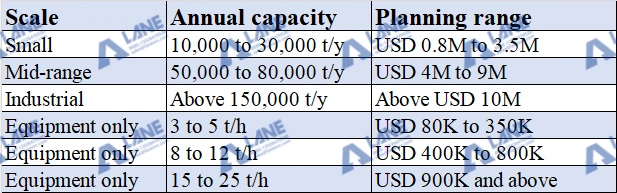
These are planning benchmarks, not quotes. The final number depends on rock quality, site conditions, compliance scope, and the supplier’s scope of supply.
Operating cost and ROI
Operating cost for an SSP plant follows a predictable pattern. Phosphate rock and sulfuric acid are the largest recurring costs, usually 55 to 65 percent of production cost. Energy is next at 10 to 15 percent, especially when grinding, drying, and cooling are part of the process. Direct labor runs 8 to 12 percent, maintenance and consumables 5 to 8 percent, and the remainder is overhead, logistics, and quality management.
Utilization is the second most important variable in the SSP fertilizer plant cost model after raw material cost. Energy is the next largest line in the SSP fertilizer production line cost at 10 to 15 percent. A plant running at 60 percent utilization will not recover its capital on schedule. Published payback scenarios show mid-scale plants recovering investment in three to six years when demand is strong and utilization stays above 80 percent. LANE’s project guidance suggests four to seven years under normal operating conditions with about 70 percent utilization in year one. Both figures are scenario models, not guarantees, and buyers should pressure-test them with local prices.
Powder vs granular SSP: the decision changes the budget
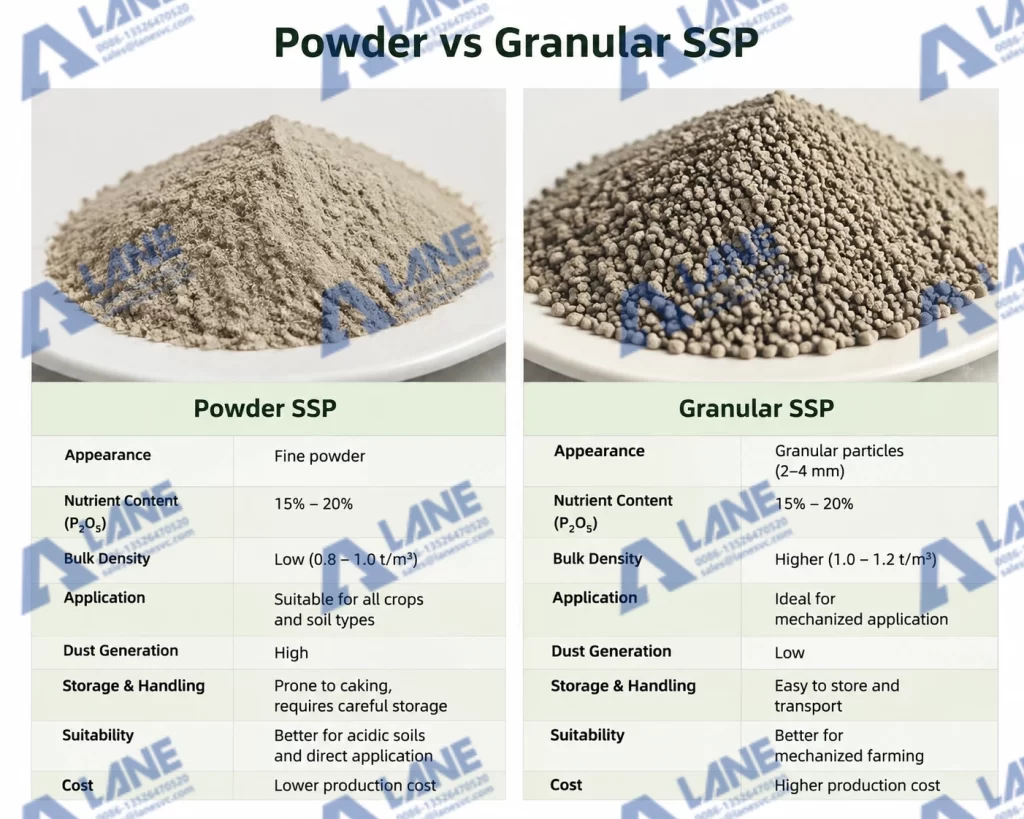
Powder SSP is the direct product of acidulation and curing. It is dusty, compacts in storage, and is harder to blend with other granules. A powder line is simpler and cheaper to build.
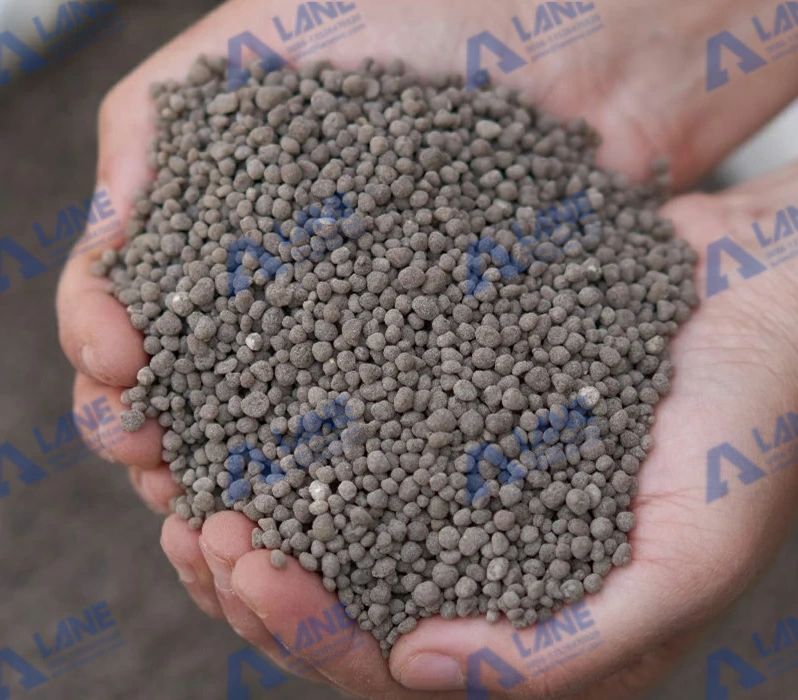
Granular SSP is conditioned and granulated into uniform particles that store, transport, and blend predictably. The granulation route adds equipment, drying energy, and operating complexity, but it also adds product value and opens markets that powder cannot reach.
For a buyer, the choice should follow the sales plan. A regional bulk market may accept powder at lower cost. A retail, export, or bulk blending market usually needs granules. The SSP fertilizer production line cost should be modeled against the expected selling price, not against the cheapest equipment configuration.
Maintenance and operations that protect the investment
Unplanned downtime during peak season is the most expensive item missing from many SSP fertilizer production line cost models. Preventive maintenance is what keeps the line at rated output.
On the acid side, inspect acid pipelines, reactor linings, mixer seals, scrubbers, and curing airflow on a schedule. On the granulation side, clean spray nozzles, dosing lines, and drum internals, and monitor granule moisture and size distribution because feed moisture changes the recycle ratio.
Screens, dryers, coolers, conveyors, and packaging machines should follow manufacturer maintenance intervals, with high-wear spare parts stocked before a breakdown. Track energy per ton, conversion efficiency, granulation pass rate, moisture, and downtime, and use remote diagnostics when the plant is far from the supplier’s engineering team.
Application scope
SSP is used in several agricultural and industrial markets:
- Direct application on phosphorus-deficient and sulfur-deficient soils.
- Bulk blending with other granular fertilizers.
- Base fertilizer for field crops, cereals, and oilseeds.
- Fertilizer programs on acidic soils.
- Export programs where P2O5 and sulfur content are documented.
The application scope also affects SSP fertilizer plant cost because product form and packaging drive equipment selection. A plant selling into bulk blending markets needs uniform granule size. A plant selling direct application product may be able to use a simpler specification.
How to evaluate an SSP supplier
Equipment price is the least reliable way to compare SSP suppliers. The evaluation should start with process fit:
- Does the supplier design the process around your phosphate rock, or only sell a standard equipment list?
- Can they show comparable-scale references?
- What is included in commissioning, operator training, and trial production?
- Will they share a P&ID, material balance, and plant layout?
- Are ISO 9001 and CE certification actually in scope, with documentation?
- Is the equipment sized for recycle loads and future expansion?
- Does the proposal separate equipment, civil works, installation, freight, and commissioning?
Ask each supplier to separate the equipment-only quote from the full SSP fertilizer production line cost and to explain how its scope maps to the total project. Ask how the same assumptions affect the full SSP fertilizer plant cost and the single superphosphate plant setup cost, including site work and commissioning. Red flags include vague process guarantees, no in-house engineering, and pricing that ignores local site conditions.
Market signals and project examples
Recent projects show that SSP remains active. Casale’s granular SSP contract in Turkmenistan demonstrates that the technology can be engineered for large industrial throughput, and ICL continues to sell granular SSP as a mainstream product.
LANE has published technical and project guidance for SSP plants, including the investment benchmarks used here, and states that it supplies SSP lines from 5 to 50 tons per hour and has delivered fertilizer equipment for national projects in Africa. For export projects, compliance is part of the market case: Regulation (EU) 2019/1009 applies common safety, quality, and labeling requirements to fertilising products, so buyers should confirm the compliance plan early.
Frequently Asked Questions
How much does an SSP fertilizer production line cost?
SSP fertilizer production line cost should always be split into equipment-only and total project scope. Equipment-only ranges start around USD 80,000 to 350,000 for small semi-mechanized lines, USD 400,000 to 800,000 for standard 8 to 12 tons per hour configurations, and above USD 1.2 million for fully automated industrial lines. Total project cost is higher because it includes civil works, installation, commissioning, and working capital.
What equipment is needed for an SSP fertilizer plant?
The core set includes rock crushing and grinding, acid storage and dosing, acidulation, curing, crushing and conditioning, granulation, drying and cooling, screening, dust collection, acid fume scrubbing, and automatic packaging.
What is the difference between powder and granular SSP?
Powder SSP is dusty, compacts in storage, and is harder to blend. Granular SSP is conditioned and granulated into uniform particles that store, transport, and blend predictably, but it requires a more expensive production line.
How long does it take to build an SSP plant?
Published project guidance ranges from 8 to 18 months from design finalization to commissioning, depending on equipment lead times, civil works, and site complexity.
What are the main operating costs?
Phosphate rock and sulfuric acid are the largest costs, typically 55 to 65 percent of production cost. Energy is next at 10 to 15 percent, followed by labor, maintenance, packaging, and logistics.
How do I choose an SSP equipment supplier?
Compare process engineering, raw material testing, line integration, commissioning support, spare parts, and references. Ask for a P&ID, material balance, and plant layout, and confirm what is included in the price.