SSP Fertilizer Plant Cost in Ethiopia: Complete Investment Breakdown for 2026
- 2026-04-02
Ethiopia has quietly become one of Africa’s most serious destinations for fertilizer manufacturing investment — and the momentum is real. The country’s agricultural sector employs the vast majority of its population, yet locally produced inputs remain in chronic short supply. For investors and project developers actively evaluating the SSP fertilizer plant cost in Ethiopia, the fundamentals are encouraging. That said, the full picture is more layered than any single figure can convey.
Understanding What Drives the SSP Fertilizer Plant Cost in Ethiopia
Plant cost is never one number. It’s the product of several overlapping variables and understanding that upfront saves a lot of headaches later. Capacity is the most obvious driver: a small-scale facility producing 50,000–100,000 metric tons per year occupies a completely different investment tier than a full industrial line pushing 300,000+ tons annually. Beyond that, site conditions, raw material access, and process automation levels all move the needle — sometimes substantially.
From what we’ve seen working with clients across East Africa, greenfield projects in Ethiopia typically require total capital investment somewhere between USD 8 million and USD 15 million, depending on output capacity and scope. That range isn’t vague — it’s real. A compact single-line plant with basic automation and locally sourced civil construction sits near the lower end. Add a second line, advanced dust suppression, granulation, and full automation, and you’re pushing toward the upper range. When clients ask us to benchmark the SSP fertilizer plant cost in Ethiopia against Tanzania or Kenya, Ethiopia tends to come out ahead — lower land acquisition costs and a more competitive labor market make a meaningful difference.
Core Equipment in an SSP Production Line
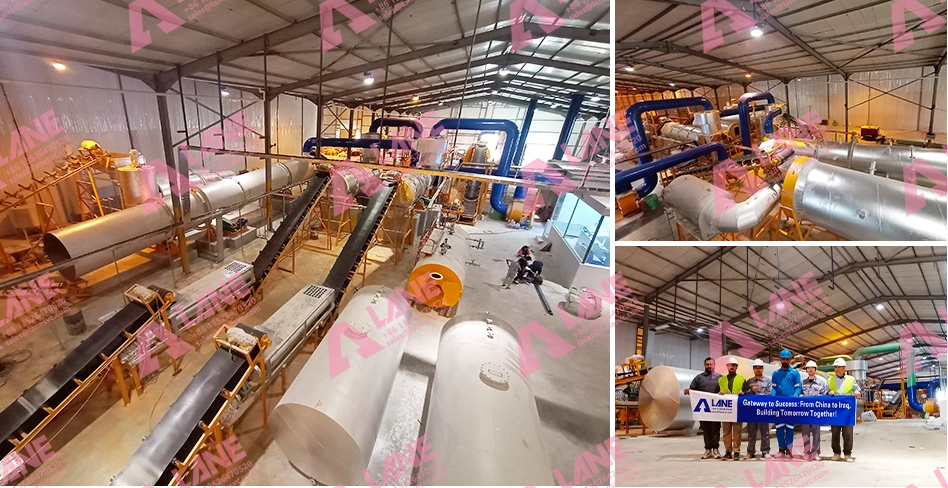
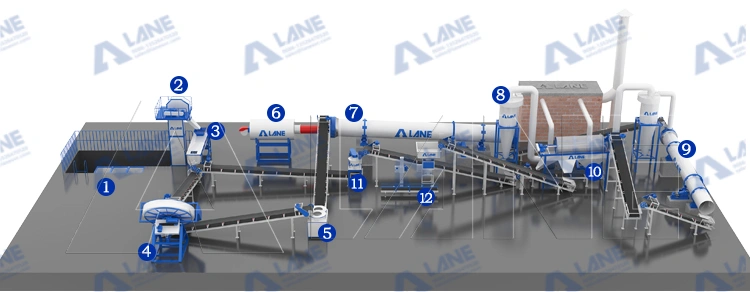
Buyers comparing the Ethiopia SSP fertilizer production line price across suppliers often make the mistake of fixating on headline equipment costs while overlooking the full system. A reactor vessel alone doesn’t tell you much. The real comparison has to account for the complete equipment inventory. Here’s what defines both the performance and the cost of a production line:
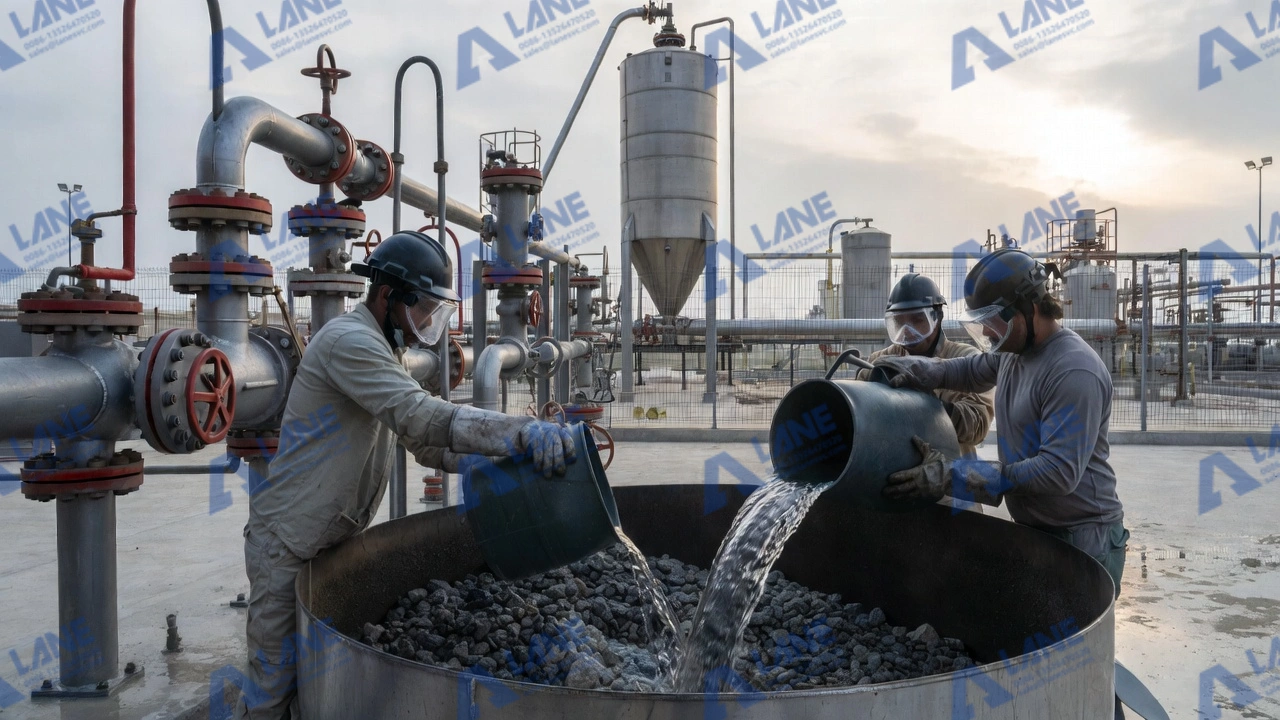
- Phosphoric Acid Storage Tank — receives and holds wet-process phosphoric acid prior to mixing; material grade and tank volume have a direct bearing on upfront investment.
- Sulfuric Acid Dosing System — a precision metering and delivery system governing the acid-to-rock ratio during acidulation; supplier safety standards vary considerably.
- Belt Conveyor System — moves reacted SSP slurry through curing stages; belt material, incline, and length each carry maintenance cost implications over the long run.
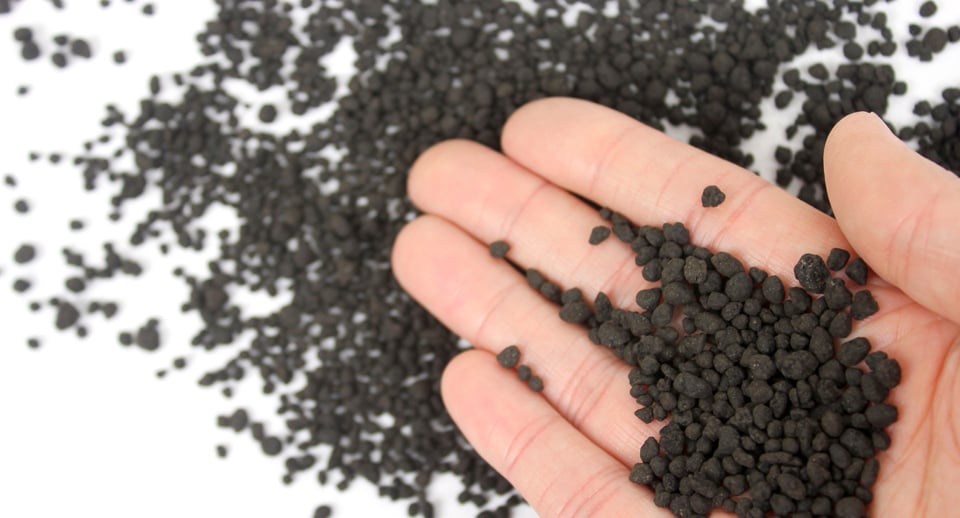
- Rotary Drum Granulator — transforms cured SSP powder into uniform, market-ready granules; granule size distribution is something buyers get particular about, and rightly so.
- Rotary Dryer and Cooler — removes excess moisture and lowers granule temperature to meet commercial specifications, typically achieving 12–14% P₂O₅ content while ensuring the product is safe for screening, handling, and packaging downstream.
- Vibrating Screen — sorts of product into on-spec, oversized, and undersized fractions; fines loop back into the granulator rather than going to waste.
- Automatic Packing Machine — handles final packaging at volume; essential for any operation targeting commercial distribution channels.
LANE, a manufacturer with deep experience in large-scale fertilizer production equipment, consistently advises clients to conduct a proper site assessment before locking in equipment specifications. It’s practical advice. What works well for a coastal facility with direct port access doesn’t automatically translate to a landlocked highland site — and Ethiopia has plenty of the latter.
Ethiopia SSP Fertilizer Production Line Price: Regional Cost Factors
The Ethiopia SSP fertilizer production line price doesn’t exist in a vacuum. Geography shapes it in ways that matter. Sulfuric acid is a prime example — Ethiopia has no industrial-scale domestic supply, so it must be imported, which introduces both cost pressure and supply chain exposure. Phosphate rock is a different story: domestic deposits in the Oromia region are available, though getting rock from source to plant still depends heavily on local transport infrastructure, which remains uneven. Equipment and chemicals coming in from abroad typically route through Djibouti, adding freight time and cost to the equation.
None of this is disqualifying. Ethiopia’s advantages are genuine. Land and labor costs are lower than most regional alternatives. Domestic fertilizer demand is growing at a pace that gives new plants a real market to serve. And government policy has leaned toward supporting local fertilizer production — it’s framed as a food security issue, which tends to generate more consistent political backing than pure industrial policy. When we look at the Ethiopia SSP fertilizer production line price across different sourcing scenarios, projects that lean on local civil works and domestic steel fabrication consistently come in 12–18% below equivalent fully-imported turnkey solutions.
Import duties, local content requirements, and available financing mechanisms — development bank schemes included — are all variables that can shift the effective SSP fertilizer plant cost in Ethiopia by 15–25% in either direction. Get legal and financial counsel involved early. Investors who have done proper due diligence on the SSP fertilizer plant cost in Ethiopia before committing to a site report far fewer costly surprises during execution. That’s not a small thing.
FAQ
Q: What is a realistic budget for a small-scale SSP plant in Ethiopia?
A: For a plant producing 50,000–80,000 MT per year, total investment — covering equipment, civil works, installation, and commissioning — typically lands between USD 5 million and USD 10 million. Raw material supply agreements and site access come on top of that.
Q: How long does it take to commission an SSP plant in Ethiopia?
A: Most projects run 14 to 22 months from contract signing to first production. Civil construction is usually where timelines stretch — highland sites in particular can complicate ground preparation in ways that are easy to underestimate.
Q: Is sulfuric acid available locally in Ethiopia?
A: Not at industrial scale. It’s imported, and that adds a real layer of operating cost and supply chain risk. Some investors have looked at co-locating a sulfur-burning acid plant to improve long-term unit economics — it works, but it increases the initial capital requirement significantly.
Q: What ongoing costs should investors anticipate beyond the initial SSP fertilizer plant cost in Ethiopia?
A: The main recurring items are raw materials — phosphate rock and sulfuric acid — along with energy, labor, maintenance, and compliance. Ethiopia’s operating cost environment is broadly competitive with regional peers, but logistics overhead deserves careful modeling; it’s the line item that tends to surprise people.
Q: Can the Ethiopia SSP fertilizer production line price be reduced through a phased investment approach, and is the Ethiopia SSP fertilizer production line price negotiable with suppliers?
A: Both, actually. Phased investment is a well-worn strategy — start with one production line, leave room for a second, and let market development and cash flow dictate the timing on expansion. It manages capital risk without giving up long-term capacity. And yes, supplier pricing is almost always negotiable, particularly on larger orders or when local fabrication components are part of the scope.
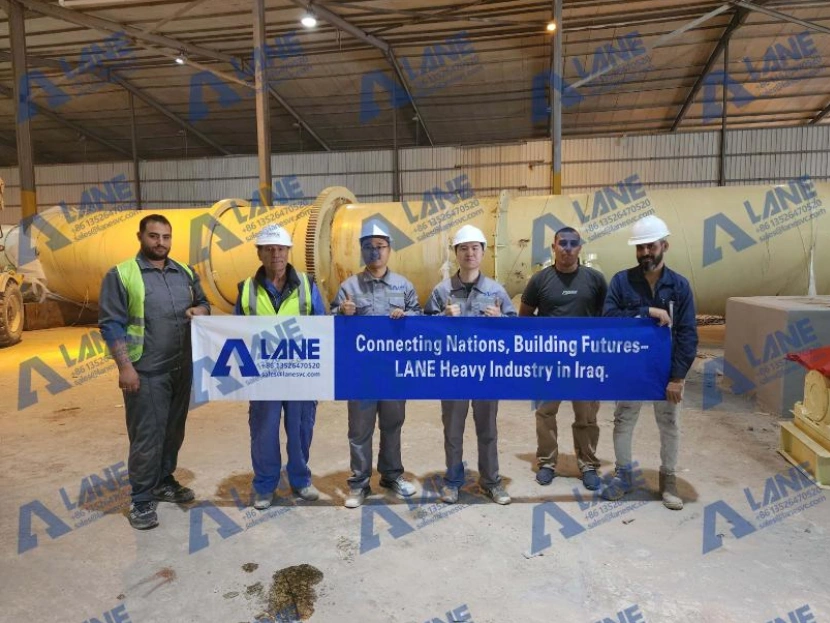
For more details, please feel free to contact us.
Henan Lane Heavy Industry Machinery Technology Co., Ltd.
Email: sales@lanesvc.com
Contact number: +86 13526470520
Whatsapp: +86 13526470520