Disc Granulator for SSP Powder: Buyer Guide
- 2026-11-13
1. Can a Disc Granulator Process SSP Powder?
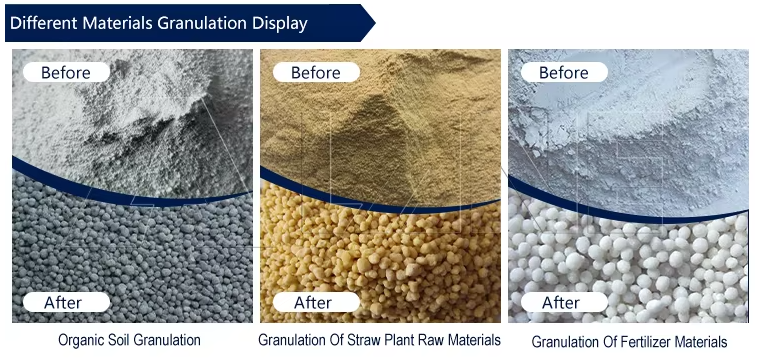
A disc granulator for SSP powder can be used to convert fine single superphosphate (SSP) material into more uniform fertilizer granules, provided that the powder has suitable physical properties and the granulation process is properly conditioned. For fertilizer manufacturers, the main purpose is not simply to make powder look round. It is to produce granules with consistent size, adequate strength, manageable moisture, and acceptable storage performance.
Powdered SSP can be difficult to handle in bulk. Fine particles may generate dust during conveying, transfer, and packaging. They can also segregate during handling, making consistent application and product presentation more difficult. Granulation can improve particle handling and make the product more convenient to store, transport, and distribute.
However, buyers should not assume that every SSP powder can be granulated under the same settings. The feed’s moisture, particle-size distribution, acidity, temperature, and tendency to agglomerate all influence the result. The right equipment selection therefore starts with a material assessment, not with a catalogue capacity.
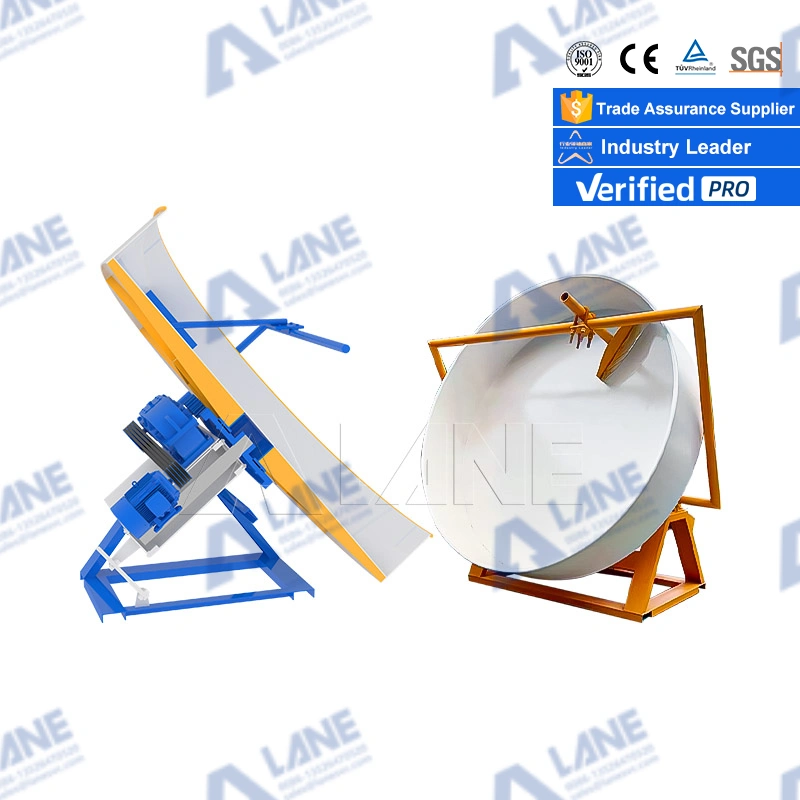
For reference, LANE’s disc granulator product page describes the machine as suitable for powder or granular feed materials and explains its rolling-agglomeration mechanism. The suitability of a specific SSP formulation should still be confirmed through a granulation test.
2. How Does a Disc Granulator for SSP Powder Work?
The disc granulation process uses a rotating, inclined pan to build particles gradually. Unlike a roller press, which forms material through mechanical compression, a disc granulator relies on rolling movement and particle adhesion.
The typical process involves five stages:
Step 1: SSP powder preparation
The SSP powder is checked, screened, and prepared before entering the granulator. Large lumps should be broken down, while foreign materials should be removed. Feed uniformity is important because uneven particle sizes can lead to inconsistent granule growth.
Step 2: Controlled feeding
Prepared powder is fed continuously into the rotating disc. A stable feeding rate helps maintain a consistent material bed. If the feed fluctuates significantly, the disc may produce a wider range of particle sizes.
Step 3: Liquid addition and particle adhesion
Water or a suitable process liquid may be introduced in a controlled manner, depending on the SSP formulation and the required granule properties. Fine particles begin to adhere to one another and form small nuclei.
This is a critical control point. Too little liquid may result in weak nuclei and excessive dust or fines. Too much liquid can create sticky material, oversized lumps, or a wet bed that is difficult to discharge and dry. The appropriate liquid addition rate must be established through testing rather than copied from another fertilizer formula.
Step 4: Rolling and granule growth
As the disc rotates, the material moves under the combined effects of gravity, friction, and centrifugal force. Particles roll along the inclined pan, collide, and gradually collect additional fine material. Small nuclei grow into larger granules.
The disc angle, rotational speed, feed rate, liquid distribution, and material-bed condition all influence this growth process.
Step 5: Discharge and downstream treatment
When granules reach the discharge area, they leave the disc and move to downstream equipment. Depending on the process design and product moisture, the line may include screening, drying, cooling, and finished-product handling. Oversized particles and undersized fines can be separated and returned for reprocessing when the process allows.

The SSP disc granulation line should be designed around the required final moisture and product specification. A disc alone does not guarantee a finished, storage-ready fertilizer.
3. What Factors Affect SSP Granule Size and Quality?
For SSP manufacturers, stable granulation depends on several interacting factors. Adjusting one setting without checking the others can make the process less stable rather than more productive.
| Process Factor | Effect on Granulation | What Buyers Should Check |
|---|---|---|
| SSP powder particle size | Influences nucleus formation and granule growth. | Feed fineness, particle-size distribution, and screening requirements. |
| Feed moisture | Affects particle adhesion and bed condition. | Actual moisture before granulation and allowable operating range. |
| Liquid addition | Controls wetting and agglomeration. | Spray uniformity, flow adjustment, and liquid compatibility. |
| Disc inclination | Influences material residence and discharge. | Adjustment range and locking arrangement. |
| Disc rotational speed | Affects rolling movement and particle growth. | Speed control and stable operation under load. |
| Feed rate | Determines the amount of material inside the disc. | Feeder accuracy and continuous-feed stability. |
| Screening aperture | Determines the qualified product-size range. | Screen size, replacement access, and recycle arrangement. |
There is no universal moisture percentage, disc angle, or rotational speed that can be recommended for every SSP powder. These values depend on the raw material and machine design. A supplier should provide a recommended operating window based on a test using the customer’s actual material.
One point buyers often overlook is the relationship between granule growth and screening. A disc may produce visually attractive granules, but if the size distribution is too broad, the screening and recycling sections may carry a high circulating load. The result can be lower net output even when the disc itself appears to be running well.
4. What Equipment Is Needed for an SSP Powder Granulation Line?
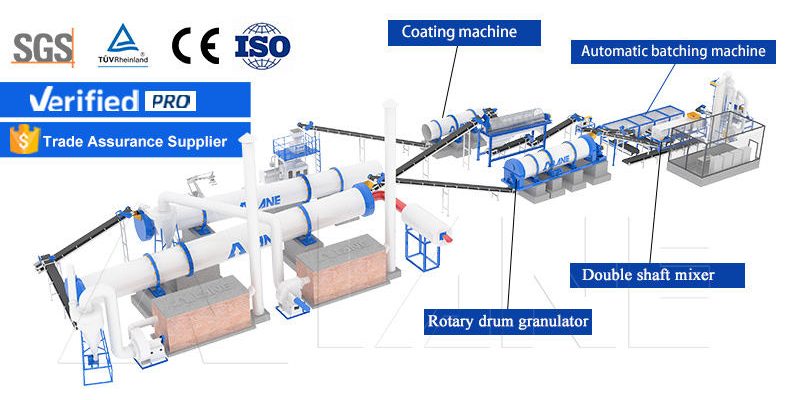
A complete SSP granulation line normally includes more than the disc granulator. The auxiliary equipment determines whether the material can be prepared, granulated, dried, screened, and transferred consistently.
A typical configuration may include:
- Raw material hopper and feeder: provides a controlled supply of SSP powder.
- Screening or lump-breaking equipment: removes oversized particles and prepares a more uniform feed.
- Mixer or conditioning unit: helps distribute moisture or other approved process additives evenly when required.
- Disc granulator: forms granules through rolling and agglomeration.
- Dryer: reduces product moisture when the process requires it.
- Cooler: brings the granules closer to a suitable handling and storage temperature.
- Vibrating screen: separates qualified granules, fines, and oversized particles.
- Return conveyor: sends suitable off-size material back into the process.
- Finished-product conveyor and packing machine: transfers and packages the qualified product.
The exact arrangement should be determined by the feed condition and the final product specification. For example, a project that receives relatively uniform, conditioned SSP powder may need a different preparation section from one that handles powder with variable moisture and frequent lumps.
For broader SSP process and equipment planning, buyers can review the SSP fertilizer production line. The line should be engineered as a connected process, with the granulator capacity matched to the dryer, screen, and conveying equipment.
5. Is a Disc Granulator Better Than a Double Roller Granulator for SSP Powder?
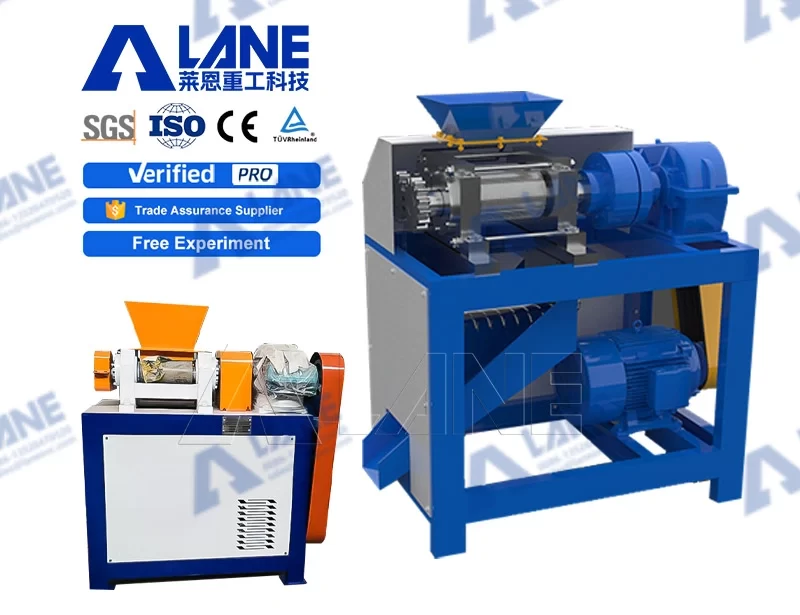
Not in every case. A disc granulator and a double roller granulator use different particle-forming mechanisms, so the correct choice depends on the material and the required product.
| Comparison | Disc Granulator | Double Roller Granulator |
|---|---|---|
| Granulation method | Rolling and agglomeration. | Mechanical compression. |
| Typical feed condition | Powder that can be conditioned to adhere and grow. | Powder that can be compacted under pressure. |
| Liquid addition | Often used, depending on formulation. | Usually dry or low-moisture compaction. |
| Particle formation | Gradual growth of rounded granules. | Compacted flakes or shaped pieces, followed by crushing and screening. |
| Main process controls | Liquid addition, disc angle, speed, and feed rate. | Roller pressure, gap, speed, and feeding stability. |
| Downstream treatment | May require drying and cooling. | Often avoids conventional wet-granulation drying, depending on feed condition. |
| Main selection concern | Moisture control and granule growth. | Compact strength and material compaction behavior. |
A disc granulator is worth evaluating when the SSP powder can form stable nuclei and grow through controlled wetting and rolling. A roller press may be considered when the powder has suitable compaction characteristics and the project prefers a dry or low-moisture route.
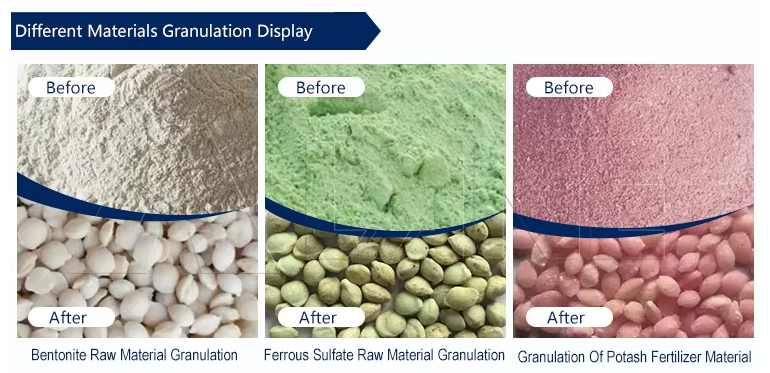
The buyer should compare the complete process cost, including liquid addition, drying energy, recycle load, wear parts, and finished-product yield. Comparing only the purchase price of the two main machines can lead to a misleading decision.
6. What Common Problems Occur When Granulating SSP Powder?
Most granulation problems can be traced to feed preparation, liquid distribution, disc operation, or downstream screening and drying.
| Problem | Possible Cause | Recommended Check |
|---|---|---|
| Too many fine particles | Poor nucleus formation or insufficient liquid distribution. | Check powder condition, spray pattern, and liquid rate. |
| Oversized granules | Excessive wetting or uncontrolled particle growth. | Review liquid addition, feed rate, and disc settings. |
| Sticky material on the disc | Excessive moisture or unsuitable process conditioning. | Inspect material moisture and disc surface condition. |
| Uneven granule size | Unstable feeding or inconsistent wetting. | Check feeder operation and spray coverage. |
| Weak granules | Insufficient adhesion or unsuitable formulation. | Conduct material tests and evaluate conditioning. |
| High recycle volume | Broad particle-size distribution or unsuitable operating settings. | Review disc operation, screen aperture, and return rate. |
A common mistake is to increase liquid addition whenever granules appear weak. This may create larger particles, but it does not necessarily improve their internal strength. Buyers should ask the supplier to evaluate granule strength, moisture, and size distribution together.
Another frequently underestimated cost is the recycle load. If a large proportion of material repeatedly returns to the disc, the equipment may handle considerably more circulating material than the final saleable output. The quotation should therefore distinguish between total feed throughput and qualified finished-product capacity.
7. What Should Buyers Check Before Purchasing a Disc Granulator for SSP Powder?
Before asking for a quotation, buyers should prepare a clear material and product specification. A supplier cannot reliably recommend disc diameter, drive power, or auxiliary equipment from the words “SSP powder” alone.
The following information makes equipment selection more practical:
- Feed material: provide an SSP sample and, if available, its moisture, particle-size distribution, and chemical analysis.
- Target capacity: state the required tonnes per hour and clarify whether this means fresh feed or qualified finished granules.
- Finished granule size: specify the target size range and acceptable proportions of undersized and oversized particles.
- Product quality: define the required granule strength, moisture after drying, and storage or handling requirements.
- Plant conditions: provide available floor space, building height, electrical supply, and the layout of upstream and downstream equipment.
- Process liquid: clarify whether water or another compatible conditioning liquid is planned, and whether its quality or supply is restricted.
Ask the supplier to conduct a granulation test using your own SSP powder. The test should record feed condition, liquid addition, disc settings, granulation yield, particle-size distribution, and the strength of the dried granules.
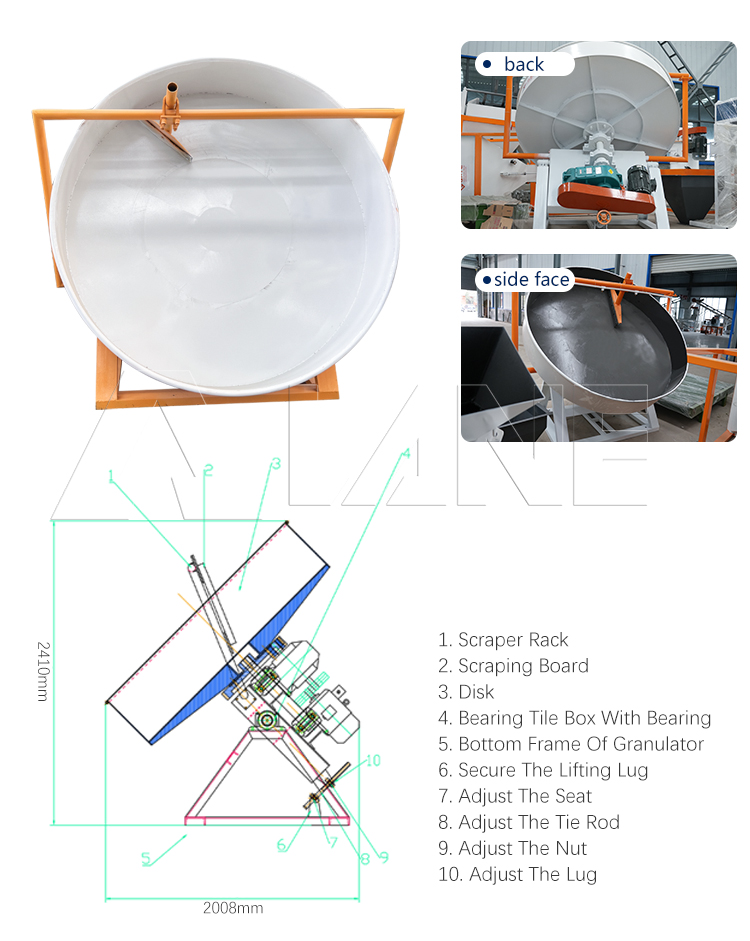
The product page for LANE’s disc granulator describes a reinforced disc bottom, a frame with an adjustment section, and a motor-reducer drive connected by a flexible belt. These are useful construction points to discuss, but they do not replace a material test or a capacity guarantee.
A practical acceptance test should define:
-
The raw material and test conditions.
-
The continuous operating period.
-
The measured feed rate and qualified product output.
-
The percentage of product within the agreed size range.
-
Finished moisture and granule strength.
-
The amount of material returned for reprocessing.
Do not accept a quotation that lists only the disc diameter and motor power. Those details describe the machine, not the performance of the complete SSP granulation process.
8. What Costs Are Often Missed in an SSP Disc Granulation Project?
The disc granulator is only one part of the investment. The cost of preparing the powder, controlling moisture, drying the granules, screening the product, and recycling off-size material can materially affect the total project budget.
The most commonly underestimated items are:
- Conditioning and feeding: inconsistent powder feed may require additional screening, mixing, or metering equipment.
- Drying energy: if liquid is added during granulation, the moisture introduced must be removed when the finished-product specification requires it.
- Dust collection: powder transfer and screening points may need suitable dust-control arrangements.
- Screening and recycling: a high off-size fraction increases circulating load and can limit saleable output.
- Wear parts and maintenance: scrapers, liners, bearings, belts, and other components should be considered in the maintenance plan.
- Installation and commissioning: foundations, electrical connections, conveyors, operator training, and process adjustment should be included in the project scope.
An important distinction is that granulation efficiency and finished-product yield are not necessarily the same measurement. A high percentage of material may form granules at the disc discharge, but some of those granules may later break during conveying, drying, cooling, or screening. The buyer should therefore evaluate the complete line and define the percentage of final product that meets the agreed specification.
A 2017 study of SSP granulation in a rotary drum found that the operating conditions producing the highest granulation efficiency did not necessarily produce the hardest granules. Although that study investigated a drum rather than a disc, it reinforces an important purchasing principle: efficiency and product strength must be assessed together, not treated as the same target.
9. FAQ: What Do Buyers Need to Know About SSP Powder Granulation?
1. Can powdered SSP be processed by a disc granulator?
Yes, it may be processed by a disc granulator if the powder has suitable agglomeration properties and the process is properly conditioned. A material test is necessary to confirm the required liquid addition, granule growth, and final product quality.
2. Does SSP powder granulation require water?
Water may be used to help fine SSP particles adhere and form granules. The required amount depends on the powder properties and process conditions. Excessive water can cause sticking, oversized lumps, and a higher drying load.
3. What size granules can a disc granulator produce?
The achievable size range depends on disc dimensions, inclination, rotational speed, feed rate, liquid distribution, and screening settings. Buyers should specify their target size and request test results rather than assume a universal output size.
4. Does a disc granulator need a dryer?
A dryer is commonly included when liquid is added and the finished SSP granules must meet a controlled moisture specification. Whether it is required, and how large it needs to be, should be determined by the granulator discharge moisture and final product requirements.
5. What is the granulation rate of a disc granulator?
LANE’s product page states that its disc granulator can achieve a granulation rate above 93%. This is a product-page claim, not a guaranteed result for every SSP formulation. Buyers should ask how the rate is calculated and request a test with their own material.
6. Can the same disc granulator process different fertilizer powders?
It may process different compatible materials, but each formula can require different feed, moisture, and operating settings. A change in material should be evaluated through testing before the machine is operated at the previous production settings.
7. How is the production capacity of an SSP granulation line determined?
Capacity depends on the disc granulator and the performance of the complete line, including feeding, drying, cooling, screening, and material return. Ask the supplier to distinguish fresh-feed capacity from qualified finished-product output.
8. Can the disc granulator be customized for an existing SSP plant?
Yes, the equipment and auxiliary layout can be considered for an existing plant, subject to the available space, feed arrangement, discharge height, and downstream capacity. Provide the plant layout and material details before confirming the configuration.
Conclusion: How Should You Choose a Disc Granulator for SSP Powder?
A suitable disc granulator for SSP powder should be selected according to the material’s agglomeration behavior, the required granule size, finished moisture, and the capacity of the complete production line. Buyers should pay particular attention to liquid distribution, disc adjustment, screening efficiency, drying requirements, and the amount of material returned for reprocessing.
Before placing an order, request a granulation test using your own SSP powder and agree on measurable acceptance criteria. This is a more reliable basis for equipment selection than comparing machine dimensions or advertised granulation rates alone.
For an SSP granulation project, you can review LANE’s disc granulator and SSP fertilizer production equipment. For broader fertilizer machinery and customized production-line support, visit Fertilizer Industry Leader or LANE Machinery. The SSP website is identified as the company’s dedicated SSP equipment site in your website summary.
For more details, please feel free to contact us.
Henan Lane Heavy Industry Machinery Technology Co., Ltd.
Email: sales@lanesvc.com
Contact number: +86 13526470520
WhatsApp: +86 13526470520