SSP Production Process Equipment: What to Specify Before You Order
- 2026-10-24
Single superphosphate looks like the simplest fertilizer in the catalog. Grind rock, add acid, cure the pile, bag it. That simplicity is why so many projects under-specify the plant, and why year one becomes a series of fixes to equipment chosen on price alone.
This guide covers the SSP production process equipment that actually determines output and product quality: what each unit does, where the design margins sit, what drives SSP plant cost, and which questions separate a real quotation from a catalog page.
What the equipment has to do
SSP is made by reacting finely ground phosphate rock with sulfuric acid. The reaction produces monocalcium phosphate and calcium sulfate, which is why the product carries both phosphorus and sulfur:
2 Ca₅(PO₄)₃F + 7 H₂SO₄ + 3 H₂O → 3 Ca(H₂PO₄)₂·H₂O + 7 CaSO₄ + 2 HF
The finished product runs roughly 16 to 20 percent P₂O₅, all of it water-soluble, plus 11 to 12 percent sulfur and 19 to 22 percent calcium. Those numbers matter to the equipment because the reaction is fast, hot, and corrosive. The plant has to move a slurry that sets into a solid, handle dilute sulfuric acid, and capture the fluoride gas that comes off the reactor.
None of that is exotic. All of it has to be designed.
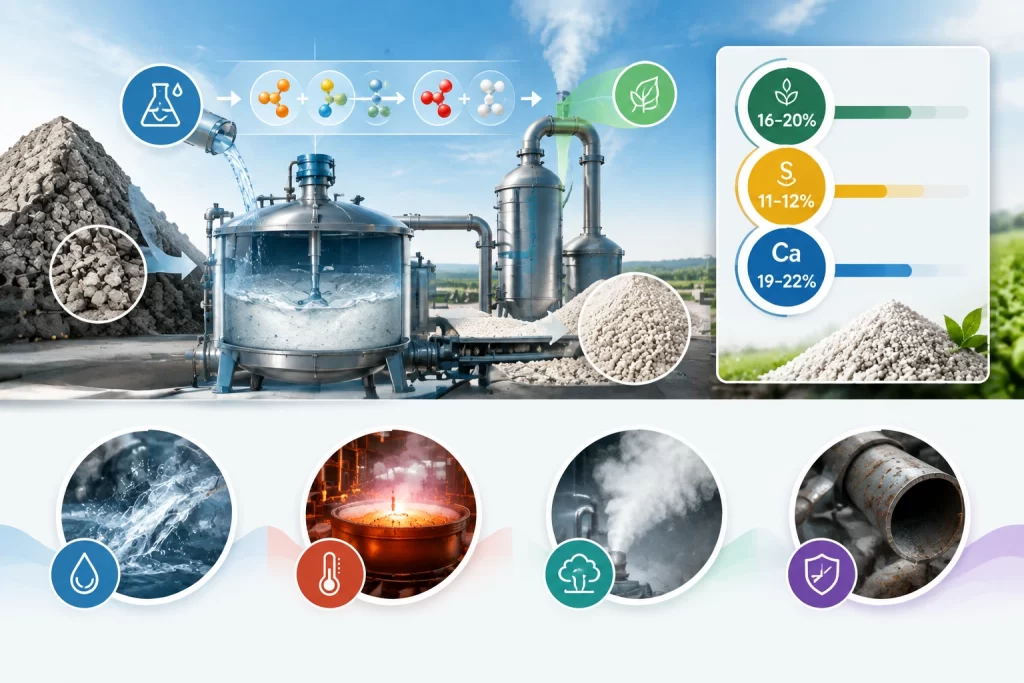
The single superphosphate manufacturing process, stage by stage
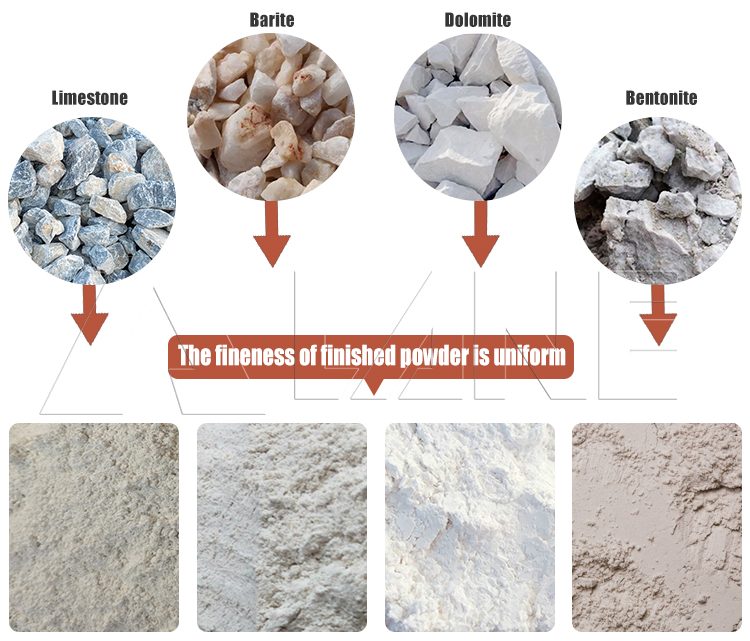
Rock preparation comes first. Phosphate rock at 28 to 32 percent P₂O₅ arrives in lumps and has to be reduced to 80 to 100 mesh, with the finer end reacting faster and more completely. A Raymond mill or ball mill with an air classifier does the work. Undersized grinding capacity shows up later as unreacted rock in the product and a P₂O₅ analysis that misses the guarantee.
Acid preparation follows. Sulfuric acid arrives at 93 to 98 percent and is diluted to roughly 68 to 72 percent before it meets the rock. Dilution is exothermic and has to be controlled, because acid that is too concentrated scorches the reaction and acid that is too dilute leaves the mix wet and sticky.
Acidulation is the core step. Ground rock and diluted acid meet in a mixer, usually a twin-shaft pug mill or a high-intensity reactor, for a residence time measured in seconds to a couple of minutes. The mixture is poured or extruded into a den, where it stays for one to two hours and sets into a solid cake while the temperature holds near 100 to 110 degrees Celsius.
Curing follows. The cake is cut, stacked, and left for two to six weeks. Curing is not storage. It is where the reaction finishes, free acid drops, and the P₂O₅ converts to its available form. A plant that ships cured material early sells a product that tests differently three weeks later in the buyer’s warehouse.
Neutralization and finishing close the loop. Ground limestone brings residual free acid down, then the material is crushed, screened, and either sold as powder or granulated.
The equipment list, and where the risk sits
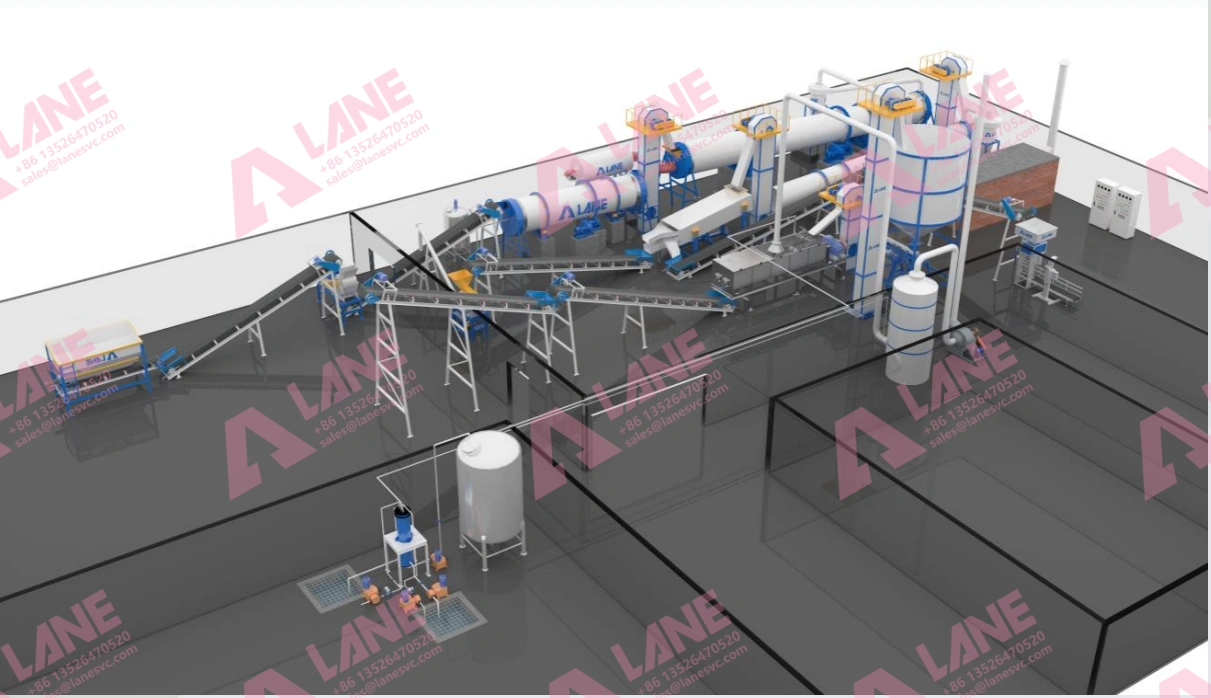
The SSP production process equipment for a complete line runs from rock intake to bagging: hopper and weigh feeder, grinding mill and classifier, acid storage and dilution skid, dosing pumps and flow meter, acidulation mixer, den with cutter, curing bay with handling equipment, neutralization mixer, crusher, screener, and bagging station. Add the granulation circuit if the product is granular: granulator, dryer, cooler, second screen, coater, and a second bagging line.
In the single superphosphate manufacturing process, two units deserve more attention than they usually get.
The den is not a box. Retention time, insulation, and the cutter design decide whether the cake is workable or a concrete block. Batch dens and continuous dens suit different capacities, and a supplier who quotes a continuous den for a three-ton-per-hour plant is usually selling a scaled-down version of a large design that will not hold residence time.
The acid dosing system is where quality is won. Acid rate has to track rock feed within a couple of percent, and the ratio is not fixed: it moves with rock grade, rock reactivity, and product target. A plant without reliable ratio control produces a product that passes on Monday and fails on Thursday.
Controlling the reaction, not just the machine
The single superphosphate manufacturing process has four levers, and every quality problem traces back to one of them.
Rock fineness sets reaction speed. Coarse rock leaves unreacted P₂O₅ that shows up as low available P in the certificate of analysis.
Acid concentration sets the physical behavior of the mix. Too strong and the mass sets before it reaches the den. Too weak and it stays plastic, sticks to the cutter, and carries excess moisture into curing.
Acid to rock ratio sets both conversion and free acid. A small excess drives the reaction to completion; a large excess creates a product that is acidic, hygroscopic, and unpleasant to handle.
Curing time sets the final analysis. Cutting curing short is the most common way to hit a shipment date and lose a customer.
Powder or granular: the decision that changes the scope
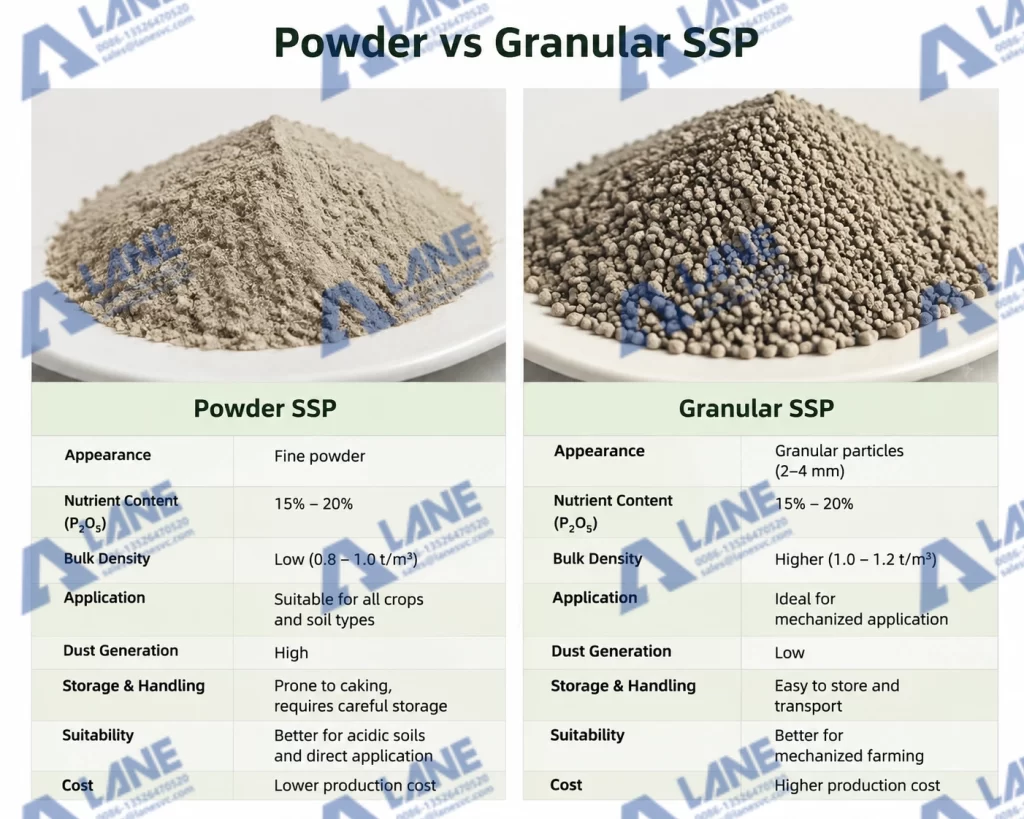
Powder SSP is cheaper to make and cheaper to ship short distances. Granular SSP bags better, spreads evenly, and commands a premium of roughly 12 to 20 percent in most markets, which is why granulation is usually the second phase of a plant that started as powder.
Granulation is not a bolt-on. It adds a granulator, dryer, cooler, recycle loop, and screen, plus the dust collection that goes with them. The SSP production process equipment for a granular line can run 40 to 60 percent above a powder line at the same reaction capacity.
There is a technical constraint most buyers learn late. Monocalcium phosphate loses water-soluble P if it gets too hot, so the dryer has to be gentle: co-current airflow, moderate inlet temperature, and a product discharge temperature that stays well below the decomposition range. A dryer sized like an NPK dryer will scorch the product and quietly convert part of your water-soluble P into a form the buyer will not pay for.
SSP plant cost: what the number includes
Published SSP plant cost guidance from LANE puts a 3 to 5 ton per hour plant at roughly USD 400,000 to 900,000, and a 5 to 10 ton per hour plant at roughly USD 500,000 to 2.5 million. The spread is wide because the scope is wide: automation level, dust control, redundancy, and whether granulation and acid dilution sit inside the battery limits.
Because the single superphosphate manufacturing process converts cheap rock into a pricier product, margin sits in conversion rather than scale.
Any SSP plant cost estimate breaks into four blocks. Equipment is the largest at roughly 45 to 60 percent, with the reaction section (mill, acid system, mixer, den) taking a quarter to a third of that and the granulation circuit taking the rest where it exists. Civil works, foundations, and acid-resistant flooring follow. Installation, piping, electrical, and insulation come next. Commissioning, training, spares, and the first fill of acid complete the picture.
Two items are routinely left out. Acid storage and unloading is a licensed chemical facility in most jurisdictions, not a tank. And the gas scrubbing train can rival the reaction section in cost, and it is not optional anywhere with an environmental regulator.
Fluoride, dust, and the permits that shape the design
The single superphosphate manufacturing process releases hydrogen fluoride and silicon tetrafluoride at the reactor. A wet scrubber with a recirculating liquor loop captures both, and the scrubber liquor becomes a saleable or disposable fluosilicic acid stream depending on local rules. The World Bank Group’s Environmental, Health, and Safety Guidelines for Fertilizer Production are a reasonable baseline for what a permit will require on fluoride, particulate, and acid handling.
Dust comes from grinding, curing, crushing, and bagging. Bag filters at each transfer point cost less than the fines you lose and the complaints you collect.
Product compliance is separate. In the European Union, Regulation (EU) 2019/1009 sets the declaration and contaminant rules for a straight phosphate fertilizer, and cadmium limits apply to phosphate products. Confirm the target market’s cadmium and P₂O₅ declaration rules before the process design is fixed, because they constrain which rock you can buy.
Maintenance and uptime
The wear list on an SSP plant is predictable: mill liners and rollers, mixer paddles, den cutter blades, crusher hammers, screen mesh, and every pump seal in the acid circuit.
Acid handling dictates materials. Rubber-lined or alloy wetted parts in the dilution and dosing system cost more and last; mild steel lasts one season and contaminates the product.
Wear parts are a modest share of SSP plant cost and the largest single cause of unplanned downtime.
The scrubber needs a weekly check, not an annual one. A fouled scrubber shows up as fluoride at the fence line before it shows up on any gauge.
Comparing the quotes
Ask three suppliers for the same four documents against the same SSP production process equipment scope: a process flow diagram with a material balance, an equipment list with installed power and materials of construction, a utility consumption table, and a guarantee of product analysis at a stated rock grade.
Then ask one question that separates engineers from resellers: what happens to the free acid if the rock grade drops two points? A supplier with a real design will answer with a ratio change and a neutralization adjustment. A reseller will answer with a new price.
FAQ
How much does an SSP plant cost?
Published LANE guidance puts a 3 to 5 t/h plant at roughly USD 400,000 to 900,000 and a 5 to 10 t/h plant at roughly USD 500,000 to 2.5 million, depending on automation, granulation scope, and whether acid storage is included.
What raw materials does SSP production need?
Phosphate rock at 28 to 32 percent P₂O₅ and sulfuric acid at 93 to 98 percent, plus dilution water, limestone for neutralization, and coating agents for granular product.
How long does the single superphosphate manufacturing process take?
Acidulation takes minutes and den residence one to two hours. Curing takes two to six weeks depending on rock reactivity and ambient conditions, and it cannot be compressed without risking the available P₂O₅ guarantee.
Why is my SSP free acid too high?
Usually an acid to rock ratio running rich, or curing cut short. Check dosing calibration and rock feed rate before changing the recipe.
Do I need granulation?
Only if you sell into a market that pays for it. Granular product earns a premium and travels better, but it adds a granulator, dryer, cooler, and dust collection, and it raises the SSP production process equipment budget by 40 to 60 percent.
What capacity justifies an SSP plant?
Most published guidance puts the minimum at 3 to 5 tons per hour. Below that, fixed costs per ton outrun the market price.
How long does commissioning take?
Roughly 60 to 120 days from civil completion to first production, depending on line complexity and local contractors.
Which standard covers SSP for export?
In the EU, Regulation (EU) 2019/1009 covers declaration and contaminant limits for straight phosphate fertilizers. Elsewhere, national fertilizer registration rules apply, and ISO 9001 is commonly requested in tenders.