The Complete Single Super Phosphate Reaction Process: Chemistry, Equipment, and Industrial-Scale Efficiency
- 2026-04-08
The single super phosphate reaction process is a mainstay in fertilizer manufacturing, but it’s still often misunderstood. Whether evaluating a new production line or troubleshooting low P₂O₅ content, the core chemistry is critical. This piece covers the process from raw materials to the final granulated product, focusing on real equipment operation—not just textbook theory.
The Core Chemistry
At its core, the single super phosphate reaction process involves treating phosphate rock with sulfuric acid. The main reaction produces monocalcium phosphate and gypsum as co-products: Ca₃(PO₄)₂ + 2H₂SO₄ → Ca(H₂PO₄)₂ + 2CaSO₄. The final product contains about 16–20% available P₂O₅. Though lower than triple superphosphate, the gypsum supplies calcium and sulfur, offering a more balanced nutrient profile than the P₂O₅ value alone suggests.
One thing worth understanding clearly: this reaction doesn’t happen all at once. It undergoes two distinct phases — a rapid initial reaction during mixing, followed by a much slower curing phase that can last anywhere from several hours to several weeks, depending on the system’s setup. That second phase is often glossed over in many SSP production writing efforts. It shouldn’t. It has real consequences for product quality.

Key Equipment in the Production Line
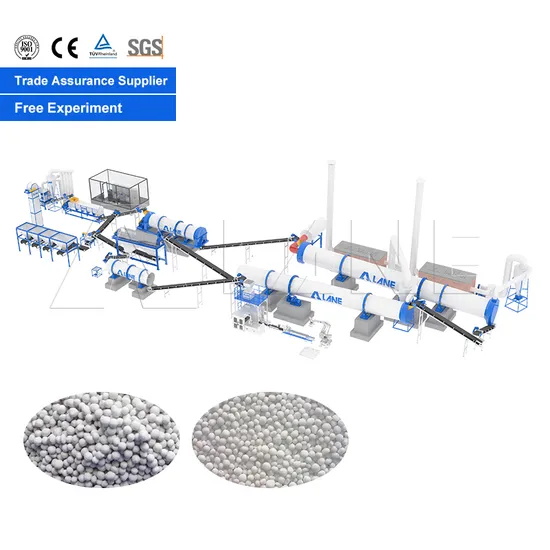
Efficient SSP production depends on a well-integrated equipment chain. Each unit plays a specific role in the reaction and product conditioning sequence:
Acidulation Reactor— This is where the actual chemistry happens. Phosphate rock and sulfuric acid come together under controlled conditions, and the design of the den — cone den versus continuous den — has a direct bearing on reaction uniformity and how much throughput the line can sustain.
Belt Conveyor System — Moves material between processing stages without interrupting flow. In larger plants, the conveyor layout ends up being a surprisingly significant factor in overall line efficiency.
Double Shaft Mixer — Handles homogenous blending of reactants or conditioning agents. Getting thorough mixing here is critical. Inconsistent blending at this stage tends to show up as uneven nutrient distribution in the final product — a problem that’s annoying to trace back.
Rotary Drum Curing Unit — Once the initial reaction is done, material moves into the curing drum, where the second phase of the single super phosphate reaction process runs its course. Residence time and temperature control inside this unit are the two variables that most directly determine the available P₂O₅ in the finished product.
Raymond Mill — Before phosphate rock enters the den, it needs to be ground down to a specified particle size. Coarser feed means less acid contact area, incomplete reaction, and lower product quality. In my experience, this is one of the more common — and more avoidable — sources of inconsistency in SSP production.
Granulator — Takes the acidulated powder and converts it into granules for handling, transport, and field application. Granule size distribution matters here both for product uniformity and for how smoothly the downstream bagging runs.
Exhaust Gas Scrubbing System — The reaction generates fluorine-containing gases, mainly silicon tetrafluoride and hydrogen fluoride. These need to be captured — both as an environmental compliance requirement and, depending on the plant configuration, as a potential byproduct recovery opportunity.
I’ve seen lines where the scrubbing system was undersized relative to the den capacity. The result was inconsistent gas capture and recurring compliance headaches that were entirely preventable. Equipment capacity needs to be matched across the line. That’s not a design nicety — it’s a basic requirement.
Process Variables That Affect Output Quality
Equipment is only part of the picture. Several process variables shape the efficiency and output of the single super phosphate reaction process, regardless of what machinery is installed. Acid concentration is among the more sensitive ones — the working range is typically 65–75% H₂SO₄ and straying outside it shifts the reaction balance and disrupts gypsum crystallization behavior. Feedstock quality matters just as much. The BPL grade of the phosphate rock, along with its impurity profile, has a direct effect on acidulation efficiency. High carbonate or iron content in the rock will pull that efficiency down noticeably.
Temperature management throughout SSP production deserves more attention than it usually gets. The acidulation reaction is exothermic, and heat accumulation in the den — especially in high-throughput continuous systems — needs to be factored into the design, not treated as an afterthought.
Scaling the Process: Industrial Considerations
Going from pilot scale to full industrial output in SSP production introduces a level of complexity that’s genuinely easy to underestimate. Material handling bottlenecks, curing yard logistics, emissions management — all of these become more demanding as tonnage climbs. Equipment manufacturers like LANE, which focuses on large-scale fertilizer production systems, approach this by designing integrated line solutions rather than selling individual units. The den capacity, curing duration, and granulation output are coordinated as a system — because treating them as isolated components is where scaling problems typically originate.
At industrial throughput, the single super phosphate reaction process requires process automation, real-time acid dosing monitoring, and continuous quality sampling to run reliably. On a line producing several hundred tons per day, small deviations in reactant ratios don’t stay small for long. They compound into quality losses, yield losses, and margin losses.
FAQ
Q: What is the typical P₂O₅ content in SSP?
Standard SSP contains 16–20% available P₂O₅, depending on phosphate rock quality and process efficiency.
Q: How long does the curing phase take?
In open-air storage pits, curing typically runs 4–6 weeks. A Rotary Drum Curing Unit in a continuous SSP production line can cut that down significantly.
Q: Can SSP be granulated?
Yes. After acidulation and curing, the material goes through a Granulator to produce uniform granules suitable for bulk blending or direct field application.
Q: What are the main byproducts of the reaction?
Gypsum — calcium sulfate — is the primary co-product. The reaction also generates fluorine-containing gases that require treatment through an Exhaust Gas Scrubbing System before any discharge.
Q: How does rock particle size affect the single super phosphate reaction process?
Finer grinding — typically to 75–90% passing 150 mesh — maximizes acid contact with the phosphate rock surface. That directly improves acidulation efficiency and the available P₂O₅ content in the finished product.
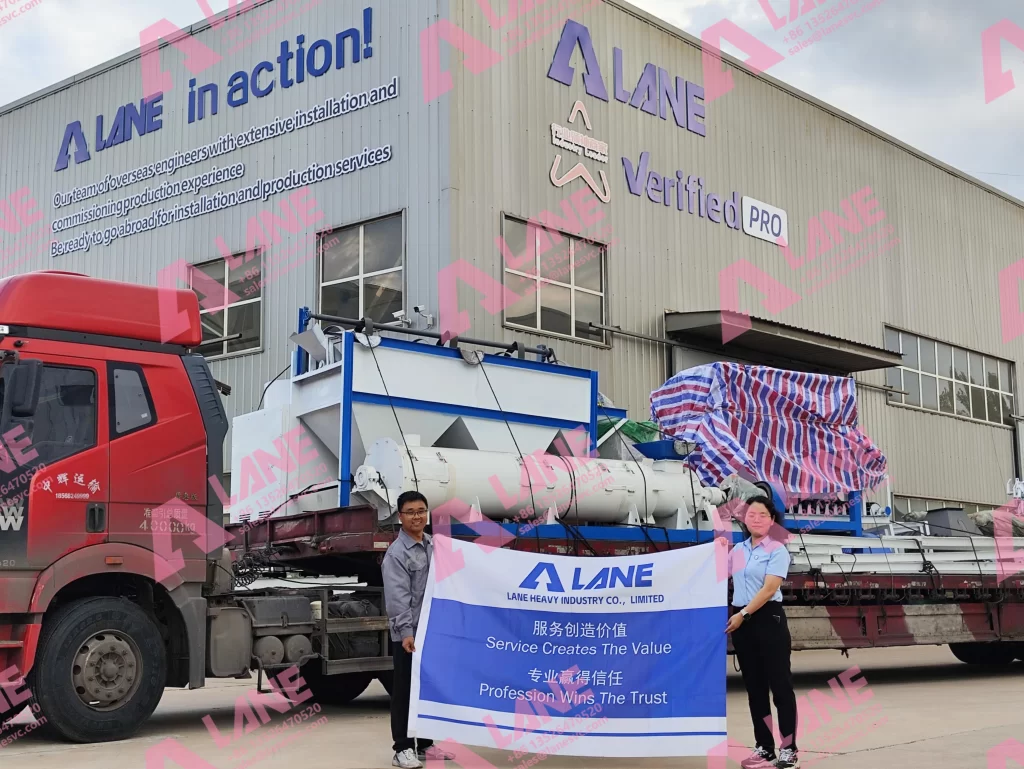
For more details, please feel free to contact us.
Henan Lane Heavy Industry Machinery Technology Co., Ltd.
Email: sales@lanesvc.com
Contact number: +86 13526470520
Whatsapp: +86 13526470520